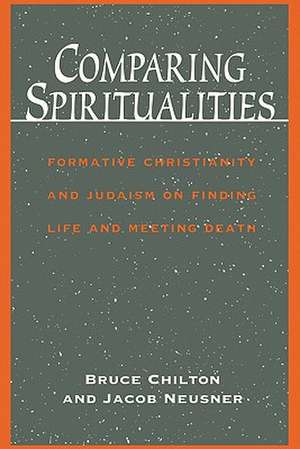
Comparing Spiritualities: Formative Christianity and Judaism on Finding Life and Meeting Death
Autor Bruce D. Chilton, Rabbi Jacob Neusneren Limba Engleză Paperback – mai 2000
In their book, Chilton and Neusner ask simply, "What are experiences both distinctive to the spiritual life of Torah and Christ, respectively, and also accessible to our common humanity?" Their response is to examine the experiences of "birth in the faith, death by the faith, and bearing witness to the faith." Each writer explores the ways in which classical statements of Christ and Torah represent critical moments in a person's life of faith, and offer a comparison of the spiritual piety that each religion teaches and nurtures.
Chilton and Neusner are the co-authors of The Body of Faith (Trinity) and God in the World (Trinity). Chilton is the author of Jesus' Prayer and Jesus' Eucharist (Trinity). Neusner is the author or editor of over 700 books including The Incarnation of God: The Character of Divinity in Formative Judaism.
For: Clergy; seminarians; graduate students; those interested in formative Judaism and Christianity and in Jewish-Christian relations
Preț: 211.07 lei
Preț vechi: 255.03 lei
-17%
Puncte Express: 317
Carte tipărită la comandă
Livrare economică 28 noiembrie-12 decembrie
Livrare prin curier în România Termenul estimat este afișat lângă disponibilitate.
Transport gratuit de la 400.00 lei Plată online sau ramburs, în funcție de opțiunile comenzii.
Retur gratuit în 14 zile Comandă securizată și suport în română.
Specificații
ISBN-13: 9781563383090
ISBN-10: 1563383098
Pagini: 158
Dimensiuni: 152 x 229 x 9 mm
Greutate: 0.22 kg
Ediția:New.
Editura: Bloomsbury Publishing
Colecția Trinity Press International
Locul publicării:New York, United States
ISBN-10: 1563383098
Pagini: 158
Dimensiuni: 152 x 229 x 9 mm
Greutate: 0.22 kg
Ediția:New.
Editura: Bloomsbury Publishing
Colecția Trinity Press International
Locul publicării:New York, United States
V-ar putea interesa
-
 -31%Preț: 932.50 lei1355.55 lei
 -
 Women and Religious TraditionsLeona M. Anderson-21%Preț: 312.23 lei397.00 lei
 -
 Religious Education and the Challenge of PluralismAdam B. Seligman-21%Preț: 271.95 lei342.83 lei
 -
 Preț: 337.28 lei
 -
 The Oxford Handbook of African American TheologyKatie G. Cannon-35%Preț: 1049.86 lei1626.97 lei
 -
 From Yoga to Kabbalah: Religious Exoticism and the Logics of BricolageVéronique Altglas-21%Preț: 375.24 lei474.91 lei
 -
 Judaism: The BasicsJacob NeusnerPreț: 146.78 lei
 -
 Families of FaithPaul Varo MartinsonPreț: 166.18 lei
 -
 Conviction and ConflictMichael Nazir-Ali-42%Preț: 124.29 lei214.06 lei
 -
 -9%Preț: 1242.58 lei1365.47 lei
 -
 -27%Preț: 50.94 lei70.26 lei
 -
 Mudhouse SabbathLauren F WinnerPreț: 89.58 lei
 -
 Islam in Relation to the Christ ImpulseAndrei YounisPreț: 145.07 lei
 -
 -19%Preț: 575.10 lei710.00 lei
 -
 -22%Preț: 234.11 lei299.51 lei
Recenzii
"It is one thing to claim that experience makes text and text makes experience. It is another to write and think as if such a claim were true. In these pages, Chilton and Neusner work together to show us the possiblities when one is not afraid to embrace such a claim. "Generative exegesis"--the method of this book-- involves a frank dialectic between detail and generality, the spiritual and the scholarly, and both sides of the dialectic are engaged rigorously and without fear. What is more, these two great minds create a space for Jewish and Christian exegetes to build a new language. Interpreters who come from these deathly rivalrous sibling traditions now have a new vocabulary with which to speak. Each uses the other's vocabulary, and yet maintains its own boundaries. The result is startlingly fresh and invigorating. We have not yet seen it before in the study of religion, and it is a model for the future." --Laurie L. Patton, Chair, Department of Religion, Emory University
"I would recommend the book as a provocative introduction to some of the central postures adopted by Judaism and Christianity in the face of basic human questions."--Ephraim Radner, Anglican Theological Review, Fall 2002
"...a beautiful book, rich in theological and homiletic insights." --Casimir Bernas, Holy Trinity Abbey, reviewing for Religious Studies Review, January 2001
"I would recommend the book as a provocative introduction to some of the central postures adopted by Judaism and Christianity in the face of basic human questions."--Ephraim Radner, Anglican Theological Review, Fall 2002
"...a beautiful book, rich in theological and homiletic insights." --Casimir Bernas, Holy Trinity Abbey, reviewing for Religious Studies Review, January 2001