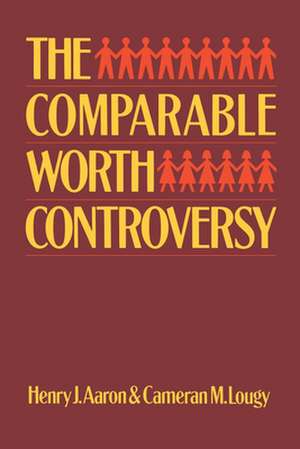
Comparable Worth Controversy: Studies of Government Finance: Second Series
Autor Henry Aaron, Cameran M. Lougyen Limba Engleză Paperback – oct 1986
The well-documented gap between men's and women's earnings has aroused intense debate over the concept of comparable worth, that is, equal pay for work judged to be of equal value. Government, business, labor unions, and the courts have been forced to consider whether workers in dissimilar jobs of comparable worth—measured by such criteria as working conditions, degree of difficulty, and knowledge and responsibility required—should receive equal wages, and how wage adjustments can be implemented.The issue has provoked inflated rhetoric, litigation, and considerable confusion.
In this concise study, Henry J. Aaron and Cameran M. Lougy review the conditions that have sparked the debate and unravel the implications of comparable worth for employers in public and private sectors, for labor union agendas and employer-employee negotiations, and for the administrative and and judicial burdens of the nation's courts. The authors conclude with general guidelines for implementing wage adjustments in ways that would not seriously disrupt society or have a major impact on overall economic efficiency.
In this concise study, Henry J. Aaron and Cameran M. Lougy review the conditions that have sparked the debate and unravel the implications of comparable worth for employers in public and private sectors, for labor union agendas and employer-employee negotiations, and for the administrative and and judicial burdens of the nation's courts. The authors conclude with general guidelines for implementing wage adjustments in ways that would not seriously disrupt society or have a major impact on overall economic efficiency.

Preț: 104.40 lei
Puncte Express: 157
Carte tipărită la comandă
Livrare economică 24 noiembrie-08 decembrie
Livrare prin curier în România Termenul estimat este afișat lângă disponibilitate.
Transport gratuit de la 400.00 lei Plată online sau ramburs, în funcție de opțiunile comenzii.
Retur gratuit în 14 zile Comandă securizată și suport în română.
Specificații
ISBN-13: 9780815700418
ISBN-10: 0815700415
Pagini: 68
Dimensiuni: 152 x 229 x 4 mm
Greutate: 0.11 kg
Editura: Brookings Institution Press
Colecția Studies of Government Finance: Second Series
Seria Studies of Government Finance: Second Series
ISBN-10: 0815700415
Pagini: 68
Dimensiuni: 152 x 229 x 4 mm
Greutate: 0.11 kg
Editura: Brookings Institution Press
Colecția Studies of Government Finance: Second Series
Seria Studies of Government Finance: Second Series
V-ar putea interesa
-
 Remote: Office Not RequiredDavid Heinemeier Hansson-29%Preț: 86.69 lei121.37 lei
 -
 Preț: 293.67 lei
 -
 -31%Preț: 917.99 lei1333.22 lei
 -
 -13%Preț: 333.85 lei381.55 lei
 -
 The Oxford Handbook of Economic InequalityWiemer Salverda-18%Preț: 341.20 lei417.49 lei
 -
 -31%Preț: 930.79 lei1354.51 lei
 -
 -28%Preț: 536.77 lei746.20 lei
 -
 Into DangerKate Adie-27%Preț: 66.78 lei91.51 lei
 -
 Economy, Work, and Education: Critical ConnectionsCatherine Casey-18%Preț: 1253.77 lei1528.98 lei
 -
 Social Media at WorkArthur L JuePreț: 167.17 lei
 -
 NLP CoachingSusie Linder-PelzPreț: 280.04 lei
 -
 Preț: 220.85 lei
 -
 Closing the Deficit: How Much Can Later Retirement Help?Gary Burtless-25%Preț: 142.30 lei188.74 lei
 -
 The Invisible Handcuffs of CapitalismMichael PerelmanPreț: 179.28 lei
 -
 Surplus American: How the 1% is Making Us RedundantCharles DerberPreț: 199.08 lei
 -
 Beyond the CorporationDavid ErdalPreț: 117.08 lei
Notă biografică
Henry J. Aaron is a senior fellow in Economic Studies at the Brookings Institution, where he holds the Bruce and Virginia MacLaury Chair. Among his many books are Can We Say No? The Challenge of Rationing Health Care, with William B. Schwartz and Melissa Cox (Brookings, 2006), and Reforming Medicare: Options,Tradeoffs, and Opportunities, written with Jeanne Lambrew (Brookings, 2008). Cameran M. Lougy is a former research assistant in the Brookings Economic Studies program.
Descriere
The well-documented gap between men's and women's earnings has aroused intense debate over the concept of comparable worth, that is, equal pay for work judged to be of equal value. Government, business, labor unions, and the courts have been forced to consider whether workers in dissimilar jobs of comparable worth—measured by such criteria as working conditions, degree of difficulty, and knowledge and responsibility required—should receive equal wages, and how wage adjustments can be implemented.The issue has provoked inflated rhetoric, litigation, and considerable confusion.
In this concise study, Henry J. Aaron and Cameran M. Lougy review the conditions that have sparked the debate and unravel the implications of comparable worth for employers in public and private sectors, for labor union agendas and employer-employee negotiations, and for the administrative and and judicial burdens of the nation's courts. The authors conclude with general guidelines for implementing wage adjustments in ways that would not seriously disrupt society or have a major impact on overall economic efficiency.
In this concise study, Henry J. Aaron and Cameran M. Lougy review the conditions that have sparked the debate and unravel the implications of comparable worth for employers in public and private sectors, for labor union agendas and employer-employee negotiations, and for the administrative and and judicial burdens of the nation's courts. The authors conclude with general guidelines for implementing wage adjustments in ways that would not seriously disrupt society or have a major impact on overall economic efficiency.