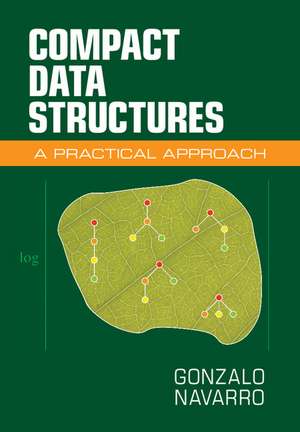
Compact Data Structures
Autor Gonzalo Navarroen Limba Engleză Hardback – 8 sep 2016
Observăm că volumul Compact Data Structures propune o structură progresivă: de la concept la implementare, începând cu bazele entropiei și codării, pentru a ajunge la aplicații sofisticate în rețele, baze de date și procesare de text. Într-o eră a volumelor masive de date, Gonzalo Navarro demonstrează cum stocarea informației în spațiu redus nu trebuie să sacrifice performanța interogărilor. Subliniem că această lucrare nu se rezumă la teorie; este un ghid tehnic care explică modul în care datele pot fi navigate și operate direct în formă comprimată, exploatând eficient ierarhia memoriei și resursele limitate ale dispozitivelor hardware. Ca și Paolo Ferragina în Pearls of Algorithm Engineering, autorul distilează experiență reală în principii acționabile, trecând dincolo de notația Big-O pentru a atinge eficiența practică. Reținem organizarea riguroasă a capitolelor, care ghidează cititorul prin implementarea de vectori de biți, permutări, arbori și grafuri, culminând cu structuri dinamice și tendințe de ultimă oră. Această abordare pragmatică reflectă expertiza autorului din lucrări anterioare precum String Processing and Information Retrieval, unde accentul a fost pus pe algoritmi de înaltă performanță. Stilul este unul tehnic și precis, susținut de cele 140 de ilustrații care clarifică mecanismele interne ale structurilor prezentate. Spre deosebire de compendiile generale, această carte se concentrează strict pe structurile relevante pentru utilizarea practică actuală, fiind o resursă esențială pentru cei care proiectează sisteme distribuite sau aplicații pentru dispozitive low-end unde memoria este o resursă critică.
Preț: 587.06 lei
Preț vechi: 733.82 lei
-20%
Carte tipărită la comandă
Livrare economică 26 noiembrie-10 decembrie
Specificații
ISBN-10: 1107152380
Pagini: 570
Ilustrații: 140 b/w illus.
Dimensiuni: 183 x 260 x 35 mm
Greutate: 1.18 kg
Editura: Cambridge University Press
Locul publicării:New York, United States
V-ar putea interesa
-
 Flexible Pattern Matching in StringsGonzalo Navarro-20%Preț: 409.81 lei512.27 lei
 -
 Algorithmic GeometryJean-Daniel Boissonnat-20%Preț: 594.09 lei742.62 lei
 -
 Algorithms on Strings, Trees and SequencesDan Gusfield-20%Preț: 674.87 lei843.59 lei
 -
 Online Computation and Competitive AnalysisRan El-Yaniv-20%Preț: 625.78 lei782.23 lei
 -
 Analysis of Boolean FunctionsRyan O'Donnell-20%Preț: 571.14 lei713.92 lei
 -
 KernelizationFedor V. Fomin-20%Preț: 469.94 lei587.42 lei
 -
 Algorithms on StringsMaxime Crochemore-20%Preț: 315.08 lei393.86 lei
 -
 Design and Analysis of AlgorithmsSandeep Sen-20%Preț: 406.84 lei508.55 lei
 -
 Algorithmic Aspects of Graph ConnectivityHiroshi NagamochiPreț: 399.94 lei
 -
 Foundations of AlgorithmsRichard Neapolitan-17%Preț: 486.00 lei585.67 lei
 -
 Network Flow AlgorithmsDavid P. Williamson-20%Preț: 315.80 lei394.74 lei
 -
 -18%Preț: 1273.06 lei1552.51 lei
 -
 -20%Preț: 665.54 lei831.93 lei
 -
 String Processing and Information RetrievalTravis Gagie-20%Preț: 339.52 lei424.40 lei
 -
 Wireless Algorithms, Systems, and ApplicationsZhipeng Cai-20%Preț: 651.20 lei814.01 lei
 -
 Approximation and Online AlgorithmsChristos Kaklamanis-20%Preț: 261.17 lei326.46 lei
 -
 Frontiers in AlgorithmicsJianer Chen-20%Preț: 338.45 lei423.07 lei
 -
 Algorithm Theory -- SWAT 2014Inge Li Gørtz-20%Preț: 341.23 lei426.53 lei
 -
 Computing and CombinatoricsZhipeng Cai-20%Preț: 356.54 lei445.68 lei
 -
 Structural Information and Communication ComplexityMagnús M. Halldórsson-20%Preț: 339.95 lei424.94 lei
 -
 -20%Preț: 374.37 lei467.96 lei
 -
 -20%Preț: 327.04 lei408.80 lei
 -
 Similarity Search and ApplicationsGonzalo Navarro-20%Preț: 304.15 lei380.19 lei
 -
 LATIN 2014: Theoretical InformaticsAlberto Pardo-20%Preț: 361.64 lei452.05 lei
 -
 Automata, Languages, and ProgrammingJavier Esparza-20%Preț: 340.38 lei425.47 lei
 -
 Mathematical Foundations of Computer Science 2014Ersébet Csuhaj-Varjú-20%Preț: 350.38 lei437.98 lei
 -
 Introduction to CryptographyHans Delfs-20%Preț: 510.64 lei638.31 lei
 -
 LATIN 2016: Theoretical InformaticsEvangelos Kranakis-20%Preț: 358.46 lei448.08 lei
De ce să citești această carte
Recomandăm această carte inginerilor software și cercetătorilor care lucrează cu seturi mari de date. Veți câștiga o înțelegere profundă a modului în care puteți reduce amprenta de memorie a aplicațiilor fără a pierde capacitatea de interogare rapidă. Este un instrument indispensabil pentru optimizarea sistemelor moderne, oferind soluții concrete pentru gestionarea eficientă a resurselor hardware prin structuri de date compacte.
Descriere scurtă
Cuprins
Recenzii
'The explanations are clear and accessible, the content substantial and the information level high, the illustrations appropriate and informative, and the subject matter timely and increasingly relevant. This text will provide a good foundation in theory and practical issues, and should be a useful introduction to the field for students, researchers, and developers desiring a solid foundational text.' R. M. Malyankar, Computing Reviews
'The book is a real gem! My excitement while reading it was similar to what I felt when learning to program as a child, browsing the bit-level details in a technical manual of an obscure computer architecture. Even though data structures are my main research interest, much of the material was new to me. There is a remarkable attention to detail, pseudocode in the book is written very carefully, with all details explicitly given … In 540 pages, the book discusses a large number of data structuring questions, exploring various designs and tradeoffs, followed by relevant applications. The book is very well-organized, and its concept is compelling (once the reader gets the hang of it), the various results fit together and build upon each other. I imagine that seminars could easily be based on the book; it can also be useful for self-study and reference, even for practitioners.' Laszlo Kozma, SIGACT News