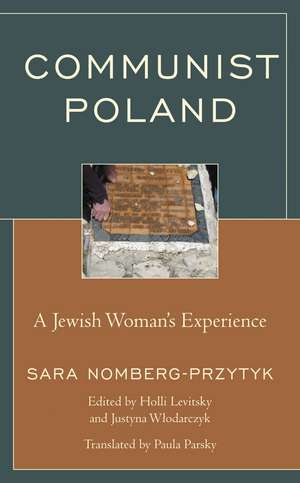
Communist Poland: A Jewish Woman's Experience: Bloomsbury Studies in Jewish Literature
Autor Sara Nomberg-Przytyk Editat de Holli Levitsky, Justyna Wlodarczyk Traducere de Paula Parskyen Limba Engleză Hardback – 3 mar 2022



Preț: 526.84 lei
Preț vechi: 816.93 lei
-36%
Puncte Express: 790
Carte tipărită la comandă
Livrare economică 30 noiembrie-14 decembrie
Livrare prin curier în România Termenul estimat este afișat lângă disponibilitate.
Transport gratuit pentru acest produs Plată online sau ramburs, în funcție de opțiunile comenzii.
Retur gratuit în 14 zile Comandă securizată și suport în română.
Specificații
ISBN-13: 9781498577502
ISBN-10: 1498577504
Pagini: 254
Dimensiuni: 163 x 237 x 21 mm
Greutate: 0.54 kg
Editura: Bloomsbury Publishing
Colecția Lexington Books
Seria Bloomsbury Studies in Jewish Literature
Locul publicării:New York, United States
ISBN-10: 1498577504
Pagini: 254
Dimensiuni: 163 x 237 x 21 mm
Greutate: 0.54 kg
Editura: Bloomsbury Publishing
Colecția Lexington Books
Seria Bloomsbury Studies in Jewish Literature
Locul publicării:New York, United States
Cuprins
Table of Contents
Introduction
Chapter 1 My First Day in the New Poland
Chapter 2 A Piece of White Bread
Chapter 3 An Armed Soldier at the Door of the Party Committee of Lublin
Chapter 4 A Parade of People and Portraits
Chapter 5 My First Victory
Chapter 6 I Meet My Destined One
Chapter 7 Small Candles Among the Ruins
Chapter 8 Old Friends in the New Poland
Chapter 9 The Kielce Pogrom
Chapter 10 You Don't Know Me
Chapter 11 A New Job
Chapter 12 Why We Needed a 99% Majority in the Elections
Chapter 13 Tell Me-Is It Possible?
Chapter 14 The Miracle in Lublin
Chapter 15 The Ruins of the War Will Disappear; In Their Places New Houses Will Stand
Chapter 16 You Are Going to Die
Chapter 17 I Want To, But My Wife Doesn't
Chapter 18 The Light in the Shadows of the New Times
Chapter 19 Threat of Provocation Looming Over My Head
Chapter 20 The Death of a Dictator
Chapter 21 Nothing has Changed - 'The Jews are Guilty'
Chapter 22 Opportunism Wins Out
Chapter 23 At the New Job
Chapter 24 In the Chains of Bureaucracy
Chapter 25 New Schools and Water in Peasant Houses - Optimistic Accents in the 1960s
Chapter 26 Is This the Role of a Journalist in Poland?
Chapter 27 My First Book
Chapter 28 The Pillars of Samson
Chapter 29 Jews in Auschwitz
Chapter 30 The Six-Day War
Chapter 31 Feelings of Terror and Insecurity Return
Chapter 32 The Polish Spring of 1968
Chapter 33 A Beilis-like Trial Against My Husband
Chapter 34 We Can No Longer Eat Bread Full of Worms
Chapter 35 As Though After a Pogrom
Chapter 36 The Last Stage of Our Exodus
Chapter 37 On the Road
Chapter 38 The Day of Escape for Jews in Poland
Epilogue I am at Home
Introduction
Chapter 1 My First Day in the New Poland
Chapter 2 A Piece of White Bread
Chapter 3 An Armed Soldier at the Door of the Party Committee of Lublin
Chapter 4 A Parade of People and Portraits
Chapter 5 My First Victory
Chapter 6 I Meet My Destined One
Chapter 7 Small Candles Among the Ruins
Chapter 8 Old Friends in the New Poland
Chapter 9 The Kielce Pogrom
Chapter 10 You Don't Know Me
Chapter 11 A New Job
Chapter 12 Why We Needed a 99% Majority in the Elections
Chapter 13 Tell Me-Is It Possible?
Chapter 14 The Miracle in Lublin
Chapter 15 The Ruins of the War Will Disappear; In Their Places New Houses Will Stand
Chapter 16 You Are Going to Die
Chapter 17 I Want To, But My Wife Doesn't
Chapter 18 The Light in the Shadows of the New Times
Chapter 19 Threat of Provocation Looming Over My Head
Chapter 20 The Death of a Dictator
Chapter 21 Nothing has Changed - 'The Jews are Guilty'
Chapter 22 Opportunism Wins Out
Chapter 23 At the New Job
Chapter 24 In the Chains of Bureaucracy
Chapter 25 New Schools and Water in Peasant Houses - Optimistic Accents in the 1960s
Chapter 26 Is This the Role of a Journalist in Poland?
Chapter 27 My First Book
Chapter 28 The Pillars of Samson
Chapter 29 Jews in Auschwitz
Chapter 30 The Six-Day War
Chapter 31 Feelings of Terror and Insecurity Return
Chapter 32 The Polish Spring of 1968
Chapter 33 A Beilis-like Trial Against My Husband
Chapter 34 We Can No Longer Eat Bread Full of Worms
Chapter 35 As Though After a Pogrom
Chapter 36 The Last Stage of Our Exodus
Chapter 37 On the Road
Chapter 38 The Day of Escape for Jews in Poland
Epilogue I am at Home
Recenzii
Sara Nomberg-Przytyk's "memoir in piece" is one of the most important ego documents of a Polish-Jewish woman's life in the twentieth century. Nomberg-Przytyk spreads out before us the richness and contradictions of Polish-Jewish existence in communist Poland. Her multi-layered life is filled with immense personal and communal losses during the Holocaust, post-war pains and joys of love, marriage, and motherhood, and swift success as a Jewish female investigative journalist under the communist regime. Nomberg-Przytyk, a descendent of a religious Jewish family from Lublin, an Auschwitz survivor, a communist believer who would undergo an ideological transformation in the 1960s during the anti-Zionist/anti-Jewish campaign, poignantly shows how an individual's life suffers at the hands of great historical forces. Nomberg-Przytyk's memoir, impressively annotated, is a must-read for everyone in the fields of European History, the Holocaust, Gender, and Memories studies.
Communist Poland: A Jewish Woman's Experience is a breathtaking memoir of Nomberg-Przytyk, a Polish Jewish journalist born and raised in an Orthodox family during rabid antisemitism in Catholic Poland before WWII. Imprisoned at Auschwitz, she remained committed to communism in her naïve desire to rid Poland of antisemitism and social inequities. She was destroyed by the same communism for being a Jew, and forced to emigrate to Israel, stripped of the citizenship of the country to which she devoted most of her life and all of her professional passions. The book editors Holli Levitsky and Justyna Wlodarczyk created a masterful text providing extraordinary rich and nuanced historical detail and context to Sara's memoir. Both the memoir and the extensive historical annotations make this text an important insightful historical document about those dramatic times, with superb quality of writing - making the book hard to put down.
As a firsthand Jewish witness of the Holocaust, a powerfully inventive creative writer, and a journalist navigating a new totalitarian regime in postwar Poland, Sara Nomberg-Przytyk has few rivals among European writers of her generation. Communist Poland, both a personal memoir and a closely-observed documentary record, is the portrait of a woman at the intersection of history. Composed through transcriptions of oral recollection, translation of several languages, and incisive editorial commentary, her life story is a scholarly and testimonial work of lasting importance.
This remarkable autobiography by a woman who survived Auschwitz and subsequently became a prominent journalist in the Polish People's Republic until she was forced to emigrate as a result of the 'anti-Zionist' campaign of 1968 is a microcosm of the tragic fate of the Jews in Poland. It is essential reading for all those interested in Polish-Jewish relations and the history of Poland in the twentieth century.
The book, while offering much interesting information about life in Poland in the first three decades after the war, serves as an exercise in memory studies and a critical evaluation of one's life that includes the process of making sense of losses, mistakes, and accomplishments. The short chapters lend themselves to an informative reading for undergraduate students, but the book in its entirety, while read through the prism of collective and individual memory of life under communism, can be more complex, more challenging, and hence more interesting. Regardless of how one chooses to read this memoir, it is clear that the life and works of Nomberg-Przytyk are certainly worthy of our attention. The richness of her life, the choices she made, and the way she chose to narrate her story should reach students of Polish history as well as wider audiences.
Communist Poland: A Jewish Woman's Experience is a breathtaking memoir of Nomberg-Przytyk, a Polish Jewish journalist born and raised in an Orthodox family during rabid antisemitism in Catholic Poland before WWII. Imprisoned at Auschwitz, she remained committed to communism in her naïve desire to rid Poland of antisemitism and social inequities. She was destroyed by the same communism for being a Jew, and forced to emigrate to Israel, stripped of the citizenship of the country to which she devoted most of her life and all of her professional passions. The book editors Holli Levitsky and Justyna Wlodarczyk created a masterful text providing extraordinary rich and nuanced historical detail and context to Sara's memoir. Both the memoir and the extensive historical annotations make this text an important insightful historical document about those dramatic times, with superb quality of writing - making the book hard to put down.
As a firsthand Jewish witness of the Holocaust, a powerfully inventive creative writer, and a journalist navigating a new totalitarian regime in postwar Poland, Sara Nomberg-Przytyk has few rivals among European writers of her generation. Communist Poland, both a personal memoir and a closely-observed documentary record, is the portrait of a woman at the intersection of history. Composed through transcriptions of oral recollection, translation of several languages, and incisive editorial commentary, her life story is a scholarly and testimonial work of lasting importance.
This remarkable autobiography by a woman who survived Auschwitz and subsequently became a prominent journalist in the Polish People's Republic until she was forced to emigrate as a result of the 'anti-Zionist' campaign of 1968 is a microcosm of the tragic fate of the Jews in Poland. It is essential reading for all those interested in Polish-Jewish relations and the history of Poland in the twentieth century.
The book, while offering much interesting information about life in Poland in the first three decades after the war, serves as an exercise in memory studies and a critical evaluation of one's life that includes the process of making sense of losses, mistakes, and accomplishments. The short chapters lend themselves to an informative reading for undergraduate students, but the book in its entirety, while read through the prism of collective and individual memory of life under communism, can be more complex, more challenging, and hence more interesting. Regardless of how one chooses to read this memoir, it is clear that the life and works of Nomberg-Przytyk are certainly worthy of our attention. The richness of her life, the choices she made, and the way she chose to narrate her story should reach students of Polish history as well as wider audiences.