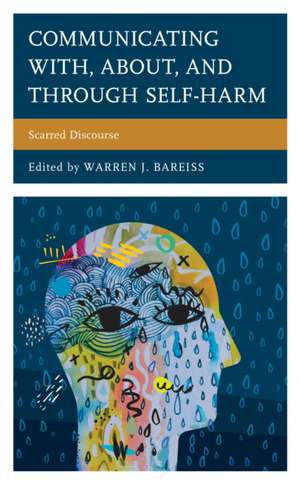
Communicating With, About, and Through Self-Harm: Scarred Discourse: Bloomsbury Studies in Health Communication
Editat de Warren J. Bareiss Contribuţii de Mike Alvarez, Lisann Anders, Marta Carvalhal, Kathryn R. Fox, Carolyn E. Helps, Jill M. Hooley, Tina In-Albon, Anita N.D. Kwashie, John Levitt, Shuang Liu, Janine Lüdtke, Yanni Ma, Nicole S. Parrish, Marc Schmid, Taru Tschan, Brianna J. Turner, Shirley B. Wangen Limba Engleză Paperback – 18 aug 2022
| Toate formatele și edițiile | Preț | Express |
|---|---|---|
| Paperback (1) | 243.42 lei 6-8 săpt. | |
| Bloomsbury Publishing – 18 aug 2022 | 243.42 lei 6-8 săpt. | |
| Hardback (1) | 553.29 lei 6-8 săpt. | |
| Bloomsbury Publishing – 10 dec 2020 | 553.29 lei 6-8 săpt. |
Din seria Bloomsbury Studies in Health Communication
- 27%
 Preț: 255.42 lei
 - 34%
 Preț: 522.27 lei
 - 27%
 Preț: 241.05 lei
 - 32%
 Preț: 508.52 lei
 - 30%
 Preț: 246.24 lei
 -
 Preț: 210.11 lei
 - 34%
 Preț: 696.45 lei
 - 34%
 Preț: 671.15 lei
 - 32%
 Preț: 508.37 lei
 - 34%
 Preț: 555.30 lei
 - 34%
 Preț: 641.01 lei
 - 27%
 Preț: 241.52 lei
 - 26%
 Preț: 256.07 lei
 - 26%
 Preț: 247.19 lei
 - 34%
 Preț: 567.29 lei
 - 34%
 Preț: 521.63 lei
 - 30%
 Preț: 243.45 lei
 - 27%
 Preț: 515.40 lei
 - 31%
 Preț: 466.06 lei
 - 31%
 Preț: 467.34 lei
 - 31%
 Preț: 466.82 lei
 - 32%
 Preț: 430.36 lei
 - 5%
 Preț: 612.91 lei
Preț: 243.42 lei
Preț vechi: 330.36 lei
-26%
Puncte Express: 365
Preț estimativ în valută:
43.11€ • 50.35$ • 37.45£
43.11€ • 50.35$ • 37.45£
Carte tipărită la comandă
Livrare economică 21 februarie-07 martie
Preluare comenzi: 021 569.72.76
Specificații
ISBN-13: 9781498563079
ISBN-10: 1498563074
Pagini: 232
Ilustrații: 8 b/w illustrations; 9 tables; 1 textboxes;
Dimensiuni: 152 x 228 x 17 mm
Greutate: 0.34 kg
Editura: Bloomsbury Publishing
Colecția Lexington Books
Seria Bloomsbury Studies in Health Communication
Locul publicării:New York, United States
ISBN-10: 1498563074
Pagini: 232
Ilustrații: 8 b/w illustrations; 9 tables; 1 textboxes;
Dimensiuni: 152 x 228 x 17 mm
Greutate: 0.34 kg
Editura: Bloomsbury Publishing
Colecția Lexington Books
Seria Bloomsbury Studies in Health Communication
Locul publicării:New York, United States
V-ar putea interesa
-
 Preț: 210.96 lei
 -
 Minds in MotionRene'-Marc ManginPreț: 207.13 lei
 -
 Preț: 315.38 lei
 -
 Das Bild im digitalen ZeitalterJanina FranzPreț: 88.80 lei
 -
 Preț: 187.35 lei
 -
 Die Darstellung von Folter in der TV-Serie 24Florian SteinackerPreț: 157.62 lei
 -
 Linksextreme Musik - Konträr zur rechtsextremen Musik?Diana SchuettPreț: 87.51 lei
 -
 Der Markteintritt der Tageszeitung "Österreich"Gregor MatheisPreț: 237.80 lei
 -
 Preț: 80.03 lei
 -
 Fernsehnutzung blinder MenschenChristian OhrensPreț: 133.54 lei
 -
 Preț: 105.21 lei
 -
 Preț: 91.09 lei
 -
 Preț: 73.17 lei
 -
 Mehr Hörer, aber wie?Mark HegewaldPreț: 198.48 lei
 -
 Preț: 80.29 lei
Cuprins
Acknowledgements
Prologue
Chapter 1: Non-Suicidal Self-Injury: Communicating in Chaos
Marta Carvalhal, LISW-CP and Nicole S. Parrish, M.D.
Chapter 2: Self-Regulatory Communication in the Treatment of Self-Injury: Development and
Maintenance of Therapeutic Rapport
John L. Levitt, PhD, FAED, FIAEDP, CEDS-S
Chapter 3: Novel Online Daily Diary Interventions for Nonsuicidal Self-Injury: A Randomized Controlled Trial
Jill M. Hooley, Kathryn R. Fox, Shirley B. Wang, and Anita N. D. Kwashie
Chapter 4: Sibling Relationships of Female Adolescents with Nonsuicidal Self-Injury Disorder in Comparison to a Clinical and a Nonclinical Control Group
Taru Tschan, Janine Lüdtke, Marc Schmid, and Tina In-Albon
Chapter 5: Using Micro-Longitudinal Methods to Examine Social-Communicative Functions of Self-injury in Everyday Life
Brianna J. Turner and Carolyn E. Helps
Chapter 6: Discursive Tensions and Contradictions: A Cultural Analysis of an Online Self-Harm Forum
Mike Alvarez
Chapter 7: "Can Airport Scanners See Scars?" An Interpretive Analysis of Self-Injury Narratives
Warren Bareiss
Chapter 8: Fighting the Self: Inter- and Intra-Personal Communicative Violence in Chuck Palahniuk's Fight Club
Lisann Anders
Chapter 9: A Systematic Review of Media Use and Non-Suicidal Self-Injury Behaviors
Shuang Liu, Ph.D. and Yanni Ma, Ph.D.
Chapter 10:
The End (a.k.a The Beginning): Application of Buddhist Principles in Communicating With, About, and Through Self-Harm
Warren Bareiss
About the Contributors
Prologue
Chapter 1: Non-Suicidal Self-Injury: Communicating in Chaos
Marta Carvalhal, LISW-CP and Nicole S. Parrish, M.D.
Chapter 2: Self-Regulatory Communication in the Treatment of Self-Injury: Development and
Maintenance of Therapeutic Rapport
John L. Levitt, PhD, FAED, FIAEDP, CEDS-S
Chapter 3: Novel Online Daily Diary Interventions for Nonsuicidal Self-Injury: A Randomized Controlled Trial
Jill M. Hooley, Kathryn R. Fox, Shirley B. Wang, and Anita N. D. Kwashie
Chapter 4: Sibling Relationships of Female Adolescents with Nonsuicidal Self-Injury Disorder in Comparison to a Clinical and a Nonclinical Control Group
Taru Tschan, Janine Lüdtke, Marc Schmid, and Tina In-Albon
Chapter 5: Using Micro-Longitudinal Methods to Examine Social-Communicative Functions of Self-injury in Everyday Life
Brianna J. Turner and Carolyn E. Helps
Chapter 6: Discursive Tensions and Contradictions: A Cultural Analysis of an Online Self-Harm Forum
Mike Alvarez
Chapter 7: "Can Airport Scanners See Scars?" An Interpretive Analysis of Self-Injury Narratives
Warren Bareiss
Chapter 8: Fighting the Self: Inter- and Intra-Personal Communicative Violence in Chuck Palahniuk's Fight Club
Lisann Anders
Chapter 9: A Systematic Review of Media Use and Non-Suicidal Self-Injury Behaviors
Shuang Liu, Ph.D. and Yanni Ma, Ph.D.
Chapter 10:
The End (a.k.a The Beginning): Application of Buddhist Principles in Communicating With, About, and Through Self-Harm
Warren Bareiss
About the Contributors
Recenzii
Bareiss envelops the complexities of a certain class of human behaviors in this thoughtfully curated volume. Each chapter serves as a gateway to comprehending the multifaceted experience of persons affected by non-suicidal self-injury (NSSI) and its communicative channels. To unravel the entanglement of functions involved, Bareiss invited a panel of diverse scholars and clinicians to provide insights. The essays that compose the volume are contextually practical while expressing a respectful tone, carefully maintained across the different voices of the various contributors. Bareiss acknowledges that "this book's fundamental purpose is to empower individuals," and with this singular goal each chapter provides a unique path to awareness and compassion for those who may be seeking help with unconventional communicative behaviors. Recommended.
Is self-injury a form of communication? What message, if any, can be communicated through the act? Tackling these intricate questions, this impressive volume reveals how the experience of self-injury is communicated via scars, journals, media and clinical discourse, wherein the wounded bodies become the nexus of meaning, relationship, and control. Lively and sophisticated, this is a must read for those interested in communicative dimensions of self-injury.
This collection is informative and insightful. The contributors set out to place the contemporary phenomenon of self-injury into a number of contexts that foreground the communicative and deeply complex social aspects of the behaviour. The collection adds considerable value to the seam of socially-oriented professional studies, looking at online forums, diaries, news media, and even fictional portrayals of self-harm. It is a compassionate and reflexive set of contributions, expertly marshalled and bookended by Warren Bareiss; the book seeks to foreground communicative aspects without slipping into reactionary tropes about 'attention-seeking'. It carries throughout the firm conviction that self-injurious behaviour is usefully understood as human communication, enacted and received in particular contexts, and not simply as a blanket term for something pathological.
We have come along way in the last decade in understanding self injury from the vantage point of science. What we have lacked, until now, is a robust, refined, and compassionate-laced understanding of what self-injury communicates to and for individuals who use it and to and for those who bear witness-from near and afar. This edited volume offers important, unique and, ultimately, humane insight into the ways in which how we speak about self-injury matters and why it is so important to deeply listen to what we hear.
This text brings together expert, innovative content to highlight a diverse array of topics related to the communicative aspects of self-injury and the importance of understanding NSSI within a relational context. The creative and timely knowledge shared in this text expands current understandings of self-injury, adding depth to professionals' conceptualization of this behavior. It's a refreshing addition to the literature in this area.
Is self-injury a form of communication? What message, if any, can be communicated through the act? Tackling these intricate questions, this impressive volume reveals how the experience of self-injury is communicated via scars, journals, media and clinical discourse, wherein the wounded bodies become the nexus of meaning, relationship, and control. Lively and sophisticated, this is a must read for those interested in communicative dimensions of self-injury.
This collection is informative and insightful. The contributors set out to place the contemporary phenomenon of self-injury into a number of contexts that foreground the communicative and deeply complex social aspects of the behaviour. The collection adds considerable value to the seam of socially-oriented professional studies, looking at online forums, diaries, news media, and even fictional portrayals of self-harm. It is a compassionate and reflexive set of contributions, expertly marshalled and bookended by Warren Bareiss; the book seeks to foreground communicative aspects without slipping into reactionary tropes about 'attention-seeking'. It carries throughout the firm conviction that self-injurious behaviour is usefully understood as human communication, enacted and received in particular contexts, and not simply as a blanket term for something pathological.
We have come along way in the last decade in understanding self injury from the vantage point of science. What we have lacked, until now, is a robust, refined, and compassionate-laced understanding of what self-injury communicates to and for individuals who use it and to and for those who bear witness-from near and afar. This edited volume offers important, unique and, ultimately, humane insight into the ways in which how we speak about self-injury matters and why it is so important to deeply listen to what we hear.
This text brings together expert, innovative content to highlight a diverse array of topics related to the communicative aspects of self-injury and the importance of understanding NSSI within a relational context. The creative and timely knowledge shared in this text expands current understandings of self-injury, adding depth to professionals' conceptualization of this behavior. It's a refreshing addition to the literature in this area.