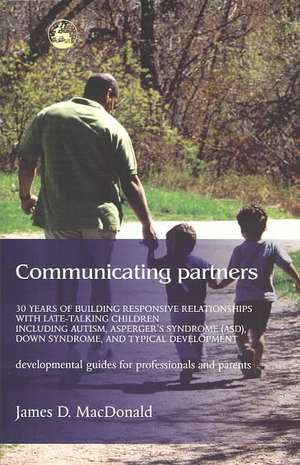
Communicating Partners: 30 Years of Building Responsive Relationships with Late Talking Children including Autism, Asperger's Syndrome (ASD), Down Syndrome, and Typical Devel
Autor James D. MacDonalden Limba Engleză Paperback – 15 mai 2004
* What does a child need to do before language?
* What are effective ways to help a child socialize and communicate from early play through civil conversations?
* How have parents successfully helped children learn to communicate at home?
* How can a child develop socially effective language and conversation skills?
* How can a child with an autistic spectrum disorder, Down Syndrome or other significant delays develop rich social relationships?
* What have families done to build warm social relationships with their children?
* What is developmentally effective therapy and education when social and communicative delays are of major concern?
Illustrated with personal stories and research findings, and containing a wealth of practical suggestions to help parents, teachers, and professionals understand their child's world, Communicating Partners is an invaluable resource for all those interacting and working with late talking children.
Preț: 203.43 lei
Preț vechi: 271.07 lei
-25%
Puncte Express: 305
Carte disponibilă
Livrare economică 26 septembrie-10 octombrie
Livrare prin curier în România Termenul estimat este afișat lângă disponibilitate.
Transport gratuit de la 400.00 lei Plată online sau ramburs, în funcție de opțiunile comenzii.
Retur gratuit în 14 zile Comandă securizată și suport în română.
Specificații
ISBN-13: 9781843107583
ISBN-10: 1843107589
Pagini: 336
Ilustrații: references, index
Dimensiuni: 185 x 228 x 20 mm
Greutate: 0.51 kg
Ediția:American Pbk.
Editura: JESSICA KINGSLEY PUBLISHERS
Colecția Jessica Kingsley Publishers
Locul publicării:London, United Kingdom
ISBN-10: 1843107589
Pagini: 336
Ilustrații: references, index
Dimensiuni: 185 x 228 x 20 mm
Greutate: 0.51 kg
Ediția:American Pbk.
Editura: JESSICA KINGSLEY PUBLISHERS
Colecția Jessica Kingsley Publishers
Locul publicării:London, United Kingdom
Recenzii
James MacDonald's book is based on over 30 years of research and clinical work at Ohio State University. Communicating Partners is an optimistic approach to working with children with communication disorders. It challenges practitioners to think beyond traditional therapy programmes and focus more on language learning in naturalistic environments and developing strengths through positive social relationships. MacDonald encourages practitioners and parents to consider the power of child-led play and advocates the theory that only once you enter into the child's world will you have the slightest chance of teaching them something new. Communicating Partners is a useful resource for professionals working with children with language and social communication difficulties and would also be of interest to parents.
The book offers speech and language professionals a model to guide their therapy plans, but emphasizes the need for therapy to be generalized to daily life. Accordingly it emphasizes the need for parents and professionals to become partners in helping the child, stressing that children best develop social interaction skills within the family. Numerous anecdotes are included to illustrate how this approach has helped a wide variety of children and their families. This book would be of particular benefit to the parents/carers of children who are late to develop language for any reason, since it provides simple ideas to help stimulate social communication by following the child's lead. Professionals working with families may also find it useful to give ideas of where to start remediation and target therapy. Although it is not solely aimed at parents/carers of children on the autistic spectrum, it would probably be of most benefit to this group.
The author, who is vastly experienced, presents this child-centred approach clearly, offering students, parents and professionals plenty of background information and practical guidance.
The book offers speech and language professionals a model to guide their therapy plans, but emphasizes the need for therapy to be generalized to daily life. Accordingly it emphasizes the need for parents and professionals to become partners in helping the child, stressing that children best develop social interaction skills within the family. Numerous anecdotes are included to illustrate how this approach has helped a wide variety of children and their families. This book would be of particular benefit to the parents/carers of children who are late to develop language for any reason, since it provides simple ideas to help stimulate social communication by following the child's lead. Professionals working with families may also find it useful to give ideas of where to start remediation and target therapy. Although it is not solely aimed at parents/carers of children on the autistic spectrum, it would probably be of most benefit to this group.
The author, who is vastly experienced, presents this child-centred approach clearly, offering students, parents and professionals plenty of background information and practical guidance.
Cuprins
Preface. Part I: Introduction to the Model. 1. The 30-year journey with 1000 children - how Communicating Partners came about. 2. Guiding Principles. 3. Key features of Communicating Partners and contrasts with traditional approaches to autism. 4. Examples of children studied for this book. 5. Theoretical foundations for Communicating Partners. 6. Basic components of Communicating Partners: five developmental stages and five relationship strategies. Part II: Five Stages of Communication. 7. Interaction: the first stage in learning to communicate. 8. Nonverbal communication: the second stage in learning to communicate. 9. Social language: the third stage in learning to communicate. 10. Conversation: the fourth stage in learning to communicate. 11. Civil behavior: the fifth stage in learning to communicate. Part III: Following your child's development from isolation to civil conversation. 12. The Adult-Child Relationship Map for assessment and planning. 13. The environment form. Appendix A: Research support for Communicating Partners. References. Subject Index. Author Index.