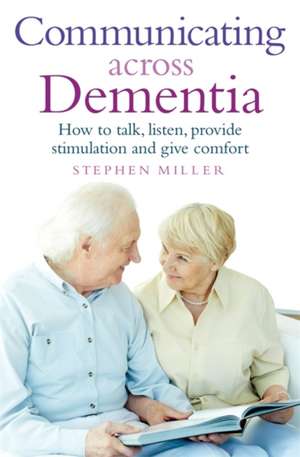
Communicating Across Dementia: How to talk, listen, provide stimulation and give comfort
Autor Stephen Milleren Limba Engleză Paperback – 7 mai 2015
Making key changes to the way you communicate
Creating the right physical environment for good communication
And bear in mind that communication in the broadest sense goes well beyond talking; there is also a wide range of non-verbal communication such as facial expression, posture and touch.
The person with dementia in your life needs your help. This straightforward book will help you to acquire the knack for improving and facilitating communication that works in a wide variety of situations including:
Improving conversation
Finding stimulating activities
Dealing with challenging situations
Making important decisions
Reducing stress and agitation
Moving into residential care
This book provides invaluable information for people helping to care for people with dementia at home and also those who do so as part of their job.
Preț: 65.78 lei
Preț vechi: 90.93 lei
-28%
Puncte Express: 99
Carte disponibilă
Livrare economică 03-17 noiembrie
Livrare express 17-23 octombrie pentru 43.54 lei
Livrare prin curier în România Termenul estimat este afișat lângă disponibilitate.
Transport gratuit de la 400.00 lei Plată online sau ramburs, în funcție de opțiunile comenzii.
Retur gratuit în 14 zile Comandă securizată și suport în română.
Specificații
ISBN-13: 9781845285708
ISBN-10: 1845285700
Pagini: 224
Ilustrații: no plate section/illustrations
Dimensiuni: 131 x 195 x 15 mm
Greutate: 0.18 kg
Editura: Little Brown
Colecția Robinson
Locul publicării:London, United Kingdom
ISBN-10: 1845285700
Pagini: 224
Ilustrații: no plate section/illustrations
Dimensiuni: 131 x 195 x 15 mm
Greutate: 0.18 kg
Editura: Little Brown
Colecția Robinson
Locul publicării:London, United Kingdom
Recenzii
Information, advice and suggestions for making vital communication easier and more effective
If someone close to you has dementia (Alzheimer’s Disease is the most common type) they need your help. You will know that communication has become more difficult and frustrating. This jargon-free book explains why this happens and how you can make important improvements by re-thinking your whole approach and including, for instance, non-verbal communications.
Areas covered include:
Creating the right conditions for good communication
Making conversation easier
Non-verbal communication
Adaptations to the home
Finding stimulating activities
Dealing with difficult situations
Helping to look after a person with dementia involves many challenges. Good and effective communication can make them more manageable and greatly reduce stress levels in people with dementia - and in their carers.
If someone close to you has dementia (Alzheimer’s Disease is the most common type) they need your help. You will know that communication has become more difficult and frustrating. This jargon-free book explains why this happens and how you can make important improvements by re-thinking your whole approach and including, for instance, non-verbal communications.
Areas covered include:
Creating the right conditions for good communication
Making conversation easier
Non-verbal communication
Adaptations to the home
Finding stimulating activities
Dealing with difficult situations
Helping to look after a person with dementia involves many challenges. Good and effective communication can make them more manageable and greatly reduce stress levels in people with dementia - and in their carers.