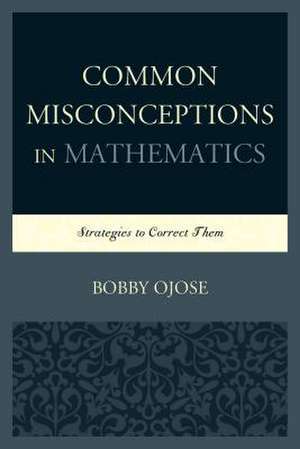
Common Misconceptions in Mathematics: Strategies to Correct Them
Autor Bobby Ojoseen Limba Engleză Paperback – mai 2015
Preț: 177.38 lei
Preț vechi: 249.10 lei
-29%
Puncte Express: 266
Carte tipărită la comandă
Livrare economică 19 noiembrie-03 decembrie
Livrare prin curier în România Termenul estimat este afișat lângă disponibilitate.
Transport gratuit de la 400.00 lei Plată online sau ramburs, în funcție de opțiunile comenzii.
Retur gratuit în 14 zile Comandă securizată și suport în română.
Specificații
ISBN-13: 9780761858850
ISBN-10: 0761858857
Pagini: 150
Ilustrații: illustrations
Dimensiuni: 155 x 231 x 12 mm
Greutate: 0.25 kg
Editura: Bloomsbury Publishing
Colecția University Press of America
Locul publicării:New York, United States
ISBN-10: 0761858857
Pagini: 150
Ilustrații: illustrations
Dimensiuni: 155 x 231 x 12 mm
Greutate: 0.25 kg
Editura: Bloomsbury Publishing
Colecția University Press of America
Locul publicării:New York, United States
V-ar putea interesa
-
 -27%Preț: 192.33 lei265.00 lei
 -
 Preț: 256.01 lei
 -
 Doing Creative WritingSteve MayPreț: 220.87 lei
 -
 A Practical Guide to Teaching Design and Technology in the Secondary SchoolGwyneth Owen-JacksonPreț: 336.62 lei
 -
 Primary Grammar BoxCaroline Nixon-8%Preț: 441.92 lei480.35 lei
 -
 Teaching Languages to Young LearnersLynne Cameron-8%Preț: 361.64 lei393.08 lei
 -
 Getting the Buggers to Add Up 2nd EditionMike Ollerton-42%Preț: 97.45 lei167.79 lei
Cuprins
Introduction
The Purpose of the Book
Issues with Misconceptions
What are Misconceptions in Mathematics?
How do Misconceptions Come About?
Why is it Important to Correct Misconceptions?
Part One: Arithmetic
Misconception 1: Addition Sentence
Misconception 2: Subtracting Whole Numbers
Misconception 3: Addition of Fractions
Misconception 4: Subtraction of Fractions
Misconception 5: Rounding Decimals
Misconception 6: Comparing Decimals
Misconception 7: Multiplying Decimals
Misconception 8: More on Multiplying Decimals
Misconception 9: Division of Decimals
Misconception 10: Percent Problems
Misconception 11: Division by a Fraction
Misconception 12: Ordering Fractions
Misconception 13: Least Common Multiple (LCM)
Misconception 14: Addition of Decimal Numbers
Misconception 15: Subtraction of Integers
Misconception 16: Converting Linear Units
Misconception 17: Power to a Base
Misconception 18: Order of Operations I
Misconception 19: Order of Operations II
Misconception 20: Sim
The Purpose of the Book
Issues with Misconceptions
What are Misconceptions in Mathematics?
How do Misconceptions Come About?
Why is it Important to Correct Misconceptions?
Part One: Arithmetic
Misconception 1: Addition Sentence
Misconception 2: Subtracting Whole Numbers
Misconception 3: Addition of Fractions
Misconception 4: Subtraction of Fractions
Misconception 5: Rounding Decimals
Misconception 6: Comparing Decimals
Misconception 7: Multiplying Decimals
Misconception 8: More on Multiplying Decimals
Misconception 9: Division of Decimals
Misconception 10: Percent Problems
Misconception 11: Division by a Fraction
Misconception 12: Ordering Fractions
Misconception 13: Least Common Multiple (LCM)
Misconception 14: Addition of Decimal Numbers
Misconception 15: Subtraction of Integers
Misconception 16: Converting Linear Units
Misconception 17: Power to a Base
Misconception 18: Order of Operations I
Misconception 19: Order of Operations II
Misconception 20: Sim
Recenzii
One of the book's strengths lies in its organizational structure. Teachers can easily navigate to relevant topics because each misconception section is organized and presented in the same way. . . .The author offers a wide range of potential solutions to correct each misconception. . . .The book offers a wealth of information that would be good for K-grade 12 teachers to have at their disposal.
This book would be best used in undergraduate or master's level teacher education courses that specifically address learning mathematics. . . .The descriptions of what teachers can do are useful and straightforward, and they discuss various ways for students to understand the concept of an algorithm. The research notes are useful summaries of research that has been conducted concerning each misconception; this research can be used as a platform for further investigation.
What a great idea for a book! What I really mean is, what a great idea for reaching teachers and helping them understand and teach mathematics better!...Being able to focus on one misconception at a time will allow teachers to think about and understand concepts more than they usually do.
This book is a useful resource for the classroom math teacher as it provides many examples of student errors, and also provides some practical ways to help remedy such errors.
This book would be best used in undergraduate or master's level teacher education courses that specifically address learning mathematics. . . .The descriptions of what teachers can do are useful and straightforward, and they discuss various ways for students to understand the concept of an algorithm. The research notes are useful summaries of research that has been conducted concerning each misconception; this research can be used as a platform for further investigation.
What a great idea for a book! What I really mean is, what a great idea for reaching teachers and helping them understand and teach mathematics better!...Being able to focus on one misconception at a time will allow teachers to think about and understand concepts more than they usually do.
This book is a useful resource for the classroom math teacher as it provides many examples of student errors, and also provides some practical ways to help remedy such errors.