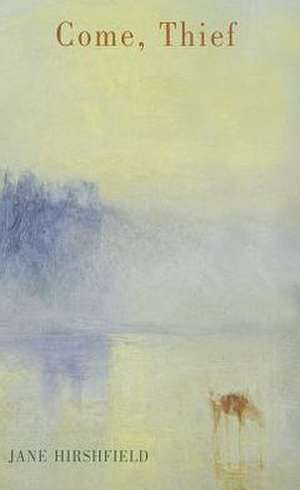
Come, Thief
Autor Jane Hirshfielden Limba Engleză Paperback – 29 mar 2012
Volumul de față se prezintă sub forma unei colecții de poezie esențiale, publicate de Bloodaxe Books, care explorează intersecția dintre frumusețe, temporalitate și acceptarea existenței. Notăm cu interes modul în care Jane Hirshfield reușește să transforme momentele cotidiene în reflecții metafizice, utilizând un limbaj precis care evită artificiile inutile. Putem afirma că structura poemelor din Come, Thief vibrează printr-o unitate între formă și expresie, abordând teme dificile precum singurătatea — pe care autoarea o clasifică între „singurătatea greșită care acrește sufletul” și „singurătatea corectă care îl unge”. Din perspectiva experienței de lectură, ritmul este unul contemplativ, invitând la o conștientizare „fără legătură la ochi” a destinului nostru politic și planetar comun. Merită menționat că această lucrare continuă explorarea fragilității umane începută în volume anterioare. Come, Thief poate fi considerat o alternativă la The Beauty pentru cei interesați de studiul poeziei contemporane americane, având avantajul unei focalizări mai intense pe ideea de „hoț” al timpului și pe modul în care acceptarea perisabilității aduce o formă neașteptată de fericire. Față de Given Sugar, Given Salt, unde mutabilitatea era celebrată ca splendoare centrală, volumul de față adoptă o postură mai intimă, aproape de confesiune, dar păstrează rigoarea intelectuală specifică autoarei. În contextul operei sale, dacă What Saves Us se concentra pe empatie și indignare socială, Come, Thief revine la o zonă de interioritate profundă, fără a ignora însă contextul global. Este o piesă de rezistență în bibliografia unei autoare recunoscute pentru capacitatea de a numi experiențe care, până acum, păreau să scape limbajului.
Preț: 66.41 lei
Preț vechi: 83.87 lei
-21%
Carte disponibilă
Livrare economică 12-19 noiembrie
Livrare express 28 octombrie-03 noiembrie pentru 33.68 lei
Specificații
ISBN-10: 1852249242
Pagini: 98
Dimensiuni: 140 x 216 x 6 mm
Greutate: 0.14 kg
Editura: Bloodaxe Books
V-ar putea interesa
-
 Stop All the ClocksW. H. AudenPreț: 70.25 lei
 -
 Wild Iris, TheLouise GluckPreț: 90.43 lei
 -
 The Bonfire PartySean O'BrienPreț: 91.81 lei
 -
 Queries on Death, the Infinite and Irrational NumbersJohn StammersPreț: 89.83 lei
 -
 MEMORYDorothea LaskyPreț: 98.51 lei
 -
 Being HumanLevi TafariPreț: 70.86 lei
 -
 Poetry Is Not a LuxuryAnonymous-20%Preț: 114.45 lei142.36 lei
 -
 An Interesting DetailKimberly Campanello-28%Preț: 55.54 lei77.42 lei
 -
 Will There Ever Be Another YouPatricia LockwoodPreț: 106.25 lei
 -
 The BeautyJane Hirshfield-20%Preț: 67.14 lei83.99 lei
 -
 LedgerJane Hirshfield-19%Preț: 74.96 lei92.84 lei
 -
 The AskingJane Hirshfield-16%Preț: 92.36 lei110.41 lei
 -
 Everything is PresentAnna WoodfordPreț: 75.95 lei
 -
 EssentialsDavid WhytePreț: 107.16 lei
 -
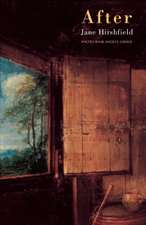 AfterJane Hirshfield-21%Preț: 66.36 lei83.53 lei
 -
 The Traveling Tree: The international bestseller from JapanMichio Hoshino-26%Preț: 90.12 lei122.20 lei
 -
 BycatchCaroline SmithPreț: 85.53 lei
 -
 Moon Base OneJemma L. KingPreț: 69.90 lei
 -
 Soon It Will Be SundayLang Leav-20%Preț: 85.27 lei106.30 leiRecomandat
 -
 Deep in My FeelsJennae Cecelia-19%Preț: 75.40 lei93.11 leiRecomandat
De ce să citești această carte
Această colecție se adresează cititorilor de poezie care caută claritate și profunzime în locul obscurității. Prin lectura acestui volum, câștigați o perspectivă rafinată asupra trecerii timpului și a modului în care pierderea poate fi integrată în experiența frumuseții. Este o recomandare concretă pentru cei care apreciază lirica ce îmbină observația naturalistă cu rigoarea filozofică, oferind un suport moral și estetic în navigarea propriei existențe.
Despre autor
Jane Hirshfield este o figură proeminentă a poeziei americane contemporane, autoare a numeroase volume de versuri și eseuri. Recunoașterea sa internațională este confirmată de nominalizările la premii prestigioase precum T. S. Eliot Prize și National Book Critics Circle Award. Opera sa, care include titluri precum After și The Asking, este frecvent publicată în publicații de renume ca The New Yorker și The Nation. Hirshfield este cunoscută pentru capacitatea de a sintetiza spiritul, inima și mintea în poeme care investighează ce înseamnă să fii om, fiind laureată a burselor Guggenheim și Rockefeller.
Descriere scurtă
Notă biografică
Extras
For a few days only,
the plum tree outside the window
shoulders perfection.
No matter the plums will be small,
eaten only by squirrels and jays.
I feast on the one thing, they on another,
the shoaling bees on a third.
What in this unpleated world isn’t someone’s seduction?
The boy playing his intricate horn in Mahler’s Fifth,
in the gaps between playing,
turns it and turns it, dismantles a section,
shakes from it the condensation
of human passage. He is perhaps twenty.
Later he takes his four bows, his face deepening red,
while a girl holds a viola’s spruce wood and maple
in one -half--opened hand and looks at him hard.
Let others clap.
These two, their ears still ringing, hear nothing.
Not the shouts of bravo, bravo,
not the timpanic clamor inside their bodies.
As the plum’s blossoms do not hear the bee
nor taste themselves turned into storable honey
by that sumptuous disturbance.
"First Light Edging Cirrus"
1025 molecules
are enough
to call wood thrush or apple.
A hummingbird, fewer.
A wristwatch: 1024.
An alphabet’s molecules,
tasting of honey, iron, and salt,
cannot be counted—
as some strings, untouched,
sound when a near one is speaking.
So it was when love slipped inside us.
It looked out face to face in every direction.
Then it was inside the tree, the rock, the cloud.
"The Decision"
There is a moment before a shape
hardens, a color sets.
Before the fixative or heat of kiln.
The letter might still be taken
from the mailbox.
The hand held back by the elbow,
the word kept between the larynx pulse
and the amplifying -drum--skin of the room’s air.
The thorax of an ant is not as narrow.
The green coat on old copper weighs more.
Yet something slips through it—
looks around,
sets out in the new direction, for other lands.
Not into exile, not into hope. Simply changed.
As a sandy -track--rut changes when called a Silk Road:
it cannot be after turned back from.
"Vinegar and Oil"
Wrong solitude vinegars the soul,
right solitude oils it.
How fragile we are, between the few good moments.
Coming and going unfinished,
puzzled by fate,
like the -half--carved relief
of a fallen donkey, above a church door in Finland.
"The Tongue Says Loneliness"
The tongue says loneliness, anger, grief,
but does not feel them.
As Monday cannot feel Tuesday,
nor Thursday
reach back to Wednesday
as a mother reaches out for her found child.
As this life is not a gate, but the horse plunging through it.
Not a bell,
but the sound of the bell in the -bell--shape,
lashing full strength with the first blow from inside the iron.