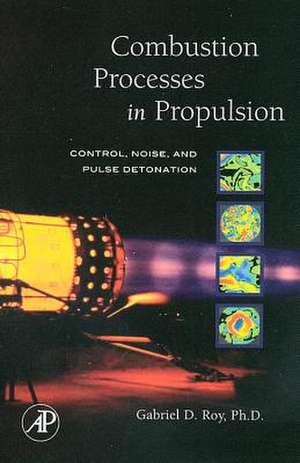
Combustion Processes in Propulsion
Autor Gabriel Royen Limba Engleză Paperback – 21 oct 2005
* Lead editor is one of the world's foremost combustion researchers, with contributions from some of the world's leading researchers in combustion engineering
* Covers all major areas of chemical propulsion-from combustion measurement, analysis and simulation, to advanced control of combustion processes, to noise and emission control
* Includes important information on advanced technologies for reducing jet engine noise and hazardous fuel combustion emissions
Preț: 795.65 lei
Preț vechi: 925.17 lei
-14%
Puncte Express: 1193
Carte indisponibilă temporar
Doresc să fiu notificat când acest titlu va fi disponibil:
Se trimite...
Specificații
Cuprins
Chapter 1: Simultaneous Velocity and Temperature Field Measurements of a Jet Flame; Chapter 2: Infrared Absorption Tomography for Active Combustion
Control; Chapter 3: Deterministic and Probabilistic Approaches for Prediction of Two-Phase Turbulent Flow in Liquid-Fuel Combustors; Chapter 4: Large-Scale Simulations of Turbulent Combustion and Propulsion Systems; Chapter 5: Direct Simulation of Primary Atomization; Chapter 6: Extinction and Relight in Opposed Premixed Flames; Chapter 7:
In uence of Markstein Number on the Parametric Acoustic Instability; Chapter 8: Prevaporized JP-10 Combustion and the Enhanced Production of Turbulence Using Countercurrent Shear; Chapter 9:
Mixing Control for Jet Flows; Chapter 10: Characteristics and Control of a Multiswirl Spray Combustor; Chapter 11: Swirling Jet Systems for Combustion Control; Chapter 12: Control of Flame Structure in Spray Combustion; Chapter 13: Porous Media Burners for Clean Engines; Chapter 14:
Simulations of a Porous Burner for a Gas Turbine; Chapter 15: Characteristics and Control of Combustion Instabilities in a Swirl-Stabilized Spray Combustor; Chapter 16: Combustion and Mixing Control Studies for Advanced Propulsion; Chapter 17:
Active Pattern Factor Control on an Advanced Combustor; Chapter 18: System Design Methods for Simultaneous Optimal Control of Combustion Instabilities and EÆciency; Chapter 19: Model-Based Optimal Active Control of Liquid-Fueled Combustion Systems;
SECTION TWO: HIGH-SPEED JET NOISE 211
Chapter 1: Aeroacoustics and Emissions Studies of Swirling Combustor Flows; Chapter 2: Considerations for the Measurement of Very-High-Amplitude Noise Fields; Chapter 3: High-Speed Jet Noise Reduction Using Microjets; Chapter 4: Acoustic Test Flight Results with Prediction for the F/A-18 E/F Aircraft During FCLP Mission; Chapter 5: Computational Fluid Dynamics Simulations of Supersonic Jet-Noise Reduction Concepts;
SECTION THREE: PULSE DETONATION ENGINES
Chapter 1: Investigation of Spray Detonation Characteristics Using a Controlled, Homogeneously Seeded Two-Phase Mixture; Chapter 2: Deagration-to-Detonation Studies for Multicycle PDE Applications
Chapter 3: Initiator Diraction Limits in a Pulse Detonation Engine; Chapter 4: The Role of Geometrical Factors in Deagration-to-Detonation Transition; Chapter 5: Pseudospark-Based Pulse Generator for Corona-Assisted Combustion Experiments; Chapter 6: Breakup of Droplets under Shock Impact; Chapter 7: Impulse Production by Injecting Fuel-Rich Combustion Products in Air; Chapter 8: Thermodynamic Evaluation of the Dual-Fuel PDE Concept; Chapter 9: Thermal Decomposition of JP-10 Studied by Microflow Tube Pyrolysis{Mass Spectrometry; Chapter 10: Laser Diagnostics and Combustion Chemistry for Pulse Detonation Engines; Chapter 11: Computational Studies of Pulse Detonation Engines; Chapter 12: Simulation of Direct Initiation of Detonation Using Realistic Finite-Rate Models; Chapter 13: System Performance and Thrust Chamber Optimization of Air-Breathing Pulse Detonation Engines; Chapter 14: Software Development for Automated Parametric Study
and Performance Optimization of Pulse Detonation Engines
Control; Chapter 3: Deterministic and Probabilistic Approaches for Prediction of Two-Phase Turbulent Flow in Liquid-Fuel Combustors; Chapter 4: Large-Scale Simulations of Turbulent Combustion and Propulsion Systems; Chapter 5: Direct Simulation of Primary Atomization; Chapter 6: Extinction and Relight in Opposed Premixed Flames; Chapter 7:
In uence of Markstein Number on the Parametric Acoustic Instability; Chapter 8: Prevaporized JP-10 Combustion and the Enhanced Production of Turbulence Using Countercurrent Shear; Chapter 9:
Mixing Control for Jet Flows; Chapter 10: Characteristics and Control of a Multiswirl Spray Combustor; Chapter 11: Swirling Jet Systems for Combustion Control; Chapter 12: Control of Flame Structure in Spray Combustion; Chapter 13: Porous Media Burners for Clean Engines; Chapter 14:
Simulations of a Porous Burner for a Gas Turbine; Chapter 15: Characteristics and Control of Combustion Instabilities in a Swirl-Stabilized Spray Combustor; Chapter 16: Combustion and Mixing Control Studies for Advanced Propulsion; Chapter 17:
Active Pattern Factor Control on an Advanced Combustor; Chapter 18: System Design Methods for Simultaneous Optimal Control of Combustion Instabilities and EÆciency; Chapter 19: Model-Based Optimal Active Control of Liquid-Fueled Combustion Systems;
SECTION TWO: HIGH-SPEED JET NOISE 211
Chapter 1: Aeroacoustics and Emissions Studies of Swirling Combustor Flows; Chapter 2: Considerations for the Measurement of Very-High-Amplitude Noise Fields; Chapter 3: High-Speed Jet Noise Reduction Using Microjets; Chapter 4: Acoustic Test Flight Results with Prediction for the F/A-18 E/F Aircraft During FCLP Mission; Chapter 5: Computational Fluid Dynamics Simulations of Supersonic Jet-Noise Reduction Concepts;
SECTION THREE: PULSE DETONATION ENGINES
Chapter 1: Investigation of Spray Detonation Characteristics Using a Controlled, Homogeneously Seeded Two-Phase Mixture; Chapter 2: Deagration-to-Detonation Studies for Multicycle PDE Applications
Chapter 3: Initiator Diraction Limits in a Pulse Detonation Engine; Chapter 4: The Role of Geometrical Factors in Deagration-to-Detonation Transition; Chapter 5: Pseudospark-Based Pulse Generator for Corona-Assisted Combustion Experiments; Chapter 6: Breakup of Droplets under Shock Impact; Chapter 7: Impulse Production by Injecting Fuel-Rich Combustion Products in Air; Chapter 8: Thermodynamic Evaluation of the Dual-Fuel PDE Concept; Chapter 9: Thermal Decomposition of JP-10 Studied by Microflow Tube Pyrolysis{Mass Spectrometry; Chapter 10: Laser Diagnostics and Combustion Chemistry for Pulse Detonation Engines; Chapter 11: Computational Studies of Pulse Detonation Engines; Chapter 12: Simulation of Direct Initiation of Detonation Using Realistic Finite-Rate Models; Chapter 13: System Performance and Thrust Chamber Optimization of Air-Breathing Pulse Detonation Engines; Chapter 14: Software Development for Automated Parametric Study
and Performance Optimization of Pulse Detonation Engines
Recenzii
“This collection represents the current state-of-the-art in combustion research for air-breathing chemical propulsion. Nearly an equal mix of computational and experimental results are presented from the major players in Pulse Detonation Engines research, providing the reader with a thorough overview of the contemporary technical issues remaining to be resolved in this promising hypersonic air-breathing propulsion technology. —W.L. Roberts and T. D. Scharton, Department of Mechanical & Aerospace Engineering, North Carolina State University, NC, USA