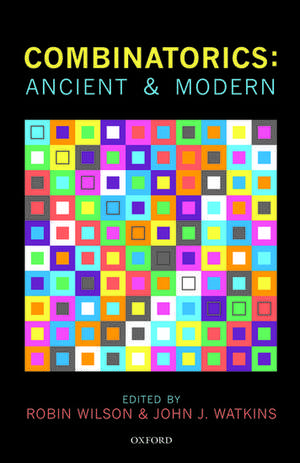
Combinatorics: Ancient & Modern
Editat de Robin Wilson, John J. Watkins Autor Ronald Grahamen Limba Engleză Hardback – 27 iun 2013
Preț: 813.52 lei
Preț vechi: 1056.52 lei
-23%
Puncte Express: 1220
Carte tipărită la comandă
Livrare economică 30 noiembrie-14 decembrie
Livrare prin curier în România Termenul estimat este afișat lângă disponibilitate.
Transport gratuit pentru acest produs Plată online sau ramburs, în funcție de opțiunile comenzii.
Retur gratuit în 14 zile Comandă securizată și suport în română.
Specificații
ISBN-13: 9780199656592
ISBN-10: 0199656592
Pagini: 392
Ilustrații: 130 b/w line drawings, 20 b/w halftones
Dimensiuni: 174 x 240 x 28 mm
Greutate: 0.75 kg
Editura: OUP OXFORD
Colecția OUP Oxford
Locul publicării:Oxford, United Kingdom
ISBN-10: 0199656592
Pagini: 392
Ilustrații: 130 b/w line drawings, 20 b/w halftones
Dimensiuni: 174 x 240 x 28 mm
Greutate: 0.75 kg
Editura: OUP OXFORD
Colecția OUP Oxford
Locul publicării:Oxford, United Kingdom
V-ar putea interesa
-
 Graphs, Colourings and the Four-Colour TheoremRobert A. Wilson-28%Preț: 511.75 lei715.08 lei
 -
 Invitation to Fixed-Parameter AlgorithmsRolf Niedermeier-33%Preț: 979.66 lei1457.01 lei
 -
 Invitation to Discrete MathematicsJi^D%rí Matoušek-33%Preț: 1252.56 lei1862.19 lei
 -
 Combinatorics: Ancient & ModernRobin Wilson-11%Preț: 363.87 lei408.06 lei
 -
 Symmetric Functions and Hall PolynomialsI. G. Macdonald-21%Preț: 411.75 lei519.22 lei
 -
 Graph Theory As I Have Known ItW. T. Tutte-12%Preț: 364.02 lei414.26 lei
 -
 Preț: 387.99 lei
 -
 The Art of the ConductorJohn J. WatkinsPreț: 61.80 lei
 -
 Topics in Commutative Ring TheoryJohn J. Watkins-19%Preț: 681.04 lei840.79 lei
 -
 Surveys in Combinatorics 2017Anders Claesson-14%Preț: 709.06 lei824.49 lei
 -
 -18%Preț: 921.46 lei1123.73 lei
 -
 Atlas of Breast CancerR. W. BlameyPreț: 222.06 lei
 -
 Möbius und sein BandJohn FauvelPreț: 470.01 lei
 -
 Introduction to the Analysis of Algorithms, an (2nd Edition)Michael SoltysPreț: 455.77 lei
 -
 WALK THROUGH COMBINATORICS (3ED)Bona MiklosPreț: 427.97 lei
 -
 CRYSTAL BASESBump DanielPreț: 416.42 lei
Notă biografică
Robin Wilson is an Emeritus Professor of Pure Mathematics at the Open University, Emeritus Professor of Geometry at Gresham College, London, and a former Fellow of Keble College, Oxford. He is currently President of the British Society for the History of Mathematics. He has written and edited many books on graph theory, including Introduction to Graph Theory and Four Colours Suffice, and on the history of mathematics, including Lewis Carroll in Numberland. He is involved with the popularization and communication of mathematics and its history, and was awarded a Pólya prize by the Mathematical Association of America for 'outstanding expository writing'.John J. Watkins is an Emeritus Professor of Mathematics at Colorado College, USA. He received his doctorate from the University of Kansas, specializing in commutative ring theory. His main research interest, however, has been in graph theory and he has published mainly in this area, including many papers with undergraduates as co-authors. He has written several books, including Graphs: An Introductory Approach, Across the Board: The Mathematics of Chessboard Problems, and Topics in Commutative Ring Theory, and has recently finished his latest book, Elementary Number Theory. Colorado College presented John Watkins with the 2005 Boettcher Award for Faculty Excellence.