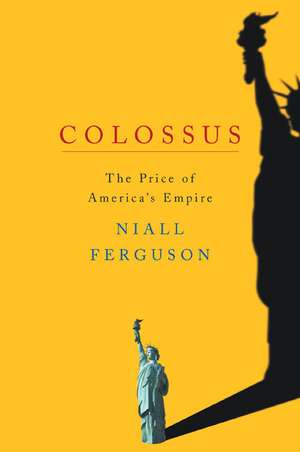
Colossus: The Price of America's Empire
Autor Niall Fergusonen Limba Engleză Hardback – 30 apr 2004 – vârsta de la 18 ani
În lucrarea Colossus, Niall Ferguson propune o analiză riguroasă a statutului geopolitic al Statelor Unite, structurată metodologic pe două coordonate esențiale: ascensiunea și potențiala decădere a ceea ce autorul numește un „imperiu în negare”. Observăm cum materialul este organizat într-o progresie logică, de la definirea limitelor puterii americane în prima parte, până la explorarea vulnerabilităților sistemice care ar putea duce la un colaps intern în cea de-a doua parte. Ferguson nu se limitează la o descriere a puterii militare, ci investighează mecanismele economice și instituționale care susțin această hiperputere.
Ne-a atras atenția în mod deosebit conceptul de „imperiu cu deficit de atenție”, prin care autorul explică de ce SUA eșuează adesea în angajamentele pe termen lung necesare reconstrucției statelor eșuate. Această abordare continuă linia începută în Empire, unde istoricul analiza ascensiunea Marii Britanii, însă în Colossus accentul se mută pe paradoxul unei națiuni care exercită o influență imperială globală în timp ce își respinge vehement propria identitate imperialistă.
Acoperă aceeași arie tematică precum The Fall of the US Empire de Vassilis K. Fouskas, dar cu o abordare mult mai axată pe continuitatea istorică și pe necesitatea unui „imperiu liberal” funcțional, spre deosebire de analizele pur critice sau marxiste. În timp ce alte lucrări din bibliografia sa, precum The Ascent of Money, se concentrează pe finanțe, aici Ferguson integrează datele economice (prezentate detaliat și în apendicele statistic) într-un cadru politic și militar, oferind o perspectivă interdisciplinară asupra modului în care „picioarele de lut” ale colosului american — datoria publică și myopia politică — pot submina stabilitatea globală.
Preț: 166.31 lei
Carte indisponibilă temporar
Specificații
ISBN-10: 1594200130
Pagini: 384
Dimensiuni: 164 x 243 x 31 mm
Greutate: 0.65 kg
Editura: Penguin Books
V-ar putea interesa
-
 The War of the WorldNiall Ferguson-21%Preț: 115.71 lei146.39 lei
 -
 High FinancierNiall Ferguson-19%Preț: 128.09 lei157.94 lei
 -
 The Great DegenerationNiall Ferguson-20%Preț: 61.36 lei76.86 lei
 -
 EmpireNiall Ferguson-28%Preț: 78.01 lei108.56 lei
 -
 CivilizationNiall Ferguson-28%Preț: 78.01 lei108.56 lei
 -
 The Ascent of MoneyNiall Ferguson-27%Preț: 90.17 lei123.22 lei
 -
 Why Empires FallJohn Rapley-32%Preț: 63.14 lei92.27 lei
 -
 Empire: A Very Short IntroductionStephen Howe-20%Preț: 57.26 lei71.18 lei
 -
 The Retreat of Western LiberalismEdward Luce-27%Preț: 68.12 lei93.00 lei
 -
 Dead AidDambisa MoyoPreț: 102.95 lei
 -
 CetagandaLois Mcmaster BujoldPreț: 46.75 lei
 -
 Shame: The Exposed SelfMichael LewisPreț: 127.96 lei
 -
 Escape from RomeWalter ScheidelPreț: 146.69 lei
 -
 Preț: 87.89 lei
 -
 Inside the House of MoneySteven DrobnyPreț: 122.71 lei
 -
 -25%Preț: 102.32 lei136.57 lei
 -
 -45%Preț: 123.81 lei225.06 lei
 -
 Guilt, Shame, and AnxietyPeter R. BregginPreț: 116.88 lei
 -
 The Decline of NationsJoseph F JohnstonPreț: 185.28 lei
 -
 History Has BegunBruno Macaes-17%Preț: 88.60 lei106.14 lei
 -
 First-Class Passengers on a Sinking ShipRichard LachmannPreț: 152.27 lei
De ce să citești această carte
Recomandăm această carte cititorilor interesați de geopolitică și istorie modernă care doresc să înțeleagă de ce intervențiile externe ale SUA produc rezultate mixte. Niall Ferguson oferă o perspectivă provocatoare despre responsabilitățile unei superputeri, argumentând că refuzul Americii de a-și asuma rolul imperial este chiar sursa instabilității sale. Este o lectură esențială pentru a descifra dinamica dintre economie, armată și politică externă.
Despre autor
Niall Ferguson este un istoric scoțian de renume mondial, specializat în istorie economică și internațională, fiind în prezent cercetător senior la Hoover Institution, Universitatea Stanford. Recunoscut pentru analizele sale asupra imperialismului britanic și american, Ferguson a predat la universități de elită precum Harvard și Oxford. Opera sa vastă include titluri de referință precum The Ascent of Money, adaptat într-un documentar premiat cu Emmy, și biografii monumentale precum Kissinger. În 2004, a fost inclus de revista Time în lista celor mai influente 100 de persoane din lume.
Descriere scurtă
Nonsense, says Niall Ferguson. In Colossus he argues that in both military and economic terms America is nothing less than the most powerful empire the world has ever seen. Just like the British Empire a century ago, the United States aspires to globalize free markets, the rule of law, and representative government. In theory it’s a good project, says Ferguson. Yet Americans shy away from the long-term commitments of manpower and money that are indispensable if rogue regimes and failed states really are to be changed for the better. Ours, he argues, is an empire with an attention deficit disorder, imposing ever more unrealistic timescales on its overseas interventions. Worse, it’s an empire in denial—a hyperpower that simply refuses to admit the scale of its global responsibilities. And the negative consequences will be felt at home as well as abroad. In an alarmingly persuasive final chapter Ferguson warns that this chronic myopia also applies to our domestic responsibilities. When overstretch comes, he warns, it will come from within—and it will reveal that more than just the feet of the American colossus is made of clay.
Cuprins
Part I—Rise
1. The Limits of the American Empire
2. The Imperialism of Anti-Imperialism
3. The Civilization of Clashes
4. Splendid Multilateralism
Part II—Fall?
5. The Case for Liberal Empire
6. Going Home or Organizing Hypocrisy
7. "Impire": Europe Between Brussels and Byzantium
8. The Closing Door
Conclusion: Looking Homeward
Statistical Appendix
Acknowledgments
Notes
Bibliography
Index
Notă biografică
Extras
There is certainly no question that the United States has the military capability to take on the old British role as underwriter of a globalized, liberalized economic system. Before the deployment of troops for the invasion of Iraq, the U.S. military had around 752 military installations located in more than 130 countries, accommodating 247,000 American service personnel deployed abroad. On land, the United States has 9,000 M1 Abrams tanks. The rest of the world has nothing that can compete. At sea, the United States possesses 9 “supercarrier” battle groups. The rest of the world has none. And in the air, the United States has 3 different kinds of undetectable stealth aircraft. The rest of the world has none. The United States is also miles ahead in the production of “smart” missiles and pilotless high-altitude drones. Pentagon insiders call it “full spectrum dominance.”
Nor is there any doubt that the United States has the economic resource to maintain FSD. America’s 31 percent share of the world product is equal to the shares of the next four countries combined (Japan, Germany, Britain and France). So rapidly has its economy grown since the late 1980s that it has been able to achieve a unique “revolution in military affairs” while vastly reducing the share of defense expenditures as a proportion of the gross domestic product. According to the Congressional Budget Office, defense spending in 2003 is likely to amount to 3.6 percent of the GDP—substantially below its cold war average. In the space of less than five years, three of the world’s tyrannies—Milosevic’s in Serbia, the Taliban’s in Afghanistan and Saddam Hussein’s in Iraq—have been swept from power at negligible cost. If this combination of military and economic dominance is not imperial power, then it is hard to know what is.
Yet the idea that the United States is now an authentic empire remains entirely foreign to the majority of Americans, who uncritically accept what has long been the official line: that the United States just doesn’t “do” empire. In the words of George W. Bush during the 2000 election campaign: “America has never been an empire. We may be the only great power in history that had the chance, and refused, preferring greatness to power, and justice to glory.” Since becoming president, Bush has in fact initiated two invasions of sovereign states, successfully overthrowing their governments in both cases. The Office of the President has produced a document on “National Security Strategy” that states as a goal of U.S. policy “to extend the benefits of freedom…;to every corner of the world.” But Bush himself has continued to deny that the United States has any imperial intentions. Speaking on board the homeward-bound Abraham Lincoln aircraft carrier on May 1, President Bush declared: “Other nations in history have fought in foreign lands and remained to occupy and exploit. Americans, following a battle, want nothing more than to return home.” A few days previously, Donald Rumsfeld was asked by a journalist from Al-Jazeera if the United States was engaged in “empire building in Iraq.” “We don’t seek empires,” shot back Rumsfeld. “We’re not imperialistic. We never have been.” Few Americans would disagree with that sentiment.
The Victorian historian J. R. Seeley famously joked that the British had “conquered and peopled half the world in a fit of absence of mind.” But the Americans have gone one better. The greatest empire of modern times has come into existence without the great majority of the American people even noticing. This is not a fit of absence of mind. This is mass myopia.
It is not hard to explain such attitudes given the anti-imperial origins of the United States. However, just because you were once a colony doesn’t mean you can’t ever become an empire. England was once a Roman colony, after all. Americans also like to point out that they don’t formally rule over that much foreign territory: the formal dependencies of the United States (like Puerto Rico) amount to just over ten thousand square kilometers. But nowadays, thanks to air power, it is possible to control vastly more territory than that with a network of strategically situated military bases. And as for the claim that when Americans invade countries they come not to subjugate but to emancipate, the British said exactly the same when they occupied Baghdad in 1917. “Our armies do not come into your cities and lands as conquerors, or enemies, but as liberators.” Those were the precise words of General F. S. Maude’s proclamation to the people of Mesopotamia, dated March 19, 1917.
Unfortunately, the American refusal to recognize the reality of their own imperial role in the world is one of the things that make their empire very different from—and significantly less effective than—the last great English-speaking empire. For a start, Americans feel no qualms about sending their servicepeople to fight wars in faraway countries, but they expect those wars to be short and the casualty list to be even shorter.
Moreover, compared with the British Empire, the United States is much less good at sending its businesspeople, its civilian administrators and its money to those same faraway countries once the fighting is over. In short, America may be a “hyperpower”—the most militarily powerful empire in all history—but it is an empire in denial, a colossus with an attention deficit disorder. And that is potentially very dangerous.
Descriere
Recenzii
One of the timeliest and most topical books to have appeared in recent years
Yet another tour de force from a writer who displays all his usual gifts of forceful polemic, unconventional intelligence and elegant prose ... guaranteed to spark fierce debate
A bravura exploration of why Americans are not cut out to be imperialists but nonetheless have an empire. Vigorous, substantive, and worrying