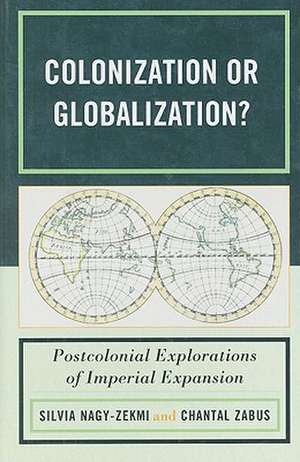
Colonization or Globalization?: Postcolonial Explorations of Imperial Expansion
Editat de Silvia Nagy-Zekmi, Chantal Zabus Contribuţii de Aishwarya Lakhsmi, Deepa Jani, Fadwa Mahmoud Hassan Gad, Gabrielle Naglieri, Geetha Ganapathy-Doré, Gilbert Adair, Hande Tekdemir, Kathleen Flanagan, Paul Ugor, Robert Marzec, Sukanya Gupta, Vladimir Suchan, Will Harrisen Limba Engleză Hardback – 3 dec 2009
Preț: 600.98 lei
Preț vechi: 910.66 lei
-34%
Puncte Express: 901
Carte tipărită la comandă
Livrare economică 19 noiembrie-03 decembrie
Livrare prin curier în România Termenul estimat este afișat lângă disponibilitate.
Transport gratuit pentru acest produs Plată online sau ramburs, în funcție de opțiunile comenzii.
Retur gratuit în 14 zile Comandă securizată și suport în română.
Specificații
ISBN-13: 9780739131763
ISBN-10: 0739131761
Pagini: 172
Dimensiuni: 154 x 236 x 18 mm
Greutate: 0.39 kg
Editura: Bloomsbury Publishing
Colecția Lexington Books
Locul publicării:New York, United States
ISBN-10: 0739131761
Pagini: 172
Dimensiuni: 154 x 236 x 18 mm
Greutate: 0.39 kg
Editura: Bloomsbury Publishing
Colecția Lexington Books
Locul publicării:New York, United States
Cuprins
Chapter 1 The Language of Imperial Expansion Pg. vii
Part 2 I. Neo-Imperial Traces or Premonitions in Modernity
Chapter 3 Empire, the Question of Representation and the Erasure of Inhabitancy
Chapter 4 Contemporary Hollywood and the Persistence of the Empire: Nostalgia and Post-Imperial Voyeurism in Hallmark's King Solomon's Mines
Chapter 5 British Nostalgia for the Ottoman Past: The Legible Multiethnicity of Old Istanbul in the Works of Barbara Nadel and Jason Goodwin
Chapter 6 Utopian Fiction and Imperial Homogeneity: The Case of William Morris's News from Nowhere and Yussuf Sybaai's The Land of Hypocrisy
Part 7 II. Interference of the Imperial Tradition in Asia
Chapter 8 Colonizing the Mind: Education and Literacy in Colonial India
Chapter 9 Re-presenting the Empire: the Picturesque Aesthetic in 69Satyajit Ray's The Chess Players
Chapter 10 Deconstructing the Instant-Mix Imperial Democracy: Arundhati Roy's Political Essays
Chapter 11 Nuclear Imperialism: The United States and Micronesia
Part 12 III. Reformulations of the Imperial Project
Chapter 13 The Nemesis of Empire as Mimesis
Chapter 14 Empire, Allegorical Imperative, and Games of Truth: J. M. Coetzee's Waiting for the Barbarians
Chapter 15 "Child-Emporererer (Vacncy)": Apprehending U.S. Empire through Robert Fitterman's Metropolis
Chapter 16 The "Armageddon Election" and the Antichrist Debates
Chapter 17 Imperialism is on the March: Market Tyranny and the Fight Beyond Revolution
Part 2 I. Neo-Imperial Traces or Premonitions in Modernity
Chapter 3 Empire, the Question of Representation and the Erasure of Inhabitancy
Chapter 4 Contemporary Hollywood and the Persistence of the Empire: Nostalgia and Post-Imperial Voyeurism in Hallmark's King Solomon's Mines
Chapter 5 British Nostalgia for the Ottoman Past: The Legible Multiethnicity of Old Istanbul in the Works of Barbara Nadel and Jason Goodwin
Chapter 6 Utopian Fiction and Imperial Homogeneity: The Case of William Morris's News from Nowhere and Yussuf Sybaai's The Land of Hypocrisy
Part 7 II. Interference of the Imperial Tradition in Asia
Chapter 8 Colonizing the Mind: Education and Literacy in Colonial India
Chapter 9 Re-presenting the Empire: the Picturesque Aesthetic in 69Satyajit Ray's The Chess Players
Chapter 10 Deconstructing the Instant-Mix Imperial Democracy: Arundhati Roy's Political Essays
Chapter 11 Nuclear Imperialism: The United States and Micronesia
Part 12 III. Reformulations of the Imperial Project
Chapter 13 The Nemesis of Empire as Mimesis
Chapter 14 Empire, Allegorical Imperative, and Games of Truth: J. M. Coetzee's Waiting for the Barbarians
Chapter 15 "Child-Emporererer (Vacncy)": Apprehending U.S. Empire through Robert Fitterman's Metropolis
Chapter 16 The "Armageddon Election" and the Antichrist Debates
Chapter 17 Imperialism is on the March: Market Tyranny and the Fight Beyond Revolution
Recenzii
Covering a wide range of texts-from contemporary British detective fiction to Hollywood's King Solomon's Mines-the essays in this collection deploy a variety of postcolonial approaches to examine and argue for a continuum between colonialism and globalization. This is a timely, refreshing volume, which will be of keen interest to scholars of contemporary literature and culture.
This is an excellent and timely intervention into the dialogue between postcolonialism and globalization studies, emphasizing as it does the utility and adaptability of postcolonial concepts to a rapidly changing world. The collection demonstrates with admirable clarity the ways in which the imperial enterprise has developed globally and shows how valuable postcolonial analyses have become.
This is an excellent and timely intervention into the dialogue between postcolonialism and globalization studies, emphasizing as it does the utility and adaptability of postcolonial concepts to a rapidly changing world. The collection demonstrates with admirable clarity the ways in which the imperial enterprise has developed globally and shows how valuable postcolonial analyses have become.