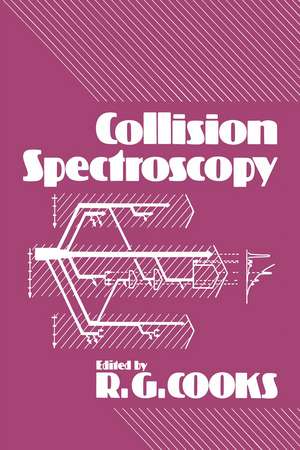
Collision Spectroscopy
Editat de R. Cooksen Limba Engleză Paperback – 21 dec 2011
Preț: 385.73 lei
Puncte Express: 579
Carte tipărită la comandă
Livrare economică 24 noiembrie-08 decembrie
Livrare prin curier în România Termenul estimat este afișat lângă disponibilitate.
Transport gratuit de la 400.00 lei Plată online sau ramburs, în funcție de opțiunile comenzii.
Retur gratuit în 14 zile Comandă securizată și suport în română.
Specificații
ISBN-13: 9781461339571
ISBN-10: 146133957X
Pagini: 476
Ilustrații: XIV, 458 p.
Dimensiuni: 152 x 229 x 26 mm
Greutate: 0.68 kg
Ediția:Softcover reprint of the original 1st ed. 1978
Editura: Springer
Locul publicării:New York, NY, United States
ISBN-10: 146133957X
Pagini: 476
Ilustrații: XIV, 458 p.
Dimensiuni: 152 x 229 x 26 mm
Greutate: 0.68 kg
Ediția:Softcover reprint of the original 1st ed. 1978
Editura: Springer
Locul publicării:New York, NY, United States
V-ar putea interesa
-
 AQA A Level Chemistry Year 1 & AS Paper 1Andrew MaczekPreț: 91.51 lei
 -
 Isotopes: A Very Short IntroductionRob Ellam-20%Preț: 56.82 lei70.93 lei
 -
 -9%Preț: 398.91 lei440.08 lei
 -
 Essentials of Computational Chemistry - Theoriesand Models 2eChristopher J. Cramer-19%Preț: 402.83 lei497.32 lei
 -
 Nonlinear Solid MechanicsGerhard A. Holzapfel-19%Preț: 451.24 lei557.09 lei
 -
 -22%Preț: 572.06 lei734.95 lei
 -
 Domino Intramolecular RearrangWitczak-9%Preț: 1102.01 lei1211.00 lei
 -
 -8%Preț: 557.51 lei605.99 lei
 -
 Sulfur-Centered Reactive Intermediates in Chemistry and BiologyC. ChatgilialogluPreț: 389.30 lei
 -
 Thermodynamics of Surfaces and Capillary SystemsMichel Soustelle-9%Preț: 985.64 lei1083.12 lei
Public țintă
ResearchCuprins
1. The Subject.- 2. Metastable Ions.- 3. Types of Collisions.- 4. Collision Cross Sections.- 5. Energy Interconversions.- 6. Energy Resolution and Angular Resolution.- 7. Laboratory and Center-of-Mass Coordinate Systems.- 8. Guideposts to the Contents.- References.- 1 Collisional Excitation of Simple Systems.- 1. Introduction.- 2. Determination of Excitation Cross Sections from Ion Energy- Loss Spectrometry.- 3. Determination of Excitation Cross Sections from Photon Emission Data.- 4. The Excitation of Atomic Hydrogen.- 5. Excitation of Helium.- 6. Differential Cross-Section Measurements.- 7. Excitation of Simple Molecules.- 8. Discussion.- References.- 2 Charge Transfer in Atomic Systems.- 1. Introduction.- 2. Theory.- 3. Experimental Methods.- 4. Experimental Data and Interpretation.- 5. Summary.- References.- 3 Inelastic Energy Loss: Newer Experimental Techniques and Molecular Orbital Theory.- 1. Introduction.- 2. The Molecular Orbital Model.- 3. Experimental Techniques and Results.- 4. Summary and Conclusion.- References.- 4 Double Electron Transfer and Related Reactions.- 1. Introduction.- 2. Cross Sections.- 3. Experimental Techniques of Double-Charge-Transfer Spectroscopy.- 4. (H+, M) Spectra and the Study of the States of the Target Species.- 5. (A+, Ar) Spectra: An Insight into Future Possible Developments.- Appendix: Energy Loss of the Projectile in an Inelastic Collision.- References.- 5 Ionic Collisions as the Basis for New Types of Mass Spectra.- 1. Introduction.- 2. 2E Mass Spectra.- 3. -E Mass Spectra.- 4. E/2 Mass Spectra.- 5. +E Mass Spectra.- 6. Other Types of Spectra.- References.- 6 Collision-Induced Dissociation of Diatomic Ions.- 1. Introduction.- 2. Dynamics of Dissociation.- 3. Experimental Techniques.- 4. Direct Dissociation in Heavy-Particle Collisions.- 5. Translational Spectroscopy.- 6. Concluding Remarks.- References.- 7 Collision-Induced Dissociation of Polyatomic Ions.- 1. Introduction.- 2. The Reaction.- 3. Experimental Procedures.- 4. Applications.- 5. Related Reactions.- 6. Prospects.- References.