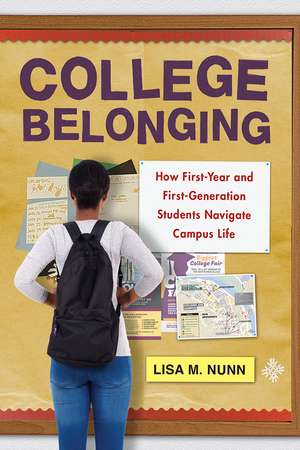
College Belonging: How First-Year and First-Generation Students Navigate Campus Life: Critical Issues in American Education
Autor Lisa M. Nunnen Limba Engleză Paperback – 12 feb 2021 – vârsta ani
Colleges bombard new students with the message to “get out there!” and “find your place” by joining student organizations, sports teams, clubs and the like. Nunn shows that this reflects a flawed understanding of what belonging is and how it works. Drawing on the sociological theories of Emile Durkheim, College Belonging shows that belonging is something that members of a community offer to each other. It is something that must be given, like a gift. Individuals cannot simply walk up to a group or community and demand belonging. That’s not how it works. The group must extend a sense of belonging to each and every member. It happens by making a person feel welcome, to feel that their presence matters to the group, that they would be missed if they were gone. This critical insight helps us understand why colleges' push for students simply to “get out there!” does not always work.


Preț: 253.38 lei
Puncte Express: 380
Carte disponibilă
Livrare economică 10-24 noiembrie
Livrare prin curier în România Termenul estimat este afișat lângă disponibilitate.
Transport gratuit de la 400.00 lei Plată online sau ramburs, în funcție de opțiunile comenzii.
Retur gratuit în 14 zile Comandă securizată și suport în română.
Specificații
ISBN-13: 9781978807655
ISBN-10: 1978807651
Pagini: 222
Dimensiuni: 152 x 229 x 15 mm
Greutate: 0 kg
Editura: Rutgers University Press
Colecția Rutgers University Press
Seria Critical Issues in American Education
ISBN-10: 1978807651
Pagini: 222
Dimensiuni: 152 x 229 x 15 mm
Greutate: 0 kg
Editura: Rutgers University Press
Colecția Rutgers University Press
Seria Critical Issues in American Education
Notă biografică
LISA M. NUNN is a professor of sociology and the director of the Center for Educational Excellence at University of San Diego. She is the author of Defining Student Success: The Role of School and Culture and 33 Simple Strategies for Faculty: A Week-by-Week Resource for Teaching First-Year and First-Generation Students (both Rutgers University Press).
Cuprins
Contents
Acknowledgements
Introduction
1 Social Belonging vs. Campus-Community Belonging
2 Campus Community Belonging and Organizational Structures
3 Academic Competence and Academic Belonging
4 The Academic Community and Academic Belonging
5 Ethnoracial Diversity and Belonging
6 “Nice” Diversity
7 Recommendations for Campuses
Theoretical Appendix: Durkheim and Belonging
Methodological Appendix
Notes
References
Index
Acknowledgements
Introduction
1 Social Belonging vs. Campus-Community Belonging
2 Campus Community Belonging and Organizational Structures
3 Academic Competence and Academic Belonging
4 The Academic Community and Academic Belonging
5 Ethnoracial Diversity and Belonging
6 “Nice” Diversity
7 Recommendations for Campuses
Theoretical Appendix: Durkheim and Belonging
Methodological Appendix
Notes
References
Index
Recenzii
"Administrators have long persisted with a problematic notion of inclusion that puts the responsibility on individual students, without thought to what belonging looks and feels like. In this fabulous book, Nunn skillfully argues that institutional context shapes the most salient forms of belonging. Nobody has tackled the issue of belonging quite in this way, and the intervention is so needed."
"College Belonging presents a fascinating account of students’ experiences, informed by in-depth interviews, and offers a level of complexity rarely encountered. Nunn compellingly argues that those who care about equity must care about belonging. Her findings show why common practices in higher education are insufficient and what colleges can do to meet the belonging needs of their students."
"An important update to sense of belonging literature because of its claims regarding campus-community belonging and how belonging cannot be earned by an individual but rather must be received from a community."
Descriere
College Belonging reveals how colleges’ and universities’ efforts to foster a sense of belonging in their students are misguided. Colleges bombard new students with the message to “get out there!” and “find your place” by joining student organizations, sports teams, clubs and the like. Nunn shows that this reflects a flawed understanding of what belonging is and how it works.