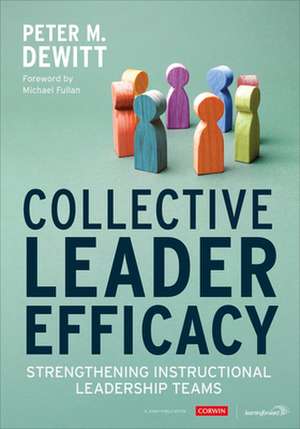
Collective Leader Efficacy
Autor Peter M. DeWitten Limba Engleză Paperback – 3 mar 2022
For school teams to succeed, they need leadership, independence, meaningful collaboration, and a shared conviction that they have real power to enact actual change. Educators know this, but they often lack an inquiry process that creates a community of learning leaders that is capable of deep collective impact on student learning and wellbeing.
In this research-based, hands-on guidebook, school leadership coach Peter DeWitt introduces eight key drivers to integrating teacher and leader efficacy (mindset, well-being, context beliefs, working conditions, professional learning, organizational commitment, skills, and confidence) and harnesses it with a process to help you focus on the nuances of instruction and teaming to develop powerful collective leader efficacy.
Readers will find:
- Activities and strategies designed to build collective efficacy in instructional teams and foster leadership and interdependence among teachers
- Theories of action to focus team efforts and how to create your own
- Tools, reflection prompts, and guiding questions to help you define your desired outcomes and the steps necessary to get there
Preț: 290.59 lei
Puncte Express: 436
Carte disponibilă
Livrare economică 29 octombrie-12 noiembrie
Livrare express 14-20 octombrie pentru 44.84 lei
Livrare prin curier în România Termenul estimat este afișat lângă disponibilitate.
Transport gratuit de la 400.00 lei Plată online sau ramburs, în funcție de opțiunile comenzii.
Retur gratuit în 14 zile Comandă securizată și suport în română.
Specificații
ISBN-13: 9781071813720
ISBN-10: 1071813722
Pagini: 312
Dimensiuni: 254 x 178 x 23 mm
Greutate: 0.65 kg
Ediția:1
Editura: Sage Publications, Inc
Locul publicării:Thousand Oaks, United States
ISBN-10: 1071813722
Pagini: 312
Dimensiuni: 254 x 178 x 23 mm
Greutate: 0.65 kg
Ediția:1
Editura: Sage Publications, Inc
Locul publicării:Thousand Oaks, United States
Recenzii
In this excellent book, Peter DeWitt demonstrates how instructional leadership teams can have a greater impact on student learning. Offering a balance between research and practice, DeWitt shows, for example, how the mindsets both of individuals and of their teams can help them meet challenges and achieve that impact. As an experienced teacher, principal, worldwide consultant, and writer, DeWitt speaks with authority and wisdom.
Collective efficacy has a powerful impact on leaders, teachers, and students, but it is hard to implement. DeWitt teases out the key skillsets and mindsets needed: understanding one another, collaborating, and evaluating impact. He addresses the critics and shows more than a correlation of successful students and teachers; DeWitt proves that actively implementing a culture of collective efficacy leads to higher levels of satisfaction, greater impact on students, and successful implementation across the school. This is not only a “how to” book, but also is grounded firmly in evidence, and a pleasure to read.
Insightful and practical—this book is a must read for formal and informal school leaders as well as leadership teams who aspire to improve outcomes for all students. DeWitt combines research and field experience in order to demonstrate specific ways to strengthen commitment, collaboration, and confidence among members of leadership teams in schools. This book is timely, relevant, and an important contribution to the literature on collective efficacy.
Instructional leadership teams play a vital role in supporting learning in schools. They are especially important during this time of rapidly changing expectations. In this book, Peter DeWitt applies the theory of collective efficacy to these instructional leadership teams, outlining eight important contributors. Including student councils as part of a school’s leadership is a fresh new approach.
This book will challenge leaders and make a difference for children. It offers a pragmatic, research-based approach to building the collective
efficacy of leaders in all roles in a school with intention and commitment to relationship building, collaboration, data collection, and action research toward measurable outcomes.
The pandemic pivot highlighted the need for collective leader efficacy as foundational and essential in responding to the changing parameters and dynamics of our new reality in education. It will likely never look the same and this is the right focus at the perfect
time.
The skills are built toward the development of a theory of action model logically and on the shoulders of great practitioners and
scholars. The learning, digesting, and applying to practice model is transformative.
The contributors to CLE are clear and built on the foundation of mindset and well-being. In that environment, the other contributors are enhanced.
Collective leader efficacy is a new concept that Peter proposes to consider how leadership teams can work together to make a difference in the lives of students. While there are many books on the nature and change of school leadership, this book makes a difference with its practitioner-oriented approach. Not only does it propose a new concept that extends our thinking on leadership towards its collective impact, but it sets out the individual dimensions that shape this practice in a very practical way. For each dimension that contributes to collective leader efficacy, it lays out the theory of change, provides bibliographical resources, guiding questions and activities that educational leaders can use to reflect on how to improve their practice. A very practical resource for educational leaders internationally which is valuable in the current times of uncertainty and change
DeWitt straddles the ground between collective efficacy, instructional leadership, and distributed leadership. The book is packed to the rafters with practical exercises, tools, and protocols that will help you to get (meaningfully) busy at enhancing the learning lives and well-being of children. You will not be handed silver bullets or magic beans, but you will find much to support deep impact.
We have known for quite some time that collective teacher efficacy is a powerful influence on student learning. Before we can expect teachers to focus on building their capability though, we first need school leaders and leadership teams that believe that: 1) this is possible; 2) it is their responsibility to nurture, and; 3) have the skills and capabilities to do so. Put simply we need Collective Leader Efficacy! In this book, Peter DeWitt draws upon research and personal practice to create a compelling narrative in support of deliberately and intentionally building collective leader efficacy (CLE). This is a book I will be both referring to and recommending to colleagues well into the future.
As a researcher, academic and experienced school leader, DeWitt offers a refreshing approach and insight into leadership in schools. The structure of the chapters takes you on the journey of learning, experience and always draws it back to key questions/reflections and actionable steps.
DeWitt presents models in clear language to meet all busy school leaders. He gets it. He understands the complexities and multiple relationships in schools. This book is highly suitable for any school leader in any country. Many leadership books can leave you inspired but with no idea or time to apply it. This book is different—you will be inspired and empowered to leave with strategies, models, and activities that actually work!
Collective efficacy has a powerful impact on leaders, teachers, and students, but it is hard to implement. DeWitt teases out the key skillsets and mindsets needed: understanding one another, collaborating, and evaluating impact. He addresses the critics and shows more than a correlation of successful students and teachers; DeWitt proves that actively implementing a culture of collective efficacy leads to higher levels of satisfaction, greater impact on students, and successful implementation across the school. This is not only a “how to” book, but also is grounded firmly in evidence, and a pleasure to read.
Insightful and practical—this book is a must read for formal and informal school leaders as well as leadership teams who aspire to improve outcomes for all students. DeWitt combines research and field experience in order to demonstrate specific ways to strengthen commitment, collaboration, and confidence among members of leadership teams in schools. This book is timely, relevant, and an important contribution to the literature on collective efficacy.
Instructional leadership teams play a vital role in supporting learning in schools. They are especially important during this time of rapidly changing expectations. In this book, Peter DeWitt applies the theory of collective efficacy to these instructional leadership teams, outlining eight important contributors. Including student councils as part of a school’s leadership is a fresh new approach.
This book will challenge leaders and make a difference for children. It offers a pragmatic, research-based approach to building the collective
efficacy of leaders in all roles in a school with intention and commitment to relationship building, collaboration, data collection, and action research toward measurable outcomes.
The pandemic pivot highlighted the need for collective leader efficacy as foundational and essential in responding to the changing parameters and dynamics of our new reality in education. It will likely never look the same and this is the right focus at the perfect
time.
The skills are built toward the development of a theory of action model logically and on the shoulders of great practitioners and
scholars. The learning, digesting, and applying to practice model is transformative.
The contributors to CLE are clear and built on the foundation of mindset and well-being. In that environment, the other contributors are enhanced.
Collective leader efficacy is a new concept that Peter proposes to consider how leadership teams can work together to make a difference in the lives of students. While there are many books on the nature and change of school leadership, this book makes a difference with its practitioner-oriented approach. Not only does it propose a new concept that extends our thinking on leadership towards its collective impact, but it sets out the individual dimensions that shape this practice in a very practical way. For each dimension that contributes to collective leader efficacy, it lays out the theory of change, provides bibliographical resources, guiding questions and activities that educational leaders can use to reflect on how to improve their practice. A very practical resource for educational leaders internationally which is valuable in the current times of uncertainty and change
DeWitt straddles the ground between collective efficacy, instructional leadership, and distributed leadership. The book is packed to the rafters with practical exercises, tools, and protocols that will help you to get (meaningfully) busy at enhancing the learning lives and well-being of children. You will not be handed silver bullets or magic beans, but you will find much to support deep impact.
We have known for quite some time that collective teacher efficacy is a powerful influence on student learning. Before we can expect teachers to focus on building their capability though, we first need school leaders and leadership teams that believe that: 1) this is possible; 2) it is their responsibility to nurture, and; 3) have the skills and capabilities to do so. Put simply we need Collective Leader Efficacy! In this book, Peter DeWitt draws upon research and personal practice to create a compelling narrative in support of deliberately and intentionally building collective leader efficacy (CLE). This is a book I will be both referring to and recommending to colleagues well into the future.
As a researcher, academic and experienced school leader, DeWitt offers a refreshing approach and insight into leadership in schools. The structure of the chapters takes you on the journey of learning, experience and always draws it back to key questions/reflections and actionable steps.
DeWitt presents models in clear language to meet all busy school leaders. He gets it. He understands the complexities and multiple relationships in schools. This book is highly suitable for any school leader in any country. Many leadership books can leave you inspired but with no idea or time to apply it. This book is different—you will be inspired and empowered to leave with strategies, models, and activities that actually work!
Cuprins
Acknowledgments
About the Author
Foreword by Michael Fullan
Vocabulary terms
Introduction
SECTION I: RESEARCH
Chapter 1: Collective Leader Efficacy
SECTION II – CONTRIBUTORS FOR COLLECTIVE LEADER EFFICACY
Chapter 2: Developing a Leadership Mindset
Chapter 3: Mental Health & Wellbeing
Chapter 4: Context Beliefs
Chapter 5: Working Conditions
Chapter 6: Professional Learning and Development
Chapter 7: Organizational Commitment
Chapter 8: The Skills to Work in Collectives
Chapter 9: The Confidence to work in collectives
SECTION III – DELIBERATE PRACTICE AND PROCESS
Chapter 10: What Components Define an Instructional Core?
Chapter 11: Instructional Leadership Team’s Cycle of Inquiry
Chapter 12 – Focus for Improvement
Appendix 1 – Instructional Leadership Team: Request for Inclusion on the Team
Appendix 2 – Activity: Cultivating Mindsets of Collaboration
Appendix 3 – Weekly Log: Where Do You Spend Your Time?
Appendix 4 – Learning Walk Form
Appendix 5 – Guiding Questions 1- 4
Appendix 6 – Timetable Checklist
Appendix 7 – Purpose Statements 1-3
Appendix 8 – Inquiry Questions 1-3
Appendix 9 – Theories of Action 1-3
Appendix 10 – Theory of Action Evidence Templates
Appendix 11 – Blank Template Program Logic Model
References
About the Author
Foreword by Michael Fullan
Vocabulary terms
Introduction
SECTION I: RESEARCH
Chapter 1: Collective Leader Efficacy
SECTION II – CONTRIBUTORS FOR COLLECTIVE LEADER EFFICACY
Chapter 2: Developing a Leadership Mindset
Chapter 3: Mental Health & Wellbeing
Chapter 4: Context Beliefs
Chapter 5: Working Conditions
Chapter 6: Professional Learning and Development
Chapter 7: Organizational Commitment
Chapter 8: The Skills to Work in Collectives
Chapter 9: The Confidence to work in collectives
SECTION III – DELIBERATE PRACTICE AND PROCESS
Chapter 10: What Components Define an Instructional Core?
Chapter 11: Instructional Leadership Team’s Cycle of Inquiry
Chapter 12 – Focus for Improvement
Appendix 1 – Instructional Leadership Team: Request for Inclusion on the Team
Appendix 2 – Activity: Cultivating Mindsets of Collaboration
Appendix 3 – Weekly Log: Where Do You Spend Your Time?
Appendix 4 – Learning Walk Form
Appendix 5 – Guiding Questions 1- 4
Appendix 6 – Timetable Checklist
Appendix 7 – Purpose Statements 1-3
Appendix 8 – Inquiry Questions 1-3
Appendix 9 – Theories of Action 1-3
Appendix 10 – Theory of Action Evidence Templates
Appendix 11 – Blank Template Program Logic Model
References
Notă biografică
Peter DeWitt, Ed.D., is the founder and CEO of the Instructional Leadership Collective. A former K-5 teacher for 11 years and principal for eight years, Peter has spent more than 12 years supporting educators and leadership teams across the United States and internationally. He provides keynotes, workshops, and long-term hybrid professional learning that combines in-person facilitation, virtual coaching, and sustained collaborative inquiry. His work focuses on instructional leadership, collective leader efficacy, and helping leadership teams turn professional learning into meaningful action.
Peter's work has been adopted by state and provincial agencies, universities, school districts, school boards, regional networks, and ministries of education across North America, Australia, Europe, Asia, the Middle East, and the United Kingdom. He is the author, co-author, or contributor to numerous bestselling books, many of which have been translated into multiple languages. Peter co-authors Education Week's Finding Common Ground column with Michael Nelson, co-hosts Corwin's Leaders Coaching Leaders podcast, and co-created Education Week's A Seat at the Table.
Peter's work has been adopted by state and provincial agencies, universities, school districts, school boards, regional networks, and ministries of education across North America, Australia, Europe, Asia, the Middle East, and the United Kingdom. He is the author, co-author, or contributor to numerous bestselling books, many of which have been translated into multiple languages. Peter co-authors Education Week's Finding Common Ground column with Michael Nelson, co-hosts Corwin's Leaders Coaching Leaders podcast, and co-created Education Week's A Seat at the Table.
Descriere
Not just another book on leadership teams
For school teams to succeed, they need leadership, independence, meaningful collaboration, and a shared conviction that they have real power to enact change. This research-based, hands-on guidebook introduces eight key drivers to integrating teacher and leader efficacy along with a process that focuses on the nuances of instruction and teaming to develop powerful collective leader efficacy.
Readers will find:
For school teams to succeed, they need leadership, independence, meaningful collaboration, and a shared conviction that they have real power to enact change. This research-based, hands-on guidebook introduces eight key drivers to integrating teacher and leader efficacy along with a process that focuses on the nuances of instruction and teaming to develop powerful collective leader efficacy.
Readers will find:
- Activities and strategies designed to foster leadership and interdependence among teachers
- Theories of action to focus team efforts—and ways to create your own
- Tools, reflection prompts, and guiding questions to help define desired outcomes and the steps that lead there