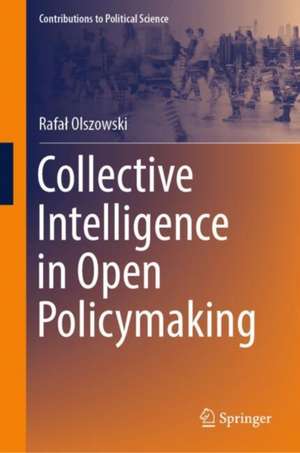
Collective Intelligence in Open Policymaking: Contributions to Political Science
Autor Rafa¿ Olszowskien Limba Engleză Hardback – 30 mai 2024
While doing so, it presents the current state of theoretical knowledge for these concepts, many practical examples of successful and unsuccessful projects, as well as additional research and laboratory experiments. The book develops an analytical framework based on qualitative research, which is applied to the analysis of different projects in selected case studies, such as Decide Madrid; Better Reykjavik; Loomio; Deliberatorium; Civic Budget of the City of Kraków.
The book is structured into four chapters, addressing essential questions in the field: (1) Opening Policymaking; (2) Beyond the Individual: Understanding the Evolution of Collective Intelligence; (3) A Review of the Projects Using Collective Intelligence in Policymaking; (4) Online Public Debate. How Can We Make it More Intelligent?
The book will appeal to students, scholars, and researchers of political science, public policy, and public administration, as well as policymakers interested in a better understanding of collective intelligence and open policymaking.
Din seria Contributions to Political Science
- 24%
 Preț: 813.67 lei
 - 18%
 Preț: 727.33 lei
 - 19%
 Preț: 443.18 lei
 - 15%
 Preț: 619.92 lei
 -
 Preț: 394.76 lei
 - 18%
 Preț: 785.00 lei
 - 18%
 Preț: 789.84 lei
 -
 Preț: 489.68 lei
 - 15%
 Preț: 630.12 lei
 -
 Preț: 383.76 lei
 - 18%
 Preț: 780.67 lei
 - 18%
 Preț: 705.69 lei
 - 15%
 Preț: 621.36 lei
 - 18%
 Preț: 784.37 lei
 -
 Preț: 381.60 lei
 -
 Preț: 372.70 lei
 - 18%
 Preț: 784.40 lei
 -
 Preț: 379.66 lei
 - 15%
 Preț: 564.26 lei
 - 15%
 Preț: 674.58 lei
 - 18%
 Preț: 876.50 lei
 -
 Preț: 382.83 lei
 -
 Preț: 380.40 lei
 -
 Preț: 389.52 lei
 -
 Preț: 414.96 lei
 -
 Preț: 389.28 lei
 - 15%
 Preț: 613.81 lei
 - 15%
 Preț: 456.57 lei
 -
 Preț: 366.19 lei
 - 18%
 Preț: 801.75 lei
 - 15%
 Preț: 623.80 lei
 - 23%
 Preț: 578.02 lei
 - 18%
 Preț: 700.73 lei
 -
 Preț: 367.68 lei
Preț: 900.75 lei
Preț vechi: 1098.48 lei
-18%
Puncte Express: 1351
Carte tipărită la comandă
Livrare economică 07-21 octombrie
Livrare prin curier în România Termenul estimat este afișat lângă disponibilitate.
Transport gratuit pentru acest produs Plată online sau ramburs, în funcție de opțiunile comenzii.
Retur gratuit în 14 zile Comandă securizată și suport în română.
Specificații
ISBN-13: 9783031581908
ISBN-10: 3031581903
Pagini: 320
Ilustrații: XVII, 299 p. 37 illus., 34 illus. in color.
Dimensiuni: 160 x 241 x 23 mm
Greutate: 0.65 kg
Ediția:2024
Editura: Springer
Colecția Contributions to Political Science
Seria Contributions to Political Science
Locul publicării:Cham, Switzerland
ISBN-10: 3031581903
Pagini: 320
Ilustrații: XVII, 299 p. 37 illus., 34 illus. in color.
Dimensiuni: 160 x 241 x 23 mm
Greutate: 0.65 kg
Ediția:2024
Editura: Springer
Colecția Contributions to Political Science
Seria Contributions to Political Science
Locul publicării:Cham, Switzerland
Cuprins
Chapter 1. Opening Policymaking.- Chapter 2. Beyond the Individual: Understanding the Evolution of Collective Intelligence.- Chapter 3. A Review of the Projects Using Collective Intelligence in Policymaking.- Chapter 4. Online Public Debate. How Can We Make it More Intelligent?.
Notă biografică
Rafał Olszowski is a social scientist specializing in research on e-participation, the public sphere, social media in politics, AI ethics, e-government, and the history of political doctrines. He is affiliated with AGH University of Kraków and the MIT Center for Collective Intelligence. He is the author of a monograph on permanence and change in the political thought of Edmund Burke (2021). He is also a seasoned business consultant in the field of new technologies, and a manager of educational projects. Apart from professional work, he is actively involved in the non-governmental sector with the Aurea Libertas Institute Foundation.
Textul de pe ultima copertă
This book examines the nexus of collective intelligence (CI), a feature of online projects in which various types of communities solve problems intelligently, and open policymaking, as a trend of large groups of people shaping public policies.
While doing so, it presents the current state of theoretical knowledge for these concepts, many practical examples of successful and unsuccessful projects, as well as additional research and laboratory experiments. The book develops an analytical framework based on qualitative research, which is applied to the analysis of different projects in selected case studies, such as Decide Madrid; Better Reykjavik; Loomio; Deliberatorium; Civic Budget of the City of Kraków.
The book is structured into four chapters, addressing essential questions in the field: (1) Opening Policymaking; (2) Beyond the Individual: Understanding the Evolution of Collective Intelligence; (3) A Review of the Projects Using Collective Intelligence in Policymaking; (4) Online Public Debate. How Can We Make it More Intelligent?
The book will appeal to students, scholars, and researchers of political science, public policy, and public administration, as well as policymakers interested in a better understanding of collective intelligence and open policymaking.
While doing so, it presents the current state of theoretical knowledge for these concepts, many practical examples of successful and unsuccessful projects, as well as additional research and laboratory experiments. The book develops an analytical framework based on qualitative research, which is applied to the analysis of different projects in selected case studies, such as Decide Madrid; Better Reykjavik; Loomio; Deliberatorium; Civic Budget of the City of Kraków.
The book is structured into four chapters, addressing essential questions in the field: (1) Opening Policymaking; (2) Beyond the Individual: Understanding the Evolution of Collective Intelligence; (3) A Review of the Projects Using Collective Intelligence in Policymaking; (4) Online Public Debate. How Can We Make it More Intelligent?
The book will appeal to students, scholars, and researchers of political science, public policy, and public administration, as well as policymakers interested in a better understanding of collective intelligence and open policymaking.