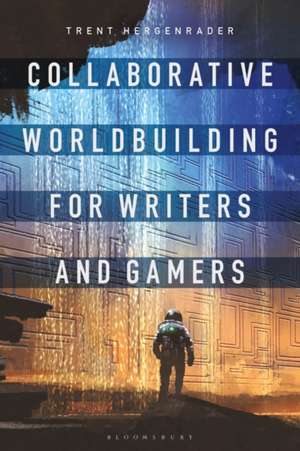
Collaborative Worldbuilding for Writers and Gamers
Autor Dr Trent Hergenraderen Limba Engleză Paperback – 18 oct 2018
Collaborative Worldbuilding for Writers and Gamers describes how writers can co-create vast worlds for use as common settings for their own stories. Using the worlds of Star Wars, Lord of the Rings, A Game of Thrones, and Dungeons & Dragons as models, this book guides readers through a step-by-step process of building sprawling fictional worlds complete with competing social forces that have complex histories and yet are always evolving. It also shows readers how to populate a catalog with hundreds of unique people, places, and things that grow organically from their world, which become a rich repository of story making potential.
The companion website collaborativeworldbuilding.com features links to online resources, past worldbuilding projects, and an innovative card system designed to work with this book.
Preț: 165.53 lei
Preț vechi: 200.37 lei
-17%
Puncte Express: 248
Carte tipărită la comandă
Livrare economică 09-23 iulie
Livrare prin curier în România Termenul estimat este afișat lângă disponibilitate.
Transport gratuit de la 400.00 lei Plată online sau ramburs, în funcție de opțiunile comenzii.
Retur gratuit în 14 zile Comandă securizată și suport în română.
Specificații
ISBN-13: 9781350016668
ISBN-10: 1350016667
Pagini: 280
Ilustrații: 18 bw illus
Dimensiuni: 154 x 232 x 20 mm
Greutate: 0.41 kg
Editura: Bloomsbury Publishing
Colecția Bloomsbury Academic
Locul publicării:London, United Kingdom
ISBN-10: 1350016667
Pagini: 280
Ilustrații: 18 bw illus
Dimensiuni: 154 x 232 x 20 mm
Greutate: 0.41 kg
Editura: Bloomsbury Publishing
Colecția Bloomsbury Academic
Locul publicării:London, United Kingdom
Cuprins
Part One - Collaborative Worldbuilding Concept and Terminology
1. Introduction to Collaborative Worldbuilding
2. Worlds, Worldbuilding, and Collaborative Worldbuilding
3. Audience and Genres
4. Frameworks of Fictional Worlds
5. Structures and Substructures of Fictional Worlds
6. Catalogs of Fictional Worlds
Part Two - Collaborative Worldbuilding Projects
7. Collaborative Worldbuilding Resources
8. Before You Begin Your Project
9. Building the Foundation and Establishing the Framework
10.Developing Structures and Substructures
11. Writing the Metanarrative
12. Designing Catalog Templates
13. Storytelling and Gaming in Collaboratively Built Worlds
Coda: Building Worlds Together
Appendix A. Worldbuilding Structures Worksheet
Appendix B. Framework Worksheet
Appendix C. Scope and Schedule Worksheet
Notes
Glossary
Index
1. Introduction to Collaborative Worldbuilding
2. Worlds, Worldbuilding, and Collaborative Worldbuilding
3. Audience and Genres
4. Frameworks of Fictional Worlds
5. Structures and Substructures of Fictional Worlds
6. Catalogs of Fictional Worlds
Part Two - Collaborative Worldbuilding Projects
7. Collaborative Worldbuilding Resources
8. Before You Begin Your Project
9. Building the Foundation and Establishing the Framework
10.Developing Structures and Substructures
11. Writing the Metanarrative
12. Designing Catalog Templates
13. Storytelling and Gaming in Collaboratively Built Worlds
Coda: Building Worlds Together
Appendix A. Worldbuilding Structures Worksheet
Appendix B. Framework Worksheet
Appendix C. Scope and Schedule Worksheet
Notes
Glossary
Index
Recenzii
If we as creative writing teachers can increase the relevance of our discipline by tackling the type of storytelling students are interested in, while simultaneously helping those students grapple with thorny cultural issues, why wouldn't we? Hergenrader's book offers one way to deal with some of the challenges we face as a discipline, and does so in a clear, cogent, and unpretentious manner, that allows him to successfully appeal to the broad audience he aspires to.
Trent Hergenrader's Collaborative Worldbuilding for Writers and Gamers is a welcome title. This book will be of most interest to educators, writers (especially within gaming industries), gamers, and academics. This is an accessible and practical guide written for groups interested in building a world together, or for educators who would like to guide students through this process. Academics may also find this title useful as a point of reference for game studies terminology
Hergenrader's collaborative worldbuilding offers a broadening of scope, in-built critique at each stage of the process, but also all of the possible conflict that comes with any group exercise fuelled by a variety of personalities and motivations.
Beginning to read Trent Hergenrader's book, Collaborative Worldbuilding for Writers and Gamers, I began by being interested and excited, having seen Hergenrader present on this project, long before the book came to fruition. My excitement was not misplaced. I am struck by how incredibly timely Hergenrader's book is, and how important it may turn out to be to creative writing as a discipline within the academy, not just now, but in the future. This book enters a storytelling landscape in which large expansive transmedia storytelling worlds, such as that of Marvel, Harry Potter, or Star Wars, are omnipresent in popular culture. As such, many of our students will come to the classroom, now, and for several generations of students to come, profoundly influenced by fictional worlds that are the product not of one creator, but of many. While I personally am an avid consumer of the above worlds, many people are not, and Hergenrader's book, intended as a guide for gamers, teachers, and writers, not just educators-has the most profound implications for helping educators either lead collaborative worldbuilding classes, or at the very least, understand more about the vast expansive, multi-author and multi-platform stories that have influenced many of their students...The straightforward nature of the instructions, and the argument for relevance through examples, rather than standard expository argument, makes the text feel transparent and easy to use. Furthermore, the inclusion of a website with example syllabi, recommended programs, and other resources, makes this book a living guide. While I find myself feeling impressed (and a tiny bit intimidated) by the amount of time that Hergenrader, a professor at the Rochester Institute for Technology, clearly devotes to creating his collaborative worldbuilding course, I do feel that the book and the companion website are enough to equip any teacher who wants to lead a class that uses collaborative worldbuilding.
Trent Hergenrader's Collaborative Worldbuilding for Writers and Gamers is a welcome title. This book will be of most interest to educators, writers (especially within gaming industries), gamers, and academics. This is an accessible and practical guide written for groups interested in building a world together, or for educators who would like to guide students through this process. Academics may also find this title useful as a point of reference for game studies terminology
Hergenrader's collaborative worldbuilding offers a broadening of scope, in-built critique at each stage of the process, but also all of the possible conflict that comes with any group exercise fuelled by a variety of personalities and motivations.
Beginning to read Trent Hergenrader's book, Collaborative Worldbuilding for Writers and Gamers, I began by being interested and excited, having seen Hergenrader present on this project, long before the book came to fruition. My excitement was not misplaced. I am struck by how incredibly timely Hergenrader's book is, and how important it may turn out to be to creative writing as a discipline within the academy, not just now, but in the future. This book enters a storytelling landscape in which large expansive transmedia storytelling worlds, such as that of Marvel, Harry Potter, or Star Wars, are omnipresent in popular culture. As such, many of our students will come to the classroom, now, and for several generations of students to come, profoundly influenced by fictional worlds that are the product not of one creator, but of many. While I personally am an avid consumer of the above worlds, many people are not, and Hergenrader's book, intended as a guide for gamers, teachers, and writers, not just educators-has the most profound implications for helping educators either lead collaborative worldbuilding classes, or at the very least, understand more about the vast expansive, multi-author and multi-platform stories that have influenced many of their students...The straightforward nature of the instructions, and the argument for relevance through examples, rather than standard expository argument, makes the text feel transparent and easy to use. Furthermore, the inclusion of a website with example syllabi, recommended programs, and other resources, makes this book a living guide. While I find myself feeling impressed (and a tiny bit intimidated) by the amount of time that Hergenrader, a professor at the Rochester Institute for Technology, clearly devotes to creating his collaborative worldbuilding course, I do feel that the book and the companion website are enough to equip any teacher who wants to lead a class that uses collaborative worldbuilding.