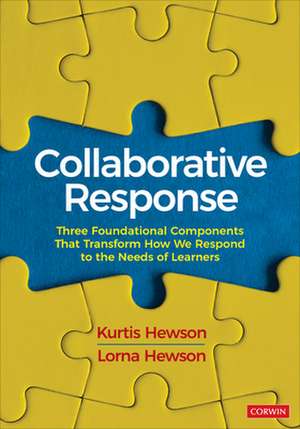
Collaborative Response: Three Foundational Components That Transform How We Respond to the Needs of Learners
Autor Kurtis Hewson, Lorna Hewsonen Limba Engleză Electronic book text – 28 mar 2022
The greatest goal of education is to ensure equity while enhancing learning and academic success for all students. And yet, it is impossible for one teacher to meet the extensive needs of all students in his or her classroom. The traditional schooling model cannot provide for this complexity and leaves educators perplexed. The solution is a collaborative approach where “every child deserves a team” to surround them with supports that recognize their strengths and challenges.
Collaborative Response offers a school-wide model for addressing students’ individual needs. The three fundamental components of the model are: collaborative structures and processes; data and evidence; and continuum of supports. In this book, readers will find:
- Entry points for beginning this work
- Potential pitfalls of the approach
- Case studies from schools that have adopted the model
- Access to a website with tools, templates, case studies, and more
Preț: 206.50 lei
Precomandă
Puncte Express: 310
Nepublicat încă
Livrare prin curier în România Precomanda se expediază când titlul devine disponibil.
Transport gratuit de la 400.00 lei Plată online sau ramburs, în funcție de opțiunile comenzii.
Retur gratuit în 14 zile Comandă securizată și suport în română.
Doresc să fiu notificat când acest titlu va fi disponibil:
Se trimite...
Specificații
ISBN-13: 9781071862841
ISBN-10: 1071862847
Pagini: 256
Dimensiuni: 178 x 254 mm
Ediția:1
Editura: SAGE Publications
Colecția Corwin
Locul publicării:Thousand Oaks, United States
ISBN-10: 1071862847
Pagini: 256
Dimensiuni: 178 x 254 mm
Ediția:1
Editura: SAGE Publications
Colecția Corwin
Locul publicării:Thousand Oaks, United States
Recenzii
Collaborative
Response has
been
instrumental
in
changing
the
lives
of
both
staff
and
students.
It
has
provided
an
explicit
and
collective
framework
to
have
conversations
that
lead
to
improved
student
learning
outcomes
and
ensured
that
the
individual
learning
needs
of
all
students
are
recognised
as
every
person's
responsibility.
Through understanding the role of assessment, collaboration, and a defined continuum of supports, Kurtis and Lorna lay out multiple entry points for schools, leadership teams, and senior leaders that will ultimately impact all students in achievement, inclusion, and well-being.
Through understanding the role of assessment, collaboration, and a defined continuum of supports, Kurtis and Lorna lay out multiple entry points for schools, leadership teams, and senior leaders that will ultimately impact all students in achievement, inclusion, and well-being.
Cuprins
Foreword
by
Andrew
Hargreaves
Table of Contents
Companion Website Contents
Introduction - A Call to Action
Chapter 1 - Examining a Culture of Response
Chapter 2 - Envisioning Collaborative Response
Chapter 3 - Collaborative Structures
Chapter 4 - Collaborative Processes
Chapter 5 - Collaborative Team Meetings
Chapter 6 - Data and Evidence
Chapter 7 - Continuum of Supports
Chapter 8 - Putting the Pieces Together
References and Resources
Table of Contents
Companion Website Contents
Introduction - A Call to Action
Chapter 1 - Examining a Culture of Response
Chapter 2 - Envisioning Collaborative Response
Chapter 3 - Collaborative Structures
Chapter 4 - Collaborative Processes
Chapter 5 - Collaborative Team Meetings
Chapter 6 - Data and Evidence
Chapter 7 - Continuum of Supports
Chapter 8 - Putting the Pieces Together
References and Resources
Descriere
A
school-wide
model
for
addressing
individual
needs
The greatest goal of education is to ensure equity while enhancing learning and academic success for all students. And yet, it is impossible for one teacher to meet the extensive needs of all students in his or her classroom. The traditional schooling model cannot provide for this complexity and leaves educators perplexed. The solution is a collaborative approach where “every child deserves a team” to surround them with supports that recognize their strengths and challenges.
Collaborative Response offers a school-wide model for addressing students’ individual needs. The three fundamental components of the model are: collaborative structures and processes; data and evidence; and continuum of supports. In this book, readers will find:
The greatest goal of education is to ensure equity while enhancing learning and academic success for all students. And yet, it is impossible for one teacher to meet the extensive needs of all students in his or her classroom. The traditional schooling model cannot provide for this complexity and leaves educators perplexed. The solution is a collaborative approach where “every child deserves a team” to surround them with supports that recognize their strengths and challenges.
Collaborative Response offers a school-wide model for addressing students’ individual needs. The three fundamental components of the model are: collaborative structures and processes; data and evidence; and continuum of supports. In this book, readers will find:
- Entry points for beginning this work
- Potential pitfalls of the approach
- Case studies from schools that have adopted the model
- Access to a website with tools, templates, case studies, and more