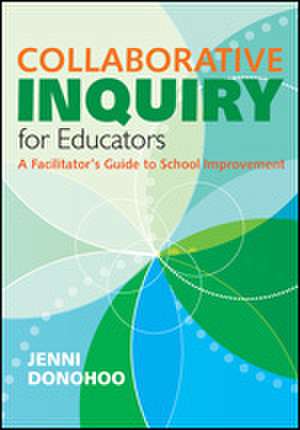
Collaborative Inquiry for Educators: A Facilitator's Guide to School Improvement
Autor Jenni Anne Marie Donohooen Limba Engleză Electronic book text – mai 2013
Preț: 175.73 lei
Puncte Express: 264
Indisponibil temporar
Doresc să fiu notificat când acest titlu va fi disponibil:
Se trimite...
Specificații
ISBN-13: 9781452274393
ISBN-10: 1452274398
Pagini: 144
Dimensiuni: 178 x 254 mm
Ediția:1
Editura: SAGE Publications
Colecția Corwin
Locul publicării:Thousand Oaks, United States
ISBN-10: 1452274398
Pagini: 144
Dimensiuni: 178 x 254 mm
Ediția:1
Editura: SAGE Publications
Colecția Corwin
Locul publicării:Thousand Oaks, United States
Recenzii
"Jenni
Donohoo's
immensely
thoughtful
and
deeply
practical
discussion
of
collaborative
inquiry
helps
teachers
to
live
up
to
and
also
be
enlivened
by
the
high
standards
of
evidence-informed
judgment
that
define
all
true
professions.
Like
the
world-class
facilitator
she
is,
she
moves
her
readers
forward
with
ideas,
activities
and
examples
that
do
not
talk
down
to
them
or
go
over
their
heads.
Her
book
is
essential
for
all
leaders,
teachers
and
staff
developers,
who
want
to
help
all
their
teachers
become
successful
professionals,
and
who
want
to
be
treated
like
top-notch
professionals
themselves
as
they
do
so."
"Student learning outcomes increase as educators' professional learning contributes to enhanced teaching quality. The most powerful strategy and structure for this dynamic is the professional learning community (PLC) and in the PLC context, adult learning results from the collaborative inquiry of the participants. The author of this significant guide to facilitating collaborative inquiry has created a compelling vision of such inquiry and the professional learning that develops from it. In clear and unpretentious language, Donohoo guides the user through a challenging but practical four-step learning sequence so that teachers learn and subsequently, students achieve--a goal to which we all subscribe and endorse."
"Donohoo provides a practical and powerful four-step process to guide collaborative inquiry teams in identifying, inventing, and investigating solutions to problems of practice that occur in their everyday work. The tools, examples, and detailed guidelines provide teacher leaders, coaches, principals, and others with the resources they need to transform unproductive team meetings into evidence-based interactions and study that result in improved practice and results for students."
"Donohoo has provided a rare gift in a book that one can read forwards, backwards, or in the middle. You can pinpoint your need, save time, and make immediate use of this excellent resource. The references are extensive and current. At the back of the book the reader finds eleven enormously practical and immediately applicable resources—analytical frameworks and thought-provoking questions that you can use the first time you read the text. The chapters include compelling evidence and practical advice, but it's too easy for readers to dismiss the last pages of a book. Don't make that mistake with this immensely useful and practical volume."
"Collaborative Inquiry for Educatorsprovides a balance of conceptual knowledge and pragmatic next steps. Perfect for a grade level or department chair."
"Jenni Donohoo’s book articulates in detail what facilitation needs to look like, along with how to create the conditions to actually make it happen. It is a must read for anyone trying to actively develop and support the link between teacher and leader actions, and positive student outcomes."
"Often educational organizations engage in 'hot topic' practices, but not always with knowledge of how to effectively do so. Jenni Donohoo provides very clear and explicit grounding for an individual who might be assigned as a facilitator for a collaborative inquiry within a school system. In the spirit of collaborative inquiry, Donohoo recognizes the need for adaptation to different situations and often provides options for facilitators to consider. Grounding this work in the professional learning literature, she does an excellent job of weaving citations from that literature into a guiding manual for how to proceed. I would certainly recommend this resource to facilitators of or participants in a collaborative inquiry as well as to administrators who set up the opportunities for such collaborations."
"This book provides detailed, practical, and well-grounded ideas for those wanting to make professional learning communities work effectively. It’s a fine resource for anyone working with school development or improvement."
"Collaborative Inquiry for Educatorsis a guide for school leaders who long to move beyond superficial group meetings and into meaningful inquiry that effects actual changes in instruction and student achievement. It provides a timely guide to meeting the expectations of Common Core Standards."
"This resource is a must have for collaborative team facilitators."
"This book provides a practical, easy-to-follow overview of collaborative inquiry for teams of classroom teachers. No longer do you need to force a match between your school and someone else's research, now your teachers can conduct their own authentic research."
"Oftentimes a reader will pick up a book and think the ideas are fantastic, but where most books fall short is in providing strategies for implementation. Not so withCollaborative Inquiry for Educators. The steps are clearly laid out, and the author has taken much of the guesswork of how to share or implement the ideas. If you are looking for the full package, including research, strategies, and implementation, then this is a book well worth your time."
"This book is an excellent hands-on manual that will guide administrators, teachers and potential administrators through the process of collaborative inquiry. This is a very practical guide to the process, with numerous vignettes making the process very easy to understand. If you have a desire to begin the process of collaborative inquiry in your school, I would definitely recommend this book."
"Student learning outcomes increase as educators' professional learning contributes to enhanced teaching quality. The most powerful strategy and structure for this dynamic is the professional learning community (PLC) and in the PLC context, adult learning results from the collaborative inquiry of the participants. The author of this significant guide to facilitating collaborative inquiry has created a compelling vision of such inquiry and the professional learning that develops from it. In clear and unpretentious language, Donohoo guides the user through a challenging but practical four-step learning sequence so that teachers learn and subsequently, students achieve--a goal to which we all subscribe and endorse."
"Donohoo provides a practical and powerful four-step process to guide collaborative inquiry teams in identifying, inventing, and investigating solutions to problems of practice that occur in their everyday work. The tools, examples, and detailed guidelines provide teacher leaders, coaches, principals, and others with the resources they need to transform unproductive team meetings into evidence-based interactions and study that result in improved practice and results for students."
"Donohoo has provided a rare gift in a book that one can read forwards, backwards, or in the middle. You can pinpoint your need, save time, and make immediate use of this excellent resource. The references are extensive and current. At the back of the book the reader finds eleven enormously practical and immediately applicable resources—analytical frameworks and thought-provoking questions that you can use the first time you read the text. The chapters include compelling evidence and practical advice, but it's too easy for readers to dismiss the last pages of a book. Don't make that mistake with this immensely useful and practical volume."
"Collaborative Inquiry for Educatorsprovides a balance of conceptual knowledge and pragmatic next steps. Perfect for a grade level or department chair."
"Jenni Donohoo’s book articulates in detail what facilitation needs to look like, along with how to create the conditions to actually make it happen. It is a must read for anyone trying to actively develop and support the link between teacher and leader actions, and positive student outcomes."
"Often educational organizations engage in 'hot topic' practices, but not always with knowledge of how to effectively do so. Jenni Donohoo provides very clear and explicit grounding for an individual who might be assigned as a facilitator for a collaborative inquiry within a school system. In the spirit of collaborative inquiry, Donohoo recognizes the need for adaptation to different situations and often provides options for facilitators to consider. Grounding this work in the professional learning literature, she does an excellent job of weaving citations from that literature into a guiding manual for how to proceed. I would certainly recommend this resource to facilitators of or participants in a collaborative inquiry as well as to administrators who set up the opportunities for such collaborations."
"This book provides detailed, practical, and well-grounded ideas for those wanting to make professional learning communities work effectively. It’s a fine resource for anyone working with school development or improvement."
"Collaborative Inquiry for Educatorsis a guide for school leaders who long to move beyond superficial group meetings and into meaningful inquiry that effects actual changes in instruction and student achievement. It provides a timely guide to meeting the expectations of Common Core Standards."
"This resource is a must have for collaborative team facilitators."
"This book provides a practical, easy-to-follow overview of collaborative inquiry for teams of classroom teachers. No longer do you need to force a match between your school and someone else's research, now your teachers can conduct their own authentic research."
"Oftentimes a reader will pick up a book and think the ideas are fantastic, but where most books fall short is in providing strategies for implementation. Not so withCollaborative Inquiry for Educators. The steps are clearly laid out, and the author has taken much of the guesswork of how to share or implement the ideas. If you are looking for the full package, including research, strategies, and implementation, then this is a book well worth your time."
"This book is an excellent hands-on manual that will guide administrators, teachers and potential administrators through the process of collaborative inquiry. This is a very practical guide to the process, with numerous vignettes making the process very easy to understand. If you have a desire to begin the process of collaborative inquiry in your school, I would definitely recommend this book."
Cuprins
Preface
Acknowledgments
About the Author
1. Why Collaborative Inquiry?
A Four-Stage Model
Getting Started
2. Stage 1: Framing the Problem
Determining a Meaningful Focus
Determining a Shared Vision
Developing an Inquiry Question
Formulating a Theory of Action
Reflection for Facilitators
3. Stage 2: Collecting Evidence
Developing Knowledge, Competencies, and Shared Understandings
Implementing Changes in Practice
Developing the Data Collection Plan
Reflection for Facilitators
4. Stage 3: Analyzing Evidence
Considering Implementation
Data Analysis
Examining Assumptions
Reflection for Facilitators
5. Stage 4: Documenting, Celebrating and Sharing
Documenting and Sharing
Celebrating
Debriefing the Process
Reflection for Facilitators
Resources
Resource A. Identifying Student Learning Needs
Resource B. Sphere of Concern Versus Realm of Control
Resource C. Examples of Purpose Statements
Resource D. Inquiry Questions--Examples--Strong and Weak
Resource E. Theory of Action T-Chart
Resource F. Innovation Configuration Map Template
Resource G. Data Collection Plan Template
Resource H. Levels of Implementation Templates
Resource I. Collaborative Inquiry Teams--Small Group Sharing
Resource J. Characteristics of Collaborative Inquiry Continuum
Resource K. Characteristics of Collaborative Inquiry--Start--Stop--Continue
References
Index
Acknowledgments
About the Author
1. Why Collaborative Inquiry?
A Four-Stage Model
Getting Started
2. Stage 1: Framing the Problem
Determining a Meaningful Focus
Determining a Shared Vision
Developing an Inquiry Question
Formulating a Theory of Action
Reflection for Facilitators
3. Stage 2: Collecting Evidence
Developing Knowledge, Competencies, and Shared Understandings
Implementing Changes in Practice
Developing the Data Collection Plan
Reflection for Facilitators
4. Stage 3: Analyzing Evidence
Considering Implementation
Data Analysis
Examining Assumptions
Reflection for Facilitators
5. Stage 4: Documenting, Celebrating and Sharing
Documenting and Sharing
Celebrating
Debriefing the Process
Reflection for Facilitators
Resources
Resource A. Identifying Student Learning Needs
Resource B. Sphere of Concern Versus Realm of Control
Resource C. Examples of Purpose Statements
Resource D. Inquiry Questions--Examples--Strong and Weak
Resource E. Theory of Action T-Chart
Resource F. Innovation Configuration Map Template
Resource G. Data Collection Plan Template
Resource H. Levels of Implementation Templates
Resource I. Collaborative Inquiry Teams--Small Group Sharing
Resource J. Characteristics of Collaborative Inquiry Continuum
Resource K. Characteristics of Collaborative Inquiry--Start--Stop--Continue
References
Index
Descriere
Move
teams
toward
impactful
collaborative
work,
improved
instruction,
and
increased
student
achievement
using
this
guide's
scaffolded,
step-by-step
activities
and
real-world
examples.