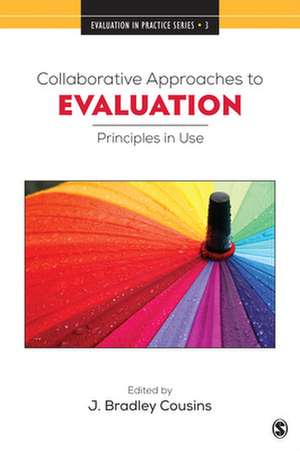
Collaborative Approaches to Evaluation: Principles in Use: Evaluation in Practice Series, cartea 3
Editat de J. Bradley Cousinsen Limba Engleză Electronic book text – 8 iul 2019



Preț: 175.73 lei
Indisponibil temporar
Specificații
ISBN-10: 1544344651
Pagini: 304
Dimensiuni: 152 x 229 mm
Ediția:First Edition
Editura: SAGE Publications
Colecția Sage Publications, Inc
Seria Evaluation in Practice Series
Locul publicării:Thousand Oaks, United States
V-ar putea interesa
-
 -18%Preț: 1467.02 lei1789.05 lei
-
 -15%Preț: 434.65 lei511.35 lei
-
 Multiple ComparisonsAlan J. KlockarsPreț: 397.45 lei
-
 Multiple Regression in PracticeWilliam Dale BerryPreț: 397.86 lei
-
 Information TheoryKlaus KrippendorffPreț: 397.86 lei
-
 Multivariate Analysis of VarianceJames H. BrayPreț: 397.86 lei
-
 Using Microcomputers in ResearchThomas William MadronPreț: 398.05 lei
-
 Logic of Causal OrderJames A DavisPreț: 396.65 lei
-
 Introduction to Linear Goal ProgrammingJames P. IgnizioPreț: 398.90 lei
-
 Survey QuestionsJean M. ConversePreț: 357.84 lei
-
 Latent Class AnalysisAllan L. McCutcheonPreț: 398.67 lei
-
 Meta-AnalysisFredric M. WolfPreț: 396.43 lei
-
 Linear ProgrammingBruce R. FeiringPreț: 398.26 lei
-
 Three Way ScalingPhipps ArabiePreț: 398.26 lei
-
 Developing Expert Leadership For Future SchoolsKenneth LeithwoodPreț: 430.29 lei
-
 The SAGE International Handbook of Educational EvaluationKatherine Ryan-27%Preț: 1140.57 lei1562.42 lei
-
 Advanced Qualitative ResearchMichelle O'ReillyPreț: 447.06 lei
-
 Doing Real ResearchEric L. JensenPreț: 451.57 lei
-
 Preț: 376.06 lei
-
 Understanding Narrative InquiryJeong-Hee Kim-9%Preț: 736.86 lei809.73 lei
-
 Monitoring and Evaluation TrainingScott G. Chaplowe-9%Preț: 738.79 lei811.87 lei
-
 Statistics without MathematicsDavid J. BartholomewPreț: 364.37 lei
-
 -27%Preț: 1085.20 lei1486.58 lei
-
 The Business of PeopleCampaign For Social SciencePreț: 152.85 lei
-
 There's a Stat for That!Bruce B. FreyPreț: 400.70 lei
-
 Stretching Exercises for Qualitative ResearchersValerie J. Janesick-18%Preț: 745.79 lei909.49 lei
-
 Excel StatisticsNeil J. SalkindPreț: 405.82 lei
-
 Participatory Evaluation Up CloseJ. Bradley Cousins-19%Preț: 676.73 lei835.47 lei
Recenzii
Cuprins
Preface
Acknowledgments
Editorial Board Members
About the Editor
PART A • INTRODUCTION
Chapter 1 • Situating Evidence-Based Principles to Guide Practice in Collaborative Approaches to Evaluation (CAE)
PART B • FIELD STUDIES
Chapter 2 • Participatory Evaluation of Cancer Prevention and Care Services: A Case Study From Valle de la Estrella, Costa Rica
Chapter 3 • Promoting Learning Through a Collaborative Approach to Evaluation: A Retrospective Examination of the Process and Principles
Chapter 4 • The Saafa Program for Excellence in the Sciences: An Application of the Principles to Guide Collaborative Approaches to Evaluation
Chapter 5 • Toward a Better Understanding of Evaluation Use and Collaborative Approaches: A Case Study of a School Improvement Program Evaluation
Chapter 6 • Roles and Functions of the Community Manager Within the Framework of Collaborative Approaches to Evaluation (CAE): Case Analysis of the Galibar Community Development Plan (Spain)
Chapter 7 • Building Capacity in Program Practitioner Realist Evaluation Through Application of CAE Principles
Chapter 8 • Comparing the Validity of Two Sets of Evaluation Principles: Adding Value to Both
Chapter 9 • The View From the Classroom: A Reflection on the Use of the CAE Principles in a Pedagogical Setting
PART C • INTEGRATION
Chapter 10 • CAE Principles: What Have We Learned?
Index
Descriere
Notă biografică
J. Bradley Cousins is professor of Evaluation at the Faculty of Education, University of Ottawa. Cousins' main interests are in program evaluation including participatory and collaborative approaches, use, and capacity building. He received his PhD in Educational Measurement and Evaluation from the University of Toronto in 1988. Throughout his career he has received several awards for his work in evaluation including the Contribution to Evaluation in Canada award (CES, 1999), the Paul F. Lazarsfeld Award for Theory in Evaluation (AEA, 2008) and the AERA Research on Evaluation Distinguished Scholar Award (2011). He has published many articles and books on evaluation and was editor of the Canadian Journal of Program Evaluation from 2002 to 2010. Throughout his career, Cousins has had considerable experience planning, delivering, and evaluating evaluation training and capacity building in Canada and abroad. Internationally he led evaluation capacity building in Central and West Africa and a major three and one-half year project in India. He is currently leading a nation-wide evaluation of teacher in-service training in that country in collaboration with several of the people he had previously trained. Cousins completed a three and one-half year term as director of the Centre for Research on Educational and Community Services at the University of Ottawa in July 2015. He continues to be an active member of CRECS, which has a strong mandate for research and evaluation capacity building. For more information, visit www.crecs.uottawa.ca.