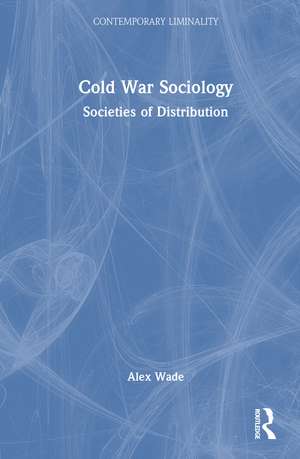
Cold War Sociology: Societies of Distribution: Contemporary Liminality
Autor Alex Wadeen Limba Engleză Hardback – 11 mar 2026
As a conflict that spanned the second half of the 20th century, the influence of the Cold War continues into the second quarter of the 21st century. Its chief organizing concept was distribution, seen in the technologies and techniques that infused the time, from game theory to the Internet and artificial intelligence, to nuclear silos that projected global power. Cold War Sociology demonstrates how distribution continues to shape politics, economic and social policy and everyday life, causing unintended consequences including climate change, war and resource depletion that are increasingly difficult to address. It draws on key thinkers from the past to the present day and applies them to a series of empirical, sociological case studies including food banking, education, computer technology, conspiracy thinking and media.
This book will be of vital reading to students of sociology, anthropology, social theory and political theory, including undergraduates, postgraduates and researchers who seek to understand the genesis of the often puzzling and contrarian contemporary world, and how the unintended consequences of the Cold War contain answers to present‑day problems.
Din seria Contemporary Liminality
-
 Preț: 379.07 lei
 -
 Preț: 380.71 lei
 -
 Preț: 409.16 lei
 -
 Preț: 356.20 lei
 - 18%
 Preț: 1150.40 lei
 -
 Preț: 404.33 lei
 -
 Preț: 422.48 lei
 -
 Preț: 425.23 lei
 - 18%
 Preț: 1112.85 lei
 -
 Preț: 424.32 lei
 -
 Preț: 441.18 lei
 -
 Preț: 413.52 lei
 -
 Preț: 425.04 lei
 - 18%
 Preț: 1113.11 lei
 -
 Preț: 421.34 lei
 -
 Preț: 417.38 lei
 -
 Preț: 375.80 lei
 -
 Preț: 433.69 lei
 -
 Preț: 362.70 lei
 -
 Preț: 467.12 lei
 -
 Preț: 424.32 lei
 - 18%
 Preț: 1055.31 lei
 -
 Preț: 402.10 lei
 -
 Preț: 457.46 lei
 -
 Preț: 410.01 lei
 -
 Preț: 456.57 lei
 - 18%
 Preț: 1117.60 lei
 - 18%
 Preț: 1114.82 lei
 - 18%
 Preț: 1347.91 lei
Preț: 1453.09 lei
Preț vechi: 1887.13 lei
-23%
Puncte Express: 2180
Carte tipărită la comandă
Livrare economică 01-07 decembrie
Livrare prin curier în România Termenul estimat este afișat lângă disponibilitate.
Transport gratuit pentru acest produs Plată online sau ramburs, în funcție de opțiunile comenzii.
Retur gratuit în 14 zile Comandă securizată și suport în română.
Specificații
ISBN-13: 9781032331997
ISBN-10: 1032331992
Pagini: 146
Dimensiuni: 156 x 234 mm
Greutate: 0.43 kg
Ediția:1
Editura: Taylor & Francis
Colecția Routledge
Seria Contemporary Liminality
Locul publicării:Oxford, United Kingdom
ISBN-10: 1032331992
Pagini: 146
Dimensiuni: 156 x 234 mm
Greutate: 0.43 kg
Ediția:1
Editura: Taylor & Francis
Colecția Routledge
Seria Contemporary Liminality
Locul publicării:Oxford, United Kingdom
Public țintă
Postgraduate and UndergraduateCuprins
Introduction: The Architecture of Distribution 1 Towards a Sociology of the Cold War 2 Poison and Meat: The Distribution of Food 3 Netflixization: The Distribution of Education 4 Chains of Approval: The Distribution of Technology 5 The Conspiracy of Theory: The Distribution of Information 6 Strategies of Containment: Distribution in Contemporary Cold War Media Conclusion: Political Anthropology of Distribution
Recenzii
'Cold War Sociology is an intriguing analysis of how Cold War dynamics continue to shape contemporary society. Far more than a historical account, this book offers a sharp sociological lens on the era’s political, technological, and ideological legacies.
The author, Alex Wade, brilliantly argues that distribution was a defining force in Cold War societies, with its impact still visible today. From missile silos and the Internet, to the paradoxes of equality, manifesting in “The drive to treat everyone equally, even – or especially – when everyone is different, is by definition an impossible goal,” this work challenges us to rethink modern structures. Engaging, rigorous, and thought-provoking, this book is essential for scholars and critical thinkers seeking a deeper understanding of the Cold War’s lasting imprint on global politics, economics, and culture.'
Regina Seiwald, Teaching Fellow in Modern Languages, University of Birmingham
'Wide ranging and challenging, this valuable study offers a new way of thinking about a world in crisis. This is an important study that avoids fashionable, simplistic and pessimistic conclusions.'
Mike Gane, Emeritus Professor of Sociology, Loughborough University
The author, Alex Wade, brilliantly argues that distribution was a defining force in Cold War societies, with its impact still visible today. From missile silos and the Internet, to the paradoxes of equality, manifesting in “The drive to treat everyone equally, even – or especially – when everyone is different, is by definition an impossible goal,” this work challenges us to rethink modern structures. Engaging, rigorous, and thought-provoking, this book is essential for scholars and critical thinkers seeking a deeper understanding of the Cold War’s lasting imprint on global politics, economics, and culture.'
Regina Seiwald, Teaching Fellow in Modern Languages, University of Birmingham
'Wide ranging and challenging, this valuable study offers a new way of thinking about a world in crisis. This is an important study that avoids fashionable, simplistic and pessimistic conclusions.'
Mike Gane, Emeritus Professor of Sociology, Loughborough University
Notă biografică
Alex Wade is Senior Research Fellow in the Faculty of Health, Education and Life Sciences at Birmingham City University. He has previously written on space and time in videogames, French social theory and media history. His current research interests focus on the relationship between technology and learning in historical and contemporary contexts.
Descriere
This book positions the Cold War as a liminal time and space that holds sway in the second quarter of the 21st century, informing a broad and deep analysis of how contemporary society was – and continues to be – fashioned by the societies of distribution found in Cold War Sociology.