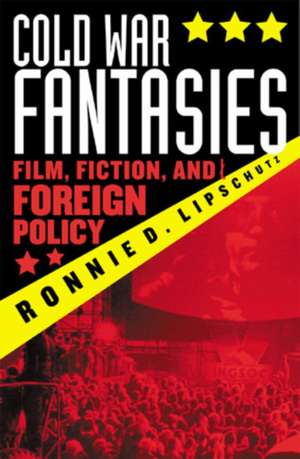
Cold War Fantasies: Film, Fiction, and Foreign Policy
Autor Ronnie D. Lipschutzen Limba Engleză Paperback – 9 oct 2001
Preț: 267.55 lei
Preț vechi: 351.91 lei
-24%
Puncte Express: 401
Carte tipărită la comandă
Livrare economică 09-23 iunie
Specificații
ISBN-13: 9780742510524
ISBN-10: 0742510522
Pagini: 256
Dimensiuni: 154 x 234 x 21 mm
Greutate: 0.42 kg
Ediția:01000
Editura: Bloomsbury Publishing
Colecția Rowman & Littlefield
Locul publicării:New York, United States
ISBN-10: 0742510522
Pagini: 256
Dimensiuni: 154 x 234 x 21 mm
Greutate: 0.42 kg
Ediția:01000
Editura: Bloomsbury Publishing
Colecția Rowman & Littlefield
Locul publicării:New York, United States
V-ar putea interesa
-
 Harry Potter and International RelationsDaniel H. Nexon-24%Preț: 265.62 lei351.43 lei
 -
 Culture in NetworksPaul McleanPreț: 167.43 lei
 -
 Bathroom Book of Canadian TriviaAngela Murphy-12%Preț: 51.60 lei58.59 lei
 -
 Fifty-Year MissionEdward GrossPreț: 291.00 lei
 -
 The Ecology of AttentionYves CittonPreț: 151.89 lei
 -
 The Art of JockWill Dennis-11%Preț: 319.27 lei357.70 lei
 -
 Shooting HipstersChristiana SpensPreț: 65.95 lei
Cuprins
Chapter 1 Films and Novels Discussed in this Book
Chapter 2 Preface: What Did You Do in the Cold War, Daddy?
Chapter 3 A Note to the Reader
Chapter 4 Film, Fiction, American Politics
Chapter 5 From Hot War to Cold War
Chapter 6 Reds among Us?
Chapter 7 Spies!
Chapter 8 Nukes!
Chapter 9 The Final Frontier
Chapter 10 Vietnam, Over and Over
Chapter 11 Renewing the Cold War
Chapter 12 New Competitors, Old Enemies
Chapter 13 Now What?
Chapter 14 Notes
Chapter 15 Resources
Chapter 16 Bibliography
Chapter 17 Index
Chapter 2 Preface: What Did You Do in the Cold War, Daddy?
Chapter 3 A Note to the Reader
Chapter 4 Film, Fiction, American Politics
Chapter 5 From Hot War to Cold War
Chapter 6 Reds among Us?
Chapter 7 Spies!
Chapter 8 Nukes!
Chapter 9 The Final Frontier
Chapter 10 Vietnam, Over and Over
Chapter 11 Renewing the Cold War
Chapter 12 New Competitors, Old Enemies
Chapter 13 Now What?
Chapter 14 Notes
Chapter 15 Resources
Chapter 16 Bibliography
Chapter 17 Index
Recenzii
Useful for gathering ideas for a foreign policy and film/novel course.
Lipschutz presents an accessible, yet thoughtful account of the political activities and cultural climate of the Cold War, using discussion on films (mostly) and some fiction as pedagogical tools. Certainly this book could nicely shape a course, but self-study is as convenient as the local video store.
The historical narrative that drives the plot forward is brilliantly executed. Lipschutz's narrative is deceptively easy to read. He skillfully weaves the two texts together and packs a lot of information into a confined space without ever losing his story's momentum.
Lipschutz provides an accessible pedagogical tool to enliven historical studies with film and illuminate broader political and economic issues on cinema and literature.
What can films like Bladerunner or Invasion of the Body Snatchers and novels such as 1984 or Rising Sun, tell us about the Cold War and U.S. foreign policy? Quite a lot, it turns out. In a delightful book suitable both for teaching and for a popular audience, Ronnie Lipschutz provides a fresh and accessible account of U.S. foreign policy since World War II. His lucid and entertaining analysis moves easily from fact to fiction, and back again, highlighting the continuities and interconnections between popular culture and state policy.
Lipschutz presents an accessible, yet thoughtful account of the political activities and cultural climate of the Cold War, using discussion on films (mostly) and some fiction as pedagogical tools. Certainly this book could nicely shape a course, but self-study is as convenient as the local video store.
The historical narrative that drives the plot forward is brilliantly executed. Lipschutz's narrative is deceptively easy to read. He skillfully weaves the two texts together and packs a lot of information into a confined space without ever losing his story's momentum.
Lipschutz provides an accessible pedagogical tool to enliven historical studies with film and illuminate broader political and economic issues on cinema and literature.
What can films like Bladerunner or Invasion of the Body Snatchers and novels such as 1984 or Rising Sun, tell us about the Cold War and U.S. foreign policy? Quite a lot, it turns out. In a delightful book suitable both for teaching and for a popular audience, Ronnie Lipschutz provides a fresh and accessible account of U.S. foreign policy since World War II. His lucid and entertaining analysis moves easily from fact to fiction, and back again, highlighting the continuities and interconnections between popular culture and state policy.