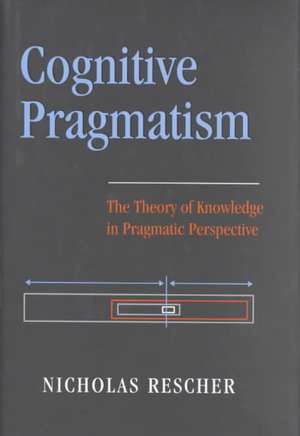
Cognitive Pragmatism: The Theory of Knowledge in Pragmatic Perspective
Autor Nicholas Rescheren Limba Engleză Hardback – 16 aug 2001
În Cognitive Pragmatism, Nicholas Rescher restructurează epistemologia clasică printr-o metodologie care prioritizează funcționalitatea în detrimentul abstractizării. Structura lucrării reflectă trecerea de la generalități teoretice la analize aplicate, unde cunoașterea nu este tratată ca o stare pasivă, ci ca o activitate umană orientată spre scop. Descoperim aici o abordare calculată a unor probleme dificile, precum validarea inductivă și raționamentul contrafactual, autorul demonstrând cum sistemele noastre cognitive de prioritizare pot rezolva paradoxuri logice fără a recurge la lumi posibile metafizice.
Putem afirma că forța acestui volum rezidă în stilul succint și în utilizarea a zeci de exemple concrete din lumea reală. Rescher respinge ideea că limitările cognitive ar trebui să fie o sursă de neliniște, propunând în schimb un model în care instrumentele noastre conceptuale, deși finite, sunt adecvate nevoilor noastre practice. Această perspectivă transformă rigoarea logică într-o metodă de navigare a realității cotidiene.
Ca alternativă la Pragmatism and Objectivity de Sami Pihlström pentru cursurile de epistemologie, Cognitive Pragmatism aduce avantajul unei focalizări stricte pe relația dintre practica cunoașterii și eficacitatea funcțională, oferind o sinteză unică între filosofia tradițională și știința cognitivă. În contextul operei sale vaste, lucrarea rafinează temele explorate în The Realm of Facts și Epistemology, continuând efortul autorului de a ancora raționalitatea în pragmatismul american. Dacă în Cognitive Harmony se concentra pe sistematizare, aici Rescher pune accentul pe validarea prin utilitate, consolidând o viziune coerentă asupra modului în care mintea umană gestionează informația.
Preț: 393.63 lei
Carte disponibilă
Livrare economică 07-21 noiembrie
Specificații
ISBN-10: 0822941538
Pagini: 264
Dimensiuni: 152 x 229 x 28 mm
Greutate: 0.51 kg
Ediția:1
Editura: University of Pittsburgh Press
Colecția University of Pittsburgh Press
V-ar putea interesa
-
 Pluralism: Against the Demand for ConsensusNicholas Rescher-29%Preț: 461.62 lei647.84 lei
 -
 Collected PapersGareth Evans-28%Preț: 349.25 lei484.26 lei
 -
 -29%Preț: 364.04 lei509.76 lei
 -
 Metaphor: Its Cognitive Force and Linguistic StructureEva Feder Kittay-28%Preț: 404.96 lei565.78 lei
 -
 Intermediate LogicDavid Bostock-28%Preț: 408.91 lei568.08 lei
 -
 The Law of Non-Contradiction: New Philosophical EssaysGraham Priest-28%Preț: 470.20 lei652.88 lei
 -
 A Philosophical Guide to ConditionalsJonathan Bennett-28%Preț: 356.64 lei494.02 lei
 -
 Nature and Understanding: The Metaphysics and Method of ScienceNicholas Rescher-20%Preț: 363.44 lei452.81 lei
 -
 The Philosophy of Mathematics TodayMatthias Schirn-27%Preț: 416.82 lei572.70 lei
 -
 -28%Preț: 443.25 lei615.36 lei
 -
 Vagueness and ContradictionRoy Sorensen-29%Preț: 356.71 lei499.48 lei
 -
 Absolute GeneralityAgustín Rayo-28%Preț: 415.85 lei579.71 lei
 -
 Understanding Wittgenstein's on CertaintyD. Moyal-Sharrock-15%Preț: 639.65 lei752.52 lei
 -
 A New Introduction to Modal LogicM.J. CresswellPreț: 433.51 lei
 -
 LogicPaul TomassiPreț: 369.59 lei
 -
 Relating Narratives: Storytelling and SelfhoodAdriana CavareroPreț: 436.25 lei
 -
 Power: A New Social AnalysisBertrand RussellPreț: 158.94 lei
 -
 What Philosophers KnowGary GuttingPreț: 233.71 lei
 -
 Logic: Key Concepts in PhilosophyLaurence Goldstein-17%Preț: 180.86 lei217.16 lei
De ce să citești această carte
Această lucrare este esențială pentru cercetătorii în filozofie și științe cognitive care caută o punte între teoria pură și practica rațională. Cititorul câștigă o înțelegere clară a modului în care pragmatismul poate soluționa probleme epistemice vechi, precum cele legate de adevăr și existență. Este o recomandare solidă pentru cei care doresc să exploreze limitele cunoașterii umane fără a cădea în scepticism, oferind un cadru teoretic robust și aplicabil.
Despre autor
Nicholas Rescher este profesor emerit de filozofie la Universitatea din Pittsburgh și președinte al Centrului pentru Filosofia Științei. Cu o carieră dedicată dezvoltării pragmatismului epistemic, Rescher este recunoscut pentru capacitatea sa de a sintetiza logica formală cu nevoile practice ale raționalității. Opera sa vastă, care include titluri precum Cognitive Complications și Reason and Reality, l-a stabilit ca o figură centrală în filosofia contemporană americană, fiind unul dintre puținii autori care au reușit să ofere o imagine coerentă și pragmatică asupra întregului spectru al teoriei cunoașterii.
Descriere scurtă
Taking his discussion down to the level of particular details, and addressing such topics as inductive validation, hypostatization fallacies, and counterfactual reasoning, Rescher abandons abstract generalities in favor of concrete specifics. For example, philosophers usually insist that to reason logically from a counterfactual, we must imagine a possible world in which the statement is fact. But Rescher argues that there’s no need to attempt to accept the facts of a world outside our cognition in order to reason from them. He shows us how we can use our own natural system of prioritizing, our own understanding of the fundamental, to resolve the inconsistencies in such statements as, “If the Eiffel Tower were in Manhattan, then it would be in New York State.”
In using dozens of real-world examples such as these, and in arguing in his characteristically succinct style, Rescher casts light on a wide variety of concrete issues in the classical theory of knowledge, and reassures us along the way that the inherent limitations on our knowledge are no cause for distress. In pragmatic theory and inquiry, we must accept that the best we can do is good enough, because we only have a certain (albeit large) set of tools and conceptualizations available to us.
A unique synthesis, this endeavor into pragmatic epistemology will be of interest to scholars and students of philosophy and cognitive science.
Recenzii
— Avrum Stroll, University of CA San Diego