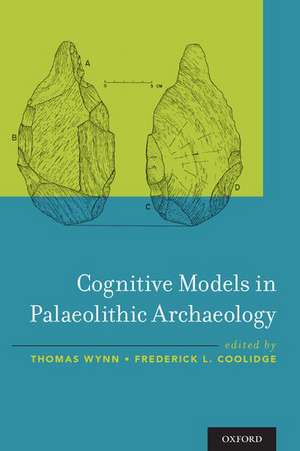
Cognitive Models in Palaeolithic Archaeology
Editat de Thomas Wynn, Frederick L. Coolidgeen Limba Engleză Hardback – 8 dec 2016
Relevanța acestei lucrări pentru cercetarea academică și cursurile de masterat în paleoantropologie este imediată, oferind un cadru riguros pentru interpretarea evoluției gândirii umane prin date materiale. În Cognitive Models in Palaeolithic Archaeology, apreciem modul în care editorii reușesc să transforme vestigiile arheologice din simple artefacte în indicatori ai proceselor mentale complexe. Ne-a atras atenția structura volumului, care nu se limitează la o descriere cronologică, ci aplică modele cognitive formale — de la procesarea informației la teoria angajamentului material — asupra unui interval vast, ce pornește de la uneltele de piatră de acum 3,3 milioane de ani și ajunge la emergența artei paleolitice.
Această abordare reprezintă o evoluție firească în opera editorilor, în special pentru Thomas Wynn, care continuă explorările din How To Think Like a Neandertal. Dacă lucrarea anterioară se concentra pe o perspectivă mai narativă și specifică asupra omului de Neanderthal, noul volum colectiv propune o sinteză metodologică mult mai tehnică și diversificată. Găsim aici o alternativă necesară la Cognitive Archaeology and Human Evolution pentru cursurile de psihologie cognitivă și arheologie, cu avantajul că integrează teorii recente precum neuroestetica și rezonanța vizuală în analiza comportamentului hominizilor. Tonul este unul precis, orientat către demonstrație științifică, făcând din acest volum un instrument indispensabil pentru studenții care doresc să înțeleagă cum funcțiile cognitive, precum memoria de lucru sau teoria minții, au lăsat urme identificabile în registrul arheologic.
Preț: 563.86 lei
Preț vechi: 853.70 lei
-34%
Carte tipărită la comandă
Livrare economică 05-16 iunie
Specificații
ISBN-10: 0190204117
Pagini: 240
Dimensiuni: 236 x 157 x 20 mm
Greutate: 0.48 kg
Editura: Oxford University Press
Colecția OUP USA
Locul publicării:New York, United States
V-ar putea interesa
-
 The Developing Visual BrainJanette AtkinsonPreț: 129.35 lei
 -
 -37%Preț: 650.12 lei1029.64 lei
 -
 Agency and Self-Awareness: Issues in Philosophy and PsychologyJohannes Roessler-24%Preț: 390.00 lei512.07 lei
 -
 Fuzzy Grammar: A ReaderBas Aarts-23%Preț: 388.60 lei506.17 lei
 -
 -23%Preț: 339.99 lei441.76 lei
 -
 TeleosemanticsGraham Macdonald-15%Preț: 329.53 lei385.47 lei
 -
 How To Think Like a NeandertalThomas Wynn-12%Preț: 124.80 lei142.54 lei
 -
 Events, Phrases, and QuestionsRobert Truswell-19%Preț: 336.55 lei413.80 lei
 -
 Origins of ObjectivityTyler BurgePreț: 337.97 lei
 -
 Memory: A Philosophical StudySven BerneckerPreț: 316.51 lei
 -
 The Opacity of Mind: An Integrative Theory of Self-KnowledgePeter Carruthers-8%Preț: 108.38 lei117.32 lei
 -
 How To Think Like a NeandertalThomas Wynn-19%Preț: 148.85 lei184.58 lei
 -
 The Complex MindMcfarland-15%Preț: 622.48 lei732.32 lei
 -
 On the Nature of the PsycheC. G. JungPreț: 125.79 lei
 -
 Consciousness: States, Mechanisms & DisordersAndrea Eugenio Cavanna-30%Preț: 1149.01 lei1646.07 lei
De ce să citești această carte
Este o resursă esențială pentru cercetătorii care doresc să depășească descrierea fizică a artefactelor și să exploreze arhitectura minții preistorice. Cititorul câștigă acces la o metodologie interdisciplinară modernă, care îmbină psihologia cu arheologia, oferind un model de analiză validat pentru evoluția cognitivă umană. Este recomandată celor care studiază paleoantropologia și doresc o înțelegere fundamentată teoretic a modului în care am devenit specia de astăzi.
Despre autor
Thomas Wynn este un pionier în domeniul arheologiei cognitive evoluționiste, fiind recunoscut la nivel internațional pentru eforturile de a uni datele arheologice cu teoriile psihologiei cognitive. Alături de Frederick L. Coolidge, a publicat lucrări fundamentale care au redefinit modul în care privim capacitățile mentale ale strămoșilor noștri. Activitatea sa la universități de prestigiu și colaborările cu Oxford University Press subliniază rigoarea academică a cercetărilor sale, fiind unul dintre puținii specialiști capabili să traducă complexitatea uneltelor paleolitice în structuri cognitive inteligibile pentru știința contemporană.
Descriere
Recenzii
“If mind is a process, we need to investigate the relationships among its parts. This book frames cognitive models into an evolutionary perspective, a necessary step to disclose those relationships. Knowledge is about questions, and this publication shows that cognitive archaeology is now looking for its own ones.>
“This offering from the standard bearers of cognitive archaeology will be a stimulating read, with both new ways of looking at the record and new ideas of when and where specific cognitive abilities are first manifested. I am particularly excited by the number of developments in cognition, including in expertise and Theory of Mind, that are suggested to occur within the Acheulean period.>