
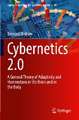
Cognitive Memory: Springer Series on Bio- and Neurosystems, cartea 17
Autor Bernard Widrow, Edward P. Katzen Limba Engleză Hardback – 2 mar 2025

Preț: 981.27 lei
Preț vechi: 1196.67 lei
-18%
Puncte Express: 1472
Carte tipărită la comandă
Livrare economică 19 decembrie 26 - 02 ianuarie 27
Livrare prin curier în România Termenul estimat este afișat lângă disponibilitate.
Transport gratuit pentru acest produs Plată online sau ramburs, în funcție de opțiunile comenzii.
Retur gratuit în 14 zile Comandă securizată și suport în română.
Specificații
ISBN-13: 9783031809385
ISBN-10: 3031809386
Pagini: 228
Dimensiuni: 160 x 241 x 18 mm
Greutate: 0.46 kg
Editura: Springer
Colecția Springer Series on Bio- and Neurosystems
Seria Springer Series on Bio- and Neurosystems
ISBN-10: 3031809386
Pagini: 228
Dimensiuni: 160 x 241 x 18 mm
Greutate: 0.46 kg
Editura: Springer
Colecția Springer Series on Bio- and Neurosystems
Seria Springer Series on Bio- and Neurosystems
Notă biografică
Bernard Widrow is Professor Emeritus in the Electrical Engineering Department at Stanford University. His research focuses on adaptive signal processing, adaptive control systems, adaptive neural networks, human memory, cybernetics, and human-like memory for computers. Applications include signal processing, prediction, noise cancelling, adaptive arrays, control systems, and pattern recognition. He received the Doctor of Science Degree from MIT in 1956, and was appointed Professor from the same University. He has been active in the field of artificial neural networks since 1957, when there were only a half-dozen researchers working on this all over the world. In 1959, he moved to Stanford University. In the same year, together with his student Ted Hoff, he invented the Least Mean Square (LMS) algorithm, which has been the world's most widely used learning algorithm to date. Since 2010, he has expanded his interest to living neural networks and biological adaptivity. A Life fellow of the Institute of Electrical and Electronic Engineering (IEEE), he was awarded with the IEEE Alexander Graham Bell Medal in 1986 and with the Benjamin Franklin Medal for Electrical Engineering in 2001. He has been inducted into both the US National Academy of Engineering and the Silicon Valley Engineering Hall of Fame, in 1995 and 1999, respectively.