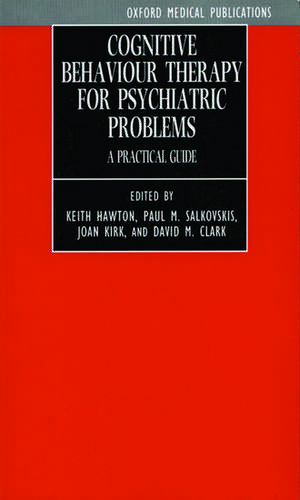
Cognitive Behaviour Therapy for Psychiatric Problems: A Practical Guide
Editat de Keith Hawton, Paul M. Salkovskis, Joan Kirk, David M. Clarken Limba Engleză Paperback – 29 iun 1989
Preț: 523.63 lei
Preț vechi: 782.62 lei
-33%
Puncte Express: 785
Carte tipărită la comandă
Livrare economică 27 noiembrie-02 decembrie
Livrare prin curier în România Termenul estimat este afișat lângă disponibilitate.
Transport gratuit pentru acest produs Plată online sau ramburs, în funcție de opțiunile comenzii.
Retur gratuit în 14 zile Comandă securizată și suport în română.
Specificații
ISBN-13: 9780192615879
ISBN-10: 0192615874
Pagini: 472
Ilustrații: figures throughout
Dimensiuni: 156 x 234 x 25 mm
Greutate: 0.73 kg
Editura: OUP OXFORD
Colecția OUP Oxford
Locul publicării:Oxford, United Kingdom
ISBN-10: 0192615874
Pagini: 472
Ilustrații: figures throughout
Dimensiuni: 156 x 234 x 25 mm
Greutate: 0.73 kg
Editura: OUP OXFORD
Colecția OUP Oxford
Locul publicării:Oxford, United Kingdom
V-ar putea interesa
-
 Stop Smoking with CBTMax Pemberton-24%Preț: 105.21 lei139.27 lei
 -
 -17%Preț: 448.67 lei541.07 lei
 -
 Overcoming Alcohol Problems: Workbook for CouplesBarbara S. McCrady-17%Preț: 308.79 lei373.44 lei
 -
 -17%Preț: 353.16 lei425.65 lei
 -
 -26%Preț: 382.59 lei516.58 lei
 -
 -12%Preț: 354.62 lei400.75 lei
 -
 A Practitioner's Guide to Rational-Emotive Behavior TherapyRaymond A. DiGiuseppe-26%Preț: 814.42 lei1103.17 lei
 -
 Hypnosis for Chronic Pain Management: Therapist GuideMark P. Jensen-16%Preț: 447.04 lei535.23 lei
 -
 ThriveDavid M. Clark-5%Preț: 74.61 lei78.54 lei
 -
 -5%Preț: 286.46 lei301.53 lei
 -
 DBT for Wellness and RecoveryAndrew Bein-5%Preț: 309.09 lei325.36 lei
 -
 CBT for Chronic Pain and Psychological Well-BeingMark Carlson-5%Preț: 343.23 lei361.29 lei
 -
 Dialectical Behavior TherapyPedersonPreț: 373.24 lei
 -
 Cultural Adaptation CBTRathodPreț: 407.89 lei
 -
 Forensic CBTRaymond Chip TafratePreț: 393.63 lei
 -
 Cognitive Behaviour Therapy for Dental Phobia andAnxietyLars-Göran Öst-8%Preț: 446.32 lei485.13 lei
 -
 -5%Preț: 256.95 lei270.47 lei
 -
 -5%Preț: 508.56 lei535.32 lei
 -
 DBT Skills Manual for Adolescents, First EditionJill H. Rathus-5%Preț: 421.47 lei443.64 lei
 -
 An Introduction to Cognitive Behaviour TherapyHelen Kennerley-5%Preț: 344.99 lei363.15 lei
 -
 -27%Preț: 91.65 lei126.24 lei
 -
 Preț: 277.60 lei
 -
 Deliberate Self-Harm in AdolescenceClaudie Fox-26%Preț: 211.44 lei286.29 lei
 -
 Overcoming Obstacles in CBTCraig Chigwedere-15%Preț: 551.23 lei648.50 lei
Cuprins
The development and principles of cognitive behavioural treatments; Cognitive behavioural assessment; Anxiety states; Phobic states; Obsessional disorders; Depression; Somatic problems; Eating disorders; Chronic psychiatric handicaps; Marital problems; Sexual dysfunctions; Problem solving; References; Index.Contributors: Gillian Butler, David M. Clark, Peter Cooper, Christopher Fairburn, Melanie Fennell, Alan E. Fruzzetti, John Hall, Keith Hawton, Neil Jacobsen, Joan Kirk, Paul M. Salkovskis, Karen B. Schmaling.
Recenzii
There are several other books on the market that cover similar topics but this has to be seen as the market leader. It is easy to read, uniformly well written and the most comprehensive of the practical handbooks available. I fully recommend it.
The editors have done an excellent editorial job and all the chapters follow a straightforward format, introducing the disorder, discussing formulation, assessment, and treatment, and finishing with a summary of the relevant research evaluating the treatment... it should be useful for any therapists, whether they be psychologists, psychiatrists, counsellors, or psychiatric nurses, who want to get an idea of what actually goes on in cognitive behavioural treatments. It should also be recommended reading in training programmes in cognitive behaviour therapy.
This is an important and timely book ... the standard of writing is very good and I think the book succeeds admirably in its stated aims. It can be recommended fully to individuals and to libraries.
A very good addition to the burgeoning literature... will be a standard text on cognitive-behavioural therapy in Britain for some time to come.
The editors have done an excellent editorial job and all the chapters follow a straightforward format, introducing the disorder, discussing formulation, assessment, and treatment, and finishing with a summary of the relevant research evaluating the treatment... it should be useful for any therapists, whether they be psychologists, psychiatrists, counsellors, or psychiatric nurses, who want to get an idea of what actually goes on in cognitive behavioural treatments. It should also be recommended reading in training programmes in cognitive behaviour therapy.
This is an important and timely book ... the standard of writing is very good and I think the book succeeds admirably in its stated aims. It can be recommended fully to individuals and to libraries.
A very good addition to the burgeoning literature... will be a standard text on cognitive-behavioural therapy in Britain for some time to come.