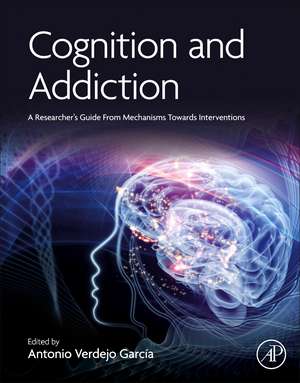
Cognition and Addiction: A Researcher’s Guide from Mechanisms Towards Interventions
Editat de Antonio Verdejo Garcíaen Limba Engleză Hardback – oct 2019
- Examines cognitive neuroscience advances in addiction theory, including both substance and behavioral addictions
- Discusses primary principles of cutting-edge assessment, phenotyping and treatment tools
- Includes detailed chapters on neuro-epidemiology and genetic imaging
Preț: 1002.95 lei
Preț vechi: 1382.92 lei
-27%
Puncte Express: 1504
Carte tipărită la comandă
Livrare economică 09-23 noiembrie
Livrare prin curier în România Termenul estimat este afișat lângă disponibilitate.
Transport gratuit pentru acest produs Plată online sau ramburs, în funcție de opțiunile comenzii.
Retur gratuit în 14 zile Comandă securizată și suport în română.
Specificații
ISBN-13: 9780128152980
ISBN-10: 0128152982
Pagini: 442
Dimensiuni: 216 x 276 x 30 mm
Editura: ELSEVIER SCIENCE
ISBN-10: 0128152982
Pagini: 442
Dimensiuni: 216 x 276 x 30 mm
Editura: ELSEVIER SCIENCE
Public țintă
Primary: researchers in cognitive neuroscience, psychology and related fields. Secondary: advanced students and physiciansCuprins
Section 1: COGNITIVE PRINCIPLES OF ADDICTION1. Cognition – the interface between nature and nurture in addiction2. From impulses to compulsions3. Dual models of addiction4. Decision-making in addiction5. Social cognition in addiction6. A neurocognitive model of addiction comorbidities
Section 2: COGNITIVE PHENOTYPING OF SUBSTANCE AND BEHAVIORAL ADDICTIONS7. Alcohol and tobacco8. Marijuana and cannabinoids9. Stimulants10. Opiates11. Gambling12. Internet and other disruptive technologies
Section 3: COGNITIVE TRAINING 13. Cognitive Bias Modification14. Working Memory Training15. Inhibitory Control Training16. Goal Management Training17. Brain Stimulation18. Cognitive Enhancers
Section 4: NEW VISTAS19. Population neuroscience in addiction20. Neuro-epidemiology21. Big data22. Modeling addiction recovery23. Clinical translation and implementation science for novel cognitive interventions24. Synergistic opportunities in combined interventions
Section 2: COGNITIVE PHENOTYPING OF SUBSTANCE AND BEHAVIORAL ADDICTIONS7. Alcohol and tobacco8. Marijuana and cannabinoids9. Stimulants10. Opiates11. Gambling12. Internet and other disruptive technologies
Section 3: COGNITIVE TRAINING 13. Cognitive Bias Modification14. Working Memory Training15. Inhibitory Control Training16. Goal Management Training17. Brain Stimulation18. Cognitive Enhancers
Section 4: NEW VISTAS19. Population neuroscience in addiction20. Neuro-epidemiology21. Big data22. Modeling addiction recovery23. Clinical translation and implementation science for novel cognitive interventions24. Synergistic opportunities in combined interventions