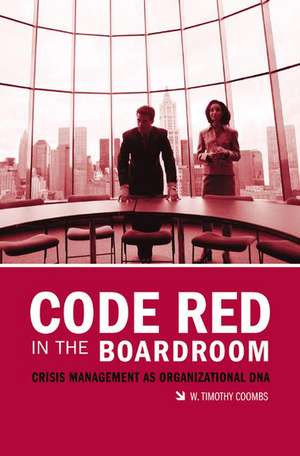
Code Red in the Boardroom: Crisis Management as Organizational DNA
Autor W. Timothy Coombsen Limba Engleză Hardback – 30 mar 2006
Subliniem de la început autoritatea incontestabilă a lui W. Timothy Coombs, un expert a cărui rigoare academică este dublată de o vastă experiență de consultanță în industrii critice precum cea petrochimică sau medicală. În Code Red in the Boardroom, autorul demontează mitul conform căruia managementul de criză este un set de măsuri de urgență activate doar în momente de dezastru. Analizând realitățile post-2001, Coombs argumentează că reziliența unei organizații depinde de transformarea vigilenței într-o componentă a ADN-ului corporativ.
Observăm o structură logică și aplicată, care pornește de la definirea tipologiilor de crize — de la atacuri externe la comportamente organizaționale defectuoase — și evoluează spre crearea unei rețele de detectare a semnalelor timpurii. Spre deosebire de alte lucrări, această ediție adnotată transformă planul de management al crizei dintr-un document static într-un instrument viu, oferind inclusiv modele de lucru și resurse oficiale precum fișele Departamentului de Securitate Internă al SUA. Pe linia practică a volumului Managing Business Crises de John James Burnett, dar cu un focus distinct pe responsabilitatea colectivă și comunicarea internă, Code Red in the Boardroom extinde temele explorate de autor în Communicating in Extreme Crises. Dacă în lucrările anterioare accentul cădea pe comunicarea în situații de indignare morală, aici descoperim un ghid strategic pentru prevenție și adaptabilitate structurală. Stilul este direct, orientat spre rezultate, oferind liderilor instrumentele necesare pentru a trece de la o postură defensivă la una proactivă.
Preț: 391.81 lei
Preț vechi: 499.04 lei
-21%
Carte tipărită la comandă
Livrare economică 26 noiembrie-10 decembrie
Specificații
ISBN-10: 0275989127
Pagini: 150
Ilustrații: 8 illustrations
Dimensiuni: 156 x 235 x 13 mm
Greutate: 0.39 kg
Ediția:annotated ed.
Editura: Bloomsbury Publishing
Colecția Praeger
Locul publicării:New York, United States
V-ar putea interesa
-
 Communicating in Extreme Crises: Lessons from the EdgeElisa R. Tachkova-18%Preț: 1116.68 lei1361.80 lei
 -
 Smart Security Cooperation ObjectivesMichael J McNerneyPreț: 159.68 lei
 -
 Information Technology AuditingJames Hall-26%Preț: 661.07 lei892.65 lei
 -
 -18%Preț: 1341.66 lei1636.17 lei
 -
 -18%Preț: 1252.16 lei1527.03 lei
 -
 Pre-Crisis Planning, Communication, and ManagementBolanie Olaniran-9%Preț: 970.44 lei1066.42 lei
 -
 -18%Preț: 1166.09 lei1422.05 lei
 -
 Oh, You Behave!Marjorie JanczakPreț: 80.96 lei
 -
 Shutting UpEric WagnerPreț: 158.45 lei
 -
 Maximize Your MessageAndrew TimminsPreț: 122.78 lei
 -
 Communicate Way More Better!Scotty GuntherPreț: 88.03 lei
 -
 Preț: 41.64 lei
 -
 Deliver Excellent Customer Service with a SnapPhilip EspinosaPreț: 53.91 lei
 -
 Outdoor Hospitality EssentialsMark J. MacihaPreț: 45.77 lei
 -
 The Consummate CommunicatorRichard S. Gallagher Ma MftPreț: 96.47 lei
 -
 Buchfuhrung & BilanzierungKlaus FrerixPreț: 60.27 lei
 -
 Top 25 Compliance and Audit Management Kpis of 2011-2012The Kpi InstitutePreț: 312.62 lei
 -
 Guidelines for Effective Business CommunicationOnline TraineesPreț: 60.48 lei
 -
 Preț: 178.87 lei
 -
 Creative Recognitions, IncSherry BlairPreț: 76.96 lei
 -
 Preț: 59.29 lei
 -
 GnuCash 2.6 Help ManualGnucash Documentation TeamPreț: 170.70 lei
 -
 GnuCash 2.6 Tutorial and Concepts GuideGnucash Documentation TeamPreț: 175.89 lei
 -
 Gnucash 2.6 HilfeGnucash Documentation TeamPreț: 133.12 lei
 -
 GnuCash 2.6 Kurs und KonzepteGnucash Documentation TeamPreț: 137.54 lei
De ce să citești această carte
Recomandăm această carte liderilor și managerilor care doresc să elimine vulnerabilitățile provocate de o falsă senzație de securitate. Cititorul va câștiga capacitatea de a implementa un sistem de avertizare timpurie și va învăța cum să implice întreaga echipă în procesul de protejare a reputației firmei. Este resursa esențială pentru a transforma managementul riscului dintr-o obligație birocratică într-un avantaj competitiv real.
Despre autor
W. Timothy Coombs este profesor la Nicholson School of Communication din cadrul University of Central Florida și un nume de referință în domeniul relațiilor publice și al afacerilor publice. Deținător al unui doctorat la Purdue University, expertiza sa a fost recunoscută internațional prin premiul Jackson, Jackson & Wagner Behavioral Science Prize, acordat de Public Relations Society of America în 2002. Autor al unor volume fundamentale precum The Handbook of Crisis Communication și Applied Crisis Communication, Coombs a predat la universități de prestigiu și oferă consultanță strategică pentru companii din sectoarele ingineriei și energiei, fiind specialist în transformarea teoriilor de comunicare în strategii de reziliență organizațională.
Descriere
Even several years after the terrorist attacks of September 11, 2001, many organizations delude themselves about crisis management. Some enterprises, especially smaller ones, still believe that a crisis cannot happen to them. Others have gone through the steps of creating a crisis management plan, but really pay no more than lip service to the program, and may, in fact, be creating a false sense of security that leaves the company even more vulnerable to attack, accident, crime, or other sources of crisis. Tim Coombs argues that crisis management should not just be something you do when a crisis hits. It should be a variety of activities that the organization performs daily to prevent crises from ocurring.
In Code Red in the Boardroom, Coombs defines the types of crises an organization might experience (both internal and external), draws from a wide variety of case examples, and showcases cutting-edge techniques that are being tested in the public and private sectors to demonstrate how crisis management can be hardwired into the corporate DNA-so that sensing, preventing, and responding quickly to crises become everyone's responsibility. In the process, he explores evolving roles for executives, managers, and front-line employees in communicating and implementing crisis plans. Ultimately, the book shows readers how proactive crisis management makes the company stronger, more resilient, and adaptable to change. A glossary of key terms and templates for establishing a crisis management program make this book an essential resource for all organizations.
Cuprins
Introduction: Crises Happen, So be Prepared
Types of Crises
Attacks on Organizations
When things go Bad
When the Organization Misbehaves
Managing Crises
Crisis Sensing Network
Crisis Management Plan as Living Document
Crisis Management as DNA: Overcoming Resistance to the Crisis Management Process
Appendix A: Sample Crisis Management Plans Elements
Appendix B: Department of Homeland Security Fact Sheet for NIMS
Index
Recenzii
Many corporations operate under the rather nave assumption that until something terrible happens, and someone in charge declares it to be a crisis, no one needs to use the word, much less think about it. Coombs advocates building crisis management into the daily life of an organization with the goal of preventing as many crises as possible and lessening the impact of those that cannot be foreseen. He describes the types of crises organizations are most likely to encounter, including attacks from without and misbehavior from within, the features of a crisis-sensing network, the benefits of a crisis management plan that serves as a living document, and methods to ensure crisis management is part of the daily corporate culture. Coombs is unflinching in his case studies, describing such crises as product liability, misconduct and boycott, and provides helpful recording instruments and strategy checklists.