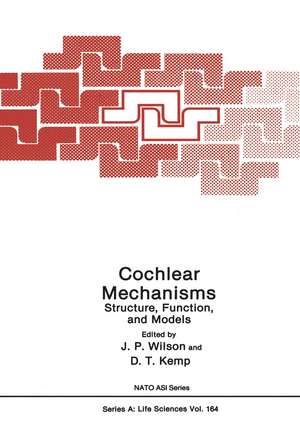
Cochlear Mechanisms: Structure, Function, and Models: NATO Science Series A:
Editat de J. Wilsonen Limba Engleză Paperback – 25 noi 2012
Din seria NATO Science Series A:
- 5%
 Preț: 372.93 lei
 - 15%
 Preț: 647.78 lei
 -
 Preț: 382.30 lei
 - 5%
 Preț: 363.51 lei
 -
 Preț: 382.65 lei
 - 18%
 Preț: 1277.85 lei
 - 5%
 Preț: 703.40 lei
 -
 Preț: 397.45 lei
 - 15%
 Preț: 624.14 lei
 - 5%
 Preț: 358.31 lei
 -
 Preț: 392.06 lei
 -
 Preț: 391.91 lei
 -
 Preț: 381.34 lei
 - 15%
 Preț: 638.29 lei
 -
 Preț: 375.57 lei
 -
 Preț: 381.63 lei
 -
 Preț: 383.23 lei
 -
 Preț: 385.99 lei
 - 15%
 Preț: 652.60 lei
 -
 Preț: 380.09 lei
 - 18%
 Preț: 904.34 lei
 - 15%
 Preț: 629.18 lei
 -
 Preț: 386.74 lei
 -
 Preț: 385.99 lei
 - 15%
 Preț: 629.98 lei
 -
 Preț: 383.11 lei
 -
 Preț: 372.43 lei
 - 5%
 Preț: 380.56 lei
 - 5%
 Preț: 1466.05 lei
 - 5%
 Preț: 1364.31 lei
 - 15%
 Preț: 626.20 lei
 -
 Preț: 384.90 lei
 -
 Preț: 372.31 lei
 - 5%
 Preț: 371.42 lei
 -
 Preț: 388.57 lei
 - 15%
 Preț: 626.36 lei
 -
 Preț: 378.95 lei
 - 5%
 Preț: 362.13 lei
 -
 Preț: 385.06 lei
 - 5%
 Preț: 374.06 lei
 -
 Preț: 385.44 lei
 - 5%
 Preț: 711.99 lei
 - 18%
 Preț: 1263.10 lei
 - 5%
 Preț: 371.77 lei
 -
 Preț: 405.77 lei
 -
 Preț: 383.59 lei
 - 5%
 Preț: 358.45 lei
Preț: 659.63 lei
Preț vechi: 776.03 lei
-15%
Puncte Express: 989
Carte tipărită la comandă
Livrare economică 28 noiembrie-12 decembrie
Livrare prin curier în România Termenul estimat este afișat lângă disponibilitate.
Transport gratuit pentru acest produs Plată online sau ramburs, în funcție de opțiunile comenzii.
Retur gratuit în 14 zile Comandă securizată și suport în română.
Specificații
ISBN-13: 9781468456424
ISBN-10: 1468456423
Pagini: 524
Ilustrații: XII, 506 p.
Dimensiuni: 170 x 244 x 29 mm
Greutate: 0.89 kg
Ediția:Softcover reprint of the original 1st ed. 1989
Editura: Springer
Colecția NATO Science Series A:
Seria NATO Science Series A:
Locul publicării:New York, NY, United States
ISBN-10: 1468456423
Pagini: 524
Ilustrații: XII, 506 p.
Dimensiuni: 170 x 244 x 29 mm
Greutate: 0.89 kg
Ediția:Softcover reprint of the original 1st ed. 1989
Editura: Springer
Colecția NATO Science Series A:
Seria NATO Science Series A:
Locul publicării:New York, NY, United States
V-ar putea interesa
-
 The Conscious Mind: In Search of a Fundamental TheoryDavid J. Chalmers-17%Preț: 144.38 lei174.98 lei
 -
 The New Executive Brain: Frontal Lobes in a Complex WorldElkhonon GoldbergPreț: 160.64 lei
 -
 The Study of Instinct: with a new PrefaceNikolaas Tinbergen-31%Preț: 536.56 lei778.78 lei
 -
 Explorations in Learning and the BrainTon De De JongPreț: 364.08 lei
 -
 Preț: 207.28 lei
 -
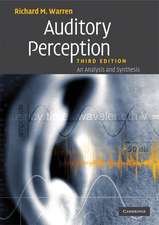 Auditory PerceptionRichard M. Warren-11%Preț: 469.85 lei527.93 lei
 -
 Foundations in Evolutionary Cognitive NeuroscienceSteven M. Platek-11%Preț: 414.98 lei466.28 lei
 -
 Neurobiology of ObesityJenni Harvey-5%Preț: 533.00 lei561.05 lei
 -
 Preț: 247.20 lei
 -
 Words And RulesProf Steven Pinker-26%Preț: 73.78 lei99.68 lei
 -
 Neurobehavioral Disorders of ChildhoodRobert Melillo-5%Preț: 1675.02 lei1763.18 lei
Public țintă
ResearchCuprins
1. Hair Cell Ultrastructure.- Structural organization of the mammalian auditory hair cells in relation to micromechanics.- Observations on the cytoskeleton and related structures of mammalian cochlear hair cells.- A comparative study of actin filaments in cochlear hair cells: outer hair cells in the apex of the guinea pig cochlea contain a unique ultrastructural feature.- The lateral walls of inner and outer hair cells.- Tip-link organization in relation to the structure and orientation of stereovillar bundles.- 2. Micromechanical measurements and models.- Hair cell mechanics controls the dynamic behaviour of the lateral line cupula.- Aminoglycoside antibiotics and lectins cause irreversible increases in the stiffness of cochlear hair-cell stereocilia.- Mechanical analysis of hair cell microstructure and motility.- A model for bidirectional transduction in outer hair cells.- A three-degree-of-freedom active micromechanical model of the cochlear partition.- Outer hair cells possess acetylcholine receptors and produce motile responses in the organ of Corti.- Mechano-electrical transduction in turtle hair cells.- Transducer motor coupling in cochlear outer hair cells.- Structure of the cortical cytoskeleton in outer hair cells from the guinea pig organ of corti.- Gating compliance, a reduction in hair-bundle stiffness associated with the gating of transduction channels in hair cells from the bullfrog’s sacculus.- Simultaneous recording of fluctuations of hair-bundle defection and intracellular voltage in saccular hair cells.- Micromechanical movements of chick sensory hair bundles to sinusoidal stimuli.- Micromechanical basis of high-frequency tuning in the bobtail lizard.- Mechanical coupling between inner and outer hair cells in the mammalian cochlea.- 3.Electrophysiological Measurements.- Phase reversal of ohc response at high sound intensities.- Outer hair cell receptor current and its effect on cochlear mechanics.- Saturation of receptor currents accounts for two-tone suppression.- Components of the membrane current in guinea pig inner hair cells.- Cochlear nonlinearities reflected in inner hair cell responses.- Asymmetries in motile responses of outer hair cells in simulated in vivo conditions.- Round window cochlear microphonic and atrophy of short and middle stereocilia on outer hair cells in hydropic cochleas in guinea pigs.- Postnatal developement of the cochlea in horseshoe bats.- On the origin of interspecific differences in auditory susceptibility.- Response properties of turtle auditory afferent nerve fibers: evidence for a high order tuning mechanism.- Cochlear filtering: a view seen through the temporal discharge patterns of single cochlear nerve fibres.- Cochlear nonlinearities implied by the differences between transient onsets and offsets to a tone burst.- “Peak-splitting”: intensity effects in cochlear afferent responses to low frequency tones.- 4. Discussion Session I.- 5. Otoacoustic Emissions.- Historical background to the proposal, 40 years ago, of an active model for cochlear frequency analysis.- CM and OAE changes following transient efferent excitation.- Effect of visual selective attention on otoacoustic emissions.- Tracking and interpretive models of the active-nonlinear cochlear response during reversible changes induced by aspirin consumption.- Analysis and influence of lidocaine on evoked otoacoustic emissions from tinnitus sufferers.- An electrical correlate of spontaneous otoacoustic emissions in a frog, a preliminary report.- Otoacoustic evidence for nonlinear behaviour in frogs’hearing: suppression but no distortion products.- Otoacoustic emissions and cochlear travelling waves.- 6. Macromechanical Measurements.- Nonlinear interactions in the mechanical response of the cochlea to two-tone stimuli.- Determinants of high-frequency sensitivity in the bird.- Mechanical response of the outer hair cell region of an isolated guinea pig cochlea in vitro.- 7. Nonlinear Models.- Power-law nonlinearities: a review of some less familiar properties.- Distortion product responses of saturating nonlinearities.- 8. Cochlear Models.- Realistic basilar membrane tuning does not require active processes.- A model of peripheral auditory preprocessing.- On the stability of cochlear mechanical models.- Time-domain solutions for 1D, 2D & 3D cochlear models.- Is basilar membrane tuning the same as neural tuning—where do we stand?.- On the nature of cochlear resonance.- 9. Discussion Session II.- Photograph of Participants.- Names and Addresses of Participants.- Names of Local Organising Committee and Session Chairmen.- Author Index.