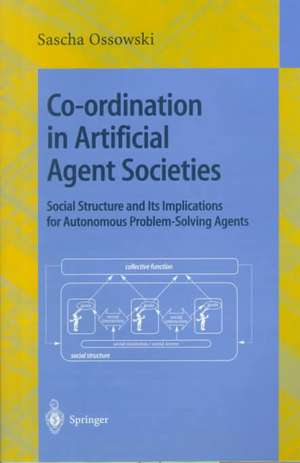
Co-ordination in Artificial Agent Societies
Autor Sascha Ossowskien Limba Engleză Paperback – 18 dec 1998
Preț: 319.10 lei
Preț vechi: 398.88 lei
-20%
Puncte Express: 479
Carte tipărită la comandă
Livrare economică 08-22 iunie
Specificații
ISBN-13: 9783540654957
ISBN-10: 354065495X
Pagini: 240
Ilustrații: XVI, 228 p.
Dimensiuni: 155 x 235 x 14 mm
Greutate: 0.37 kg
Ediția:1999
Editura: Springer
Locul publicării:Berlin, Heidelberg, Germany
ISBN-10: 354065495X
Pagini: 240
Ilustrații: XVI, 228 p.
Dimensiuni: 155 x 235 x 14 mm
Greutate: 0.37 kg
Ediția:1999
Editura: Springer
Locul publicării:Berlin, Heidelberg, Germany
V-ar putea interesa
-
 -27%Preț: 676.09 lei926.15 lei
 -
 -20%Preț: 636.04 lei795.05 lei
 -
 KanbanDavid J. Anderson-20%Preț: 249.74 lei312.18 lei
 -
 The Human Side of AgileGil BrozaPreț: 258.49 lei
 -
 Software EngineeringPer Runeson-8%Preț: 470.93 lei511.88 lei
 -
 Professional GitBrent Laster-20%Preț: 248.18 lei310.23 lei
 -
 Python AlgorithmsMagnus Lie Hetland-20%Preț: 460.12 lei575.15 lei
 -
 The Definitive Guide to HTML5 WebSocketVanessa Wang-20%Preț: 372.28 lei465.36 lei
 -
 Head First AgileAndrew Stellman-20%Preț: 327.14 lei408.92 lei
 -
 Continuous Delivery with Visual Studio ALM 2015Mathias Olausson-20%Preț: 299.70 lei374.63 lei
 -
 Design It!Michael Keeling-20%Preț: 245.51 lei306.88 lei
 -
 Mastering ServiceNow - Second EditionMartin Wood-20%Preț: 368.74 lei460.93 lei
 -
 Cooperative Information Agents VIIIMatthias Klusch-20%Preț: 323.39 lei404.23 lei
 -
 Cooperative Information Agents VIIMatthias Klusch-20%Preț: 325.71 lei407.14 lei
 -
 Reliable Software Technologies - Ada-Europe 2001Dirk Craeynest-20%Preț: 328.72 lei410.89 lei
 -
 -20%Preț: 318.89 lei398.61 lei
 -
 -20%Preț: 318.06 lei397.57 lei
 -
 Embedded SoftwareThomas A. Henzinger-20%Preț: 331.80 lei414.75 lei
 -
 Programming Languages and SystemsDaniel Le Métayer-20%Preț: 324.61 lei405.76 lei
 -
 -20%Preț: 324.61 lei405.76 lei
 -
 Software Process ImprovementIta Richardson-20%Preț: 319.10 lei398.88 lei
 -
 Programming Languages Implementation and Logic ProgrammingPierre Deransart-20%Preț: 322.80 lei403.50 lei
 -
 Coordination, Organizations, Institutions, and Norms in Agent Systems IIIJaime Simão Sichman-20%Preț: 324.82 lei406.03 lei
 -
 -20%Preț: 334.49 lei418.11 lei
 -
 -20%Preț: 397.65 lei497.06 lei
 -
 Agreement TechnologiesCarlos I. Chesnevar-20%Preț: 250.92 lei313.64 lei
Public țintă
ResearchCuprins
Co-ordination.- Distributed Artificial Intelligence.- Analysis.- Emergent Co-ordination by Structural Co-operation.- Structural Co-operation and Bargaining.- An Instrumentation of Structural Co-operation.- Road Traffic Management.- A Case Study.- Conclusions.
Textul de pe ultima copertă
This monograph provides a comprehensive survey of the different approaches to coordination in societies of artificial an human agents. Setting out from a critical assessment of the state of the art, the author develops a method of structuring multi-agent applications with a mechanism called structural cooperation. Agents are equipped with expertise about their environment in order to detect and overcome specific types of problem, they make use of their social knowledge to mutually adjust their activities, and they are coerced toward coherent collective behavior through normative rules. The proposed model is formalized theoretically within game theory and realized by means of an agent architecture. It is assessed experimentally by building a prototype of a distributed decision support system for road traffic management and compared to an alternative model based on a centralized architecture.
A valuable feature of the work is that it not only promotes a well-founded formal model of coordination in artificial agent societies but also applies it in an operational software architecture organized as a society of intelligent agents to solve real-world problems.
A valuable feature of the work is that it not only promotes a well-founded formal model of coordination in artificial agent societies but also applies it in an operational software architecture organized as a society of intelligent agents to solve real-world problems.
Caracteristici
The author presents a well-founded formal model of coordination in artificial agent societies Real-world problems solved using the model in an operational software architecture organized as a society of intelligent agents Includes supplementary material: sn.pub/extras