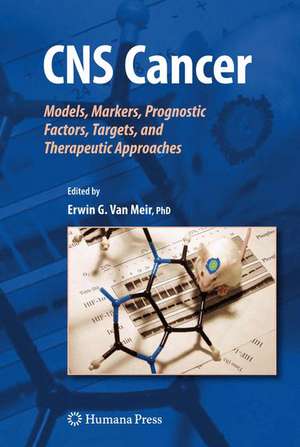
CNS Cancer
Editat de Erwin G van Meiren Limba Engleză Hardback – 30 iul 2009
În contextul în care neoplasmele sistemului nervos central rămân printre cele mai letale forme de cancer, ediția CNS Cancer coordonată de Erwin G van Meir reprezintă o sinteză clinică și teoretică de o amploare remarcabilă. Apreciem modul în care această lucrare integrează progresele obținute în ultimele două decenii prin descifrarea genomului uman, oferind o perspectivă actualizată asupra mecanismelor moleculare care guvernează rezistența tumorală. Ediția aduce în prim-plan o analiză riguroasă a stadiului actual în cercetarea oncologică, punând un accent deosebit pe tranziția de la laborator la patul pacientului. Structura volumului este organizată strategic, începând cu o secțiune vastă dedicată modelelor animale pentru tumorile SNC. Sunt detaliate protocoale specifice, precum utilizarea retrovirusurilor care exprimă PDGF pentru modelarea gliomului sau utilizarea modelelor murine pentru Neurofibromatoza de tip 1. Această abordare sistematică permite cercetătorului să înțeleagă nu doar patogeneza, ci și potențialele ținte terapeutice. Credem că această organizare facilitează o progresie logică de la biologia celulară la evaluarea preclinică a noilor modalități de diagnostic. CNS Cancer este un manual de referință comparabil cu Animal Models of Brain Tumors de Ricardo Martínez Murillo, însă volumul de față extinde aria de acoperire dincolo de metodologie, integrând date clinice despre astrocitoamele de grad înalt și glioblastomul multiform. Față de alte titluri, această lucrare reușește să mențină un echilibru între rigoarea științifică a cercetării fundamentale și necesitățile practice ale neuro-oncologului clinician, abordând inclusiv consecințele devastatoare ale terapiilor actuale asupra dezvoltării cognitive.
Preț: 1424.13 lei
Preț vechi: 1499.09 lei
-5%
Carte disponibilă
Livrare economică 18 mai-01 iunie
Specificații
ISBN-10: 1603275525
Pagini: 1284
Ilustrații: XII, 1284 p. 160 illus., 64 illus. in color. With 2 16-page color inserts.
Dimensiuni: 165 x 245 x 66 mm
Greutate: 2.06 kg
Ediția:2009 edition
Editura: Humana Press Inc.
Locul publicării:Totowa, NJ, United States
V-ar putea interesa
-
 The Selfish Cell: An Evolutionary DefeatMatteo Conti-5%Preț: 350.01 lei368.43 lei
 -
 Cancer & Stem CellsThomas Dittmar-30%Preț: 771.05 lei1099.78 lei
 -
 -5%Preț: 531.06 lei559.01 lei
 -
 MicroRNA and CancerWei Wu-5%Preț: 702.54 lei739.52 lei
 -
 Gene Therapy of Cancer: Methods and ProtocolsWolfgang Walther-5%Preț: 850.62 lei895.38 lei
 -
 Bladder Tumors:: Molecular Aspects and Clinical ManagementVinata B. Lokeshwar-5%Preț: 1364.67 lei1436.50 lei
 -
 Cancer Stem Cells: Methods and ProtocolsJohn S. Yu-5%Preț: 694.80 lei731.37 lei
 -
 Lymphoma: Methods and ProtocolsRalf Küppers-5%Preț: 700.92 lei737.81 lei
Public țintă
Professional/practitionerDe ce să citești această carte
Recomandăm această lucrare profesioniștilor care caută o înțelegere profundă a fundamentelor genetice și moleculare ale tumorilor cerebrale. Cititorul câștigă acces la o documentație vastă despre modelele experimentale de ultimă oră, esențiale pentru dezvoltarea de noi medicamente. Este o resursă indispensabilă pentru cei care doresc să depășească limitele terapiilor convenționale și să exploreze medicina de precizie în neuro-oncologie.
Despre autor
Erwin G van Meir este un cercetător și editor de prestigiu, recunoscut pentru contribuțiile sale în domeniul neuro-oncologiei. Activitatea sa se concentrează pe mecanismele moleculare ale progresiei tumorale și pe dezvoltarea de noi strategii terapeutice pentru cancerele sistemului nervos central. În acest volum publicat de Humana Press Inc., el reunește o echipă internațională de experți pentru a oferi o imagine cuprinzătoare asupra intersecției dintre genetica umană și practica clinică în tratarea neoplasmelor SNC.
Cuprins
Notă biografică
For the past 20 years Dr. Van Meir’s research has focused on defining the biological significance of specific genetic alterations for brain tumor development, with particular emphasis on extracellular signaling regulating heterotypic cell communication as in tumor angiogenesis, and translating this knowledge into new therapeutic approaches. His research is described in more than 140 peer-reviewed research papers and review articles in internationally recognized journals that have cumulated over 5,000 citations and received several awards. These contributions were presented in over 100 invited seminars worldwide and have furthered the understanding of cytokine expression for glioma biology, Turcot syndrome, the role of transcription factors p53 and HIF and of pro- and anti-angiogenesis factors IL-8, thrombospondin-1 and brain angiogenesis inhibitor-1 in brain tumor angiogenesis, hypoxia, and pseudopalisade formation. He also discovered novel biomarkers in the cerebrospinal fluid of brain tumor patients and developednovel therapeutic agents including oncolytic hypoxia-activated adenoviruses, pro-apoptotic galectin-3, anti-angiogenic vasculostatins and small molecule HIF/Hsp90/plectin1 inhibitors that are covered by several US and foreign patents. Perhaps most importantly, over his still young 20 year independent career Dr Van Meir has already mentored and trained over 60 postdoctoral fellows, students and visiting scientists, many of which now hold independent leading positions in Academia or Industry.
Dr Van Meir is an active member of the International Neuro-Oncology community and served on the Board of Directors of the Society for Neuro-Oncology from 2004-2008. He organized several international conferences on brain tumors, has served on the Scientific Committee of the European Association for Neuro-Oncology, the Scientific Advisory Board of the Southeastern Brain Tumor Foundation and is a current or former member of several other international cancer societies including the American Association for Cancer Research, the European Association for Cancer Research, and the American Society for Investigative Pathology.
Dr. Van Meir currently serves on the Editorial Board of Neuro-Oncology, Frontiers in Bioscience, and International Journal of Oncology and is a former Associate Editor of the International Journal of Cancer. He has served as a reviewer for over 30 international scientific journals and for grant proposals from public and private agencies including the US National Institutes of Health, the US Department of Defense, the Swiss National Science Foundation, the Swiss Cancer Society, the Wellcome Trust of the UK, Cancer Research UK, the Research Grants Council of Hong Kong, the Israel Science Foundation, The Belgian Fournier-Majoie and Baudouin Foundations and the Italian Association for Cancer Research.
He acknowledges present and past support by multiple funding agencies for his scientific work, including the US National Institutes of Health, the Swiss National Science Foundation, the Goldhirsh Foundation, the Charlotte Geyer Foundation, the Southeastern and National Brain Tumor Foundations, The Brain Tumor Society, the Pediatric Brain Tumor Foundation of the US, the American Brain Tumor Association, the Brain Tumor Foundation for Children, the Al Musella, Wayne O Rollins and Frances Wood Wilson Foundations, the Brain Tumor Trust, the Emory University Research Council and EmTechBio, the Swiss Cancer League and Anti-Cancer Foundations, the San Salvatore, Tossizza, Ott and Chuard-Smith Foundations, and the European Institute of Oncology.
Textul de pe ultima copertă
Erwin G. Van Meir
Cancers of the central nervous system are among the most lethal of human neoplasms. They are recalcitrant to even intensive multimodality therapies that include surgery, radiotherapy and chemotherapy. Moreover, especially in children, the consequences of these therapies can itself be devastating and involve serious cognitive and developmental disorders. It is small wonder that such cancers have come under the intense scrutiny of each of the subspecialties of clinical care and investigation as well as attracting some of the best basic research scientists. Their joint efforts are gradually peeling away the mysteries surrounding the genesis and progression of these tumors and inroads are being steadily made into understanding why they resist therapies.This makes it an especially opportune time to assemble some of the best investigators in the field to review the "state of the art" in the various arenas that comprise the assault on CNS tumors. While the lethality of these tumors has remained dismal over the past decades, there is finally real reason for optimism as our knowledge base grows exponentially larger.
The major areas of this endeavor are displayed in CNS Cancer: Models, Markers, Prognostic Factors and Therapeutic Approaches. Each of the chapters in the book represents illustrative examples of the road from discovery through translation to clinical importance, although many begin the journey at different parts of this continuum. This includes several chapters on incredibly clever mouse models for deciphering the genetic wiring underlying the development of CNS tumors and how that wiring might be targeted for therapeutic benefit. A great deal of attention has been paid in the book to the development of genetic prognostic factors and biomarkers that could be used for assessing individual responses to therapies and socould lead to truly personalized medicine. Other possible prognostic factors/biomarkers that arise from an understanding of CNS tumor pathophysiology are discussed in some detail and include tumor vascularization and hypoxia. Several of the new and rapidly developing methodologies that allow these rapid advances are detailed for the reader as well and include RNA expression profiling, proteomic analyses of both tumors and biological fluids as well as profiling small non-coding RNAs and DNA modification. Finally, several chapters explore aspects of therapeutic targeting employing small molecules and combinations thereof, various sorts of cells, viruses and immune modulation. In sum, these treatises represent the cutting edge of research that is driven to be of benefit to patients with these dreaded diseases.
Erwin G. Van Meir is Professor of Neurosurgery and Hematology & Medical Oncology in the School of Medicine at Emory University. A native of Belgium, he obtained Bachelor’s degrees in Biology and Education at the University of Fribourg, Switzerland. Dr Van Meir is an active member of the International Neuro-Oncology community and served on the Board of Directors of the Society for Neuro-Oncology from 2004-2008. Dr. Van Meir currently serves on the Editorial Board of Neuro-Oncology, Frontiers in Bioscience, and International Journal of Oncology and is a former Associate Editor of the International Journal of Cancer. He has served as a reviewer for over 30 international scientific journals and for grant proposals from public and private agencies.