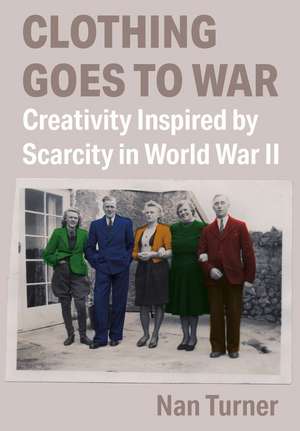
Clothing Goes to War: Creativity Inspired by Scarcity in World War II
Autor Nan Turneren Limba Engleză Paperback – 20 iul 2022
Manufacturing for civilians across the globe nearly stopped at the outset of World War II, as outfitting troops took precedence over nonmilitary production. Raw materials were prioritized for the armed forces and the majority of nonmilitary factories were shifted to war work, resulting in shortages and rationing of consumer products. Civilians, especially women, responded to the resulting scarcity of goods by using ingenuity and creativity to “make do.” In Clothing Goes to War, Nan Turner offers a critical look at some of the resourceful results of this period as necessity paved the way for fashionable invention.
Preț: 277.81 lei
Puncte Express: 417
Carte disponibilă
Livrare economică 02-16 noiembrie
Livrare express 17-23 octombrie pentru 34.51 lei
Livrare prin curier în România Termenul estimat este afișat lângă disponibilitate.
Transport gratuit de la 400.00 lei Plată online sau ramburs, în funcție de opțiunile comenzii.
Retur gratuit în 14 zile Comandă securizată și suport în română.
Specificații
ISBN-13: 9781789383461
ISBN-10: 1789383463
Pagini: 312
Ilustrații: 16 color plates, 108 halftones
Dimensiuni: 170 x 244 x 20 mm
Greutate: 0.5 kg
Editura: Intellect Ltd
Colecția Intellect Ltd
ISBN-10: 1789383463
Pagini: 312
Ilustrații: 16 color plates, 108 halftones
Dimensiuni: 170 x 244 x 20 mm
Greutate: 0.5 kg
Editura: Intellect Ltd
Colecția Intellect Ltd
V-ar putea interesa
-
 -30%Preț: 272.42 lei387.59 lei
 -
 Jane Austen's WardrobeHilary DavidsonPreț: 225.83 lei
 -
 Bringing Modernity HomeJudy Attfield-19%Preț: 682.62 lei842.73 lei
 -
 Indian DesignsDavid VillasenorPreț: 90.43 lei
 -
 Everyday Acts of Design: Learning in a Time of EmergencyZoy Anastassakis-21%Preț: 124.68 lei157.69 lei
 -
 Rose's SongNan TurnerPreț: 99.70 lei
 -
 View from the AtticNan TurnerPreț: 99.88 lei
 -
 Promises to KeepNan TurnerPreț: 99.15 lei
 -
 Return to BridgetownNan TurnerPreț: 117.26 lei
 -
 Lily's StoryNan TurnerPreț: 98.40 lei
 -
 The Box in the AtticNan TurnerPreț: 97.84 lei
 -
 A Passion for FashionAntonia KeaneyPreț: 111.32 lei
 -
 -23%Preț: 238.63 lei311.73 lei
 -
 Preț: 230.04 lei
Notă biografică
Nan Turner is a fashion and textiles instructor at the University of California, Davis.
Cuprins
Introduction
1 Rationale for Rationing
2 Gender during WWII
3 Home Front Handicrafts
4 Wartime Weddings
5 Costumes go to War
6 Black Market
7 DIY returns
Epilogue
1 Rationale for Rationing
2 Gender during WWII
3 Home Front Handicrafts
4 Wartime Weddings
5 Costumes go to War
6 Black Market
7 DIY returns
Epilogue
Recenzii
"Clothing Goes to War is a sound contribution to the ever-expanding body of literature on the interactions between material culture, social history and war. Turner explores the roles of different textiles in war — jute, cotton, wool, nylon and even rubber (never underestimate the prevalence of girdles in wartime) — and the ways in which female ingenuity battled scarcity. Her narrative is a successful interweaving of personal stories and historical analysis, sharing experiences of women across different social classes and nationalities in a way that is both moving and insightful...
The book’s broad overview of national policies on thrift in both Allied and Axis countries, balanced with individual interviews by the author, makes clear that traditional female thrift and women’s unpaid labour were both crucial factors in government economic policies... What sets this book apart from many histories of wartime apparel are the connections made across different classes, races and nations, and the comparison it draws between thrift practices then and now. Turner draws our attention to parallels between wartime crafting necessities and recent pandemic responses. Times of crisis focus consumers on issues of hoarding, scarcity and adaptability — very much features relevant to the Second World War as well as current global issues of conflict and deprivation...
Clothing Goes to War is a call for greater awareness of textile sustainability practices, and a fine tribute to so-called ordinary people who persevered through the hardships of the 1930s and 1940s."
The book’s broad overview of national policies on thrift in both Allied and Axis countries, balanced with individual interviews by the author, makes clear that traditional female thrift and women’s unpaid labour were both crucial factors in government economic policies... What sets this book apart from many histories of wartime apparel are the connections made across different classes, races and nations, and the comparison it draws between thrift practices then and now. Turner draws our attention to parallels between wartime crafting necessities and recent pandemic responses. Times of crisis focus consumers on issues of hoarding, scarcity and adaptability — very much features relevant to the Second World War as well as current global issues of conflict and deprivation...
Clothing Goes to War is a call for greater awareness of textile sustainability practices, and a fine tribute to so-called ordinary people who persevered through the hardships of the 1930s and 1940s."