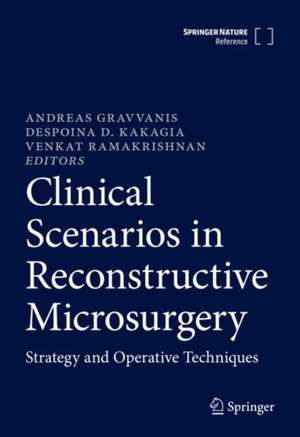
Clinical Scenarios in Reconstructive Microsurgery: Strategy and Operative Techniques
Editat de Andreas Gravvanis, Despoina D. Kakagia, Venkat Ramakrishnanen Limba Engleză Hardback – 27 noi 2022
În ultimii ani, practica microchirurgiei reconstructive a migrat de la simpla închidere a defectelor către o abordare axată pe restaurarea funcțională și estetică de înaltă precizie, susținută de evoluția tehnicilor de transfer tisular liber. Observăm o complexitate crescândă a cazurilor, unde decizia clinică nu mai depinde doar de disponibilitatea lamboului, ci de integrarea unor strategii personalizate în contextul oncologic sau traumatic al pacientului. Clinical Scenarios in Reconstructive Microsurgery răspunde acestei nevoi de rigoare, oferind o radiografie a 100 de scenarii clinice care acoperă întreg spectrul specialității.
Structura volumului este organizată anatomic, pornind de la reconstrucția complexă a capului și gâtului — unde sunt detaliate proceduri precum replantarea totală de scalp sau utilizarea lamboului radial de antebraț pentru reconstrucția nazală — și continuând cu extremitățile, trunchiul și managementul chirurgical al limfedemului. Apreciem în mod deosebit formatul didactic: fiecare caz nu este doar o expunere de succes, ci un parcurs analitic ce include diagnosticul, planificarea strategică și, esențial, o discuție critică asupra avantajelor și dezavantajelor fiecărei tehnici alese.
Suntem de părere că această lucrare reprezintă o alternativă valoroasă la Atlas of Reconstructive Surgery: A Case-Based Approach pentru rezidenții seniori și specialiști. În timp ce atlasul lui Lee L.Q. Pu se concentrează pe experiența personală a unui singur autor, volumul editat de Andreas Gravvanis și echipa sa oferă o perspectivă multi-centrică și o structură de tip algoritm, facilitând procesul de luare a deciziilor în situații limită. Această ediție 2022 integrează cele mai noi protocoale de management postoperator, devenind un instrument clinic indispensabil în arsenalul chirurgului plastician modern.
Preț: 6163.04 lei
Preț vechi: 6487.42 lei
-5%
Carte disponibilă
Livrare economică 15-29 mai
Specificații
ISBN-10: 3030237052
Pagini: 1000
Ilustrații: XXXIII, 1083 p. 936 illus., 869 illus. in color.
Dimensiuni: 178 x 254 mm
Greutate: 2.5 kg
Ediția:1st ed. 2022
Editura: Springer International Publishing
Colecția Springer
Locul publicării:Cham, Switzerland
V-ar putea interesa
-
 Flaps and Reconstructive SurgeryFu-Chan Wei-29%Preț: 1637.13 lei2308.03 lei
 -
 Plastic Surgery - Principles and PracticeRostam Farhadieh-29%Preț: 1605.62 lei2248.44 lei
 -
 Plastic Surgery: Volume 6: Hand and Upper LimbJames Chang-5%Preț: 1537.06 lei1617.96 lei
 -
 -25%Preț: 1293.34 lei1717.94 lei
 -
 Refinements in the Art of Complex Breast ReconstructionJonathan Bank-30%Preț: 1101.83 lei1567.36 lei
 -
 -5%Preț: 668.69 lei703.88 lei
 -
 Current Practice in Hand SurgeryJin Bo Tang-29%Preț: 1474.87 lei2076.38 lei
 -
 -5%Preț: 823.31 lei866.64 lei
 -
 Plastic Surgery: Volume 1: Principles (Expert Consult Online and Print)Geoffrey C Gurtner-23%Preț: 1178.01 lei1533.71 lei
 -
 Plastic Surgery: Volume 4: Trunk and Lower ExtremityDavid H Song-24%Preț: 1155.31 lei1519.22 lei
 -
 Flaps: Practical Reconstructive SurgeryKayvan Shokrollahi-5%Preț: 2171.10 lei2285.37 lei
 -
 Reconstructive Plastic Surgery of the Head and NeckMatthew M Hanasono-5%Preț: 1283.55 lei1351.10 lei
 -
 Handbook of Reconstructive FlapsMatthew M. Hanasono-5%Preț: 802.65 lei844.90 lei
 -
 Essentials of Plastic SurgeryJeffrey Janis-5%Preț: 1116.19 lei1174.95 lei
 -
 Essentials of Plastic Surgery: Q&A CompanionAlex Jones-5%Preț: 1170.99 lei1232.62 lei
 -
 Principles of Facial ReconstructionWayne F. Larrabee-5%Preț: 1277.63 lei1344.88 lei
 -
 Local Flaps in Facial ReconstructionVelupillai Ilankovan-5%Preț: 1079.84 lei1136.67 lei
 -
 Reconstructive Facial Plastic SurgeryHilko Weerda-5%Preț: 925.38 lei974.09 lei
 -
 Cutaneous Flaps in Head and Neck ReconstructionVasilios K. Thomaidis-5%Preț: 823.04 lei866.36 lei
 -
 Practical Microsurgery CasesChunlin Hou-5%Preț: 735.52 lei774.23 lei
De ce să citești această carte
Recomandăm această lucrare chirurgilor plasticieni și ortopezilor care doresc să își rafineze procesul decizional în microchirurgie. Cititorul câștigă acces la 100 de strategii chirurgicale verificate, explicate pas cu pas, depășind simpla descriere tehnică prin includerea punctelor critice de învățare. Este un ghid practic care transformă complexitatea teoretică în soluții operatorii concrete pentru cazuri de reconstrucție dificilă.
Despre autor
Volumul este coordonat de o echipă de experți internaționali de renume. Andreas Gravvanis este un specialist recunoscut în chirurgie plastică, cu o activitate vastă în reconstrucția microchirurgicală complexă. Despoina D. Kakagia aduce o expertiză academică și clinică solidă, în timp ce Venkat Ramakrishnan este un lider mondial în reconstrucția mamară microchirurgicală, fiind celebru pentru contribuțiile sale în perfecționarea tehnicilor de lambou liber. Împreună, aceștia au sintetizat decenii de experiență operatorie în acest tratat de referință publicat de Springer.
Descriere scurtă
Cuprins
A. SCALP RECONSTRUCTION
1. Total Scalp Replantation.
2. Scalp cutaneous defects with bone exposure following scald burn; Reconstruction with free ALT flap.
3. Scalp and calvarial bone defect following oncological resection; Reconstruction with hydroxyapatite bone grafts and free radial forearm flap.
4. Scalp and calvarial bone and dural defect following oncological resection; Reconstruction with fascia lata graft, hydroxyapatite bone graft and free latissimus dorsi flap.
5. Calvarial bone radionecrosis/osteomyelitis management; Radical debridement and free rectus muscle flap. 6. Cranial base reconstruction.
B. NASAL RECONSTRUCTION
7. Nasal skin defects resurfacing with a free flap
8. Total nasal reconstruction with radial forearm flap and a rib graft.
9. Total nasal reconstruction with radial forearm flap, forehead flap and a rib graft. 10. Nasal septum reconstruction following oncological resection.
11. Microsurgical Reconstruction of the Nasal Ala using a Composite Auricular Graft Based on the Superficial Temporal Vessels.
C. TONGUE RECONSTRUCTION
12. Partial glossectomy reconstruction with ulnar forearm flap.
13. Subtotal glossectomy reconstruction with saphenous flap.
14. Tongue reconstruction with ALT/vastus lateralis after total glossectomy glossectomy.
D. LIP RECONSTRUCTION
15. Total lower lip reconstruction with a skin flap and a tendon graft.
16. Total lower lip reconstruction with functioning free muscle.
E. EAR RECONSTRUCTION
17. Ear replantation.
18. Ear reconstruction using microsurgical techniques.
F. MID FACE RECONSTRUCTION
19. Massive facial defect following trauma.
20. Mid face reconstruction with TAP flap. 21. Maxillary and mid- face reconstruction with scapular flap.
22. Mandibular reconstruction with CAD/CAM technology.
23. Mandible osteomyletis reconstruction.
24. Reconstruction of Temporomandibular Joint with a Fibula Free Flap: A Case Report With a Histological Study.
25. Mandibular reconstruction with iliac crest. 26. Immediate oromandibular defect reconstruction with double flap (fibula and ALT).
27. Immediate oromandibular defect reconstruction with chimeric fibula flap.
28. Head and Neck secondary reconstruction in a vessel-depleted neck.
29. Craniofacial deformity reconstruction.
30. Hemifacial atrophy reconstruction with parascapular flap.
31. Noma disease reconstruction.
32. Facial transplantation.
G. UPPER DIGESTIVE SYSTEM RECONSTRUCTION
33. Hypopharynx reconstruction.
34. Robotic flap inset in pharyngeal reconstruction.
35. Oesophageal reconstruction with free cutaneous flap.
36. Oesophageal reconstruction with supercharged ileocolon flap.
37. Repair of a large pharyngocutaneous fistula with a free jejunal patch flap after salvage laryngectomy. 38. Voice reconstruction with free ileocolon flap transfer.
39. Tracheal reconstruction.
40. Tracheal transplantation.
H. FACIAL PARALYSIS
41. Adult Facial nerve palsy reconstruction. Gracilis functioning muscle innervated with cross face nerve graft.
42. Microsurgical eye reanimation.
43. One-stage reconstruction of facial paralysis using latissimus dorsi functioning muscle. 44. One-stage reconstruction of facial paralysis using masseter nerve-innervated gracilis.
45. One-stage reconstruction of facial paralysis using spinal accessory nerve-innervated gracilis.
46. Adult Facial nerve palsy reconstruction. Double innervation of Gracilis functioning muscle innervated with cross face nerve graft and masseter nerve.
47. Synkinesis treatment following nerve palsy.
48. Congenital facial nerve palsy (Moebius syndrome).
II. UPPER EXTREMITY
A. BRACHIAL PLEXUS INJURIES - PERIPHERAL NERVE INJURIES49. Obstetric brachial plexus injuries
50. Adult brachial plexus immediate reconstruction
With intercostal nerves.
51. Adult brachial plexus immediate reconstruction
With contralateral C7.
52. Infraclavicular brachial plexus injury.
53. Brachial plexus secondary reconstruction with functional muscle (elbow flexion-finger extension).
54. Brachial plexus secondary reconstruction with functional muscle (shoulder abduction).
55. Spaghetti wrist injury.
56. Ischemic compartment functional reconstruction.
57. Secondary reconstruction of high median nerve injury Motor and Sensory Nerve Transfers to Restore Function.
58. Application of free temporoparietal fascial flap for recurrent neural adhesion of superficial radial nerve.
59. Painful neuroma reconstruction.
B. THUMB - HAND RECONSTRUCTION
60. Thumb amputation and replantation. 61. Multiple finger replantations.
59. Thumb reconstruction.
60. Thumb pulp reconstruction with sensate flap.
61. Thumb pulp reconstruction with great toe hemi-pulp flap transfer.
62. Thumb reconstruction with toe to thumb.
63. Thumb reconstruction with wrap around flap.
64. Congenital thumb reconstruction with index pollicisation.
65. Thumb and the first web reconstruction with neurovascularised instep flap.
66. Thumb reconstruction with medial plantar artery perforator flaps.
67. Thumb reconstruction with medial femoral corticoperiosteal free flap.
68. The free instep flap for palmar and digital resurfacing.
69. Degloving injuries.
70. Transverse sensate thoracodorsal artery perforator flaps to resurface fingers.
71. Free distal forearm perforator flap for digital reconstruction.
72. SUBPRA for volar digital resurfacing.
73. Dorsal digital sensate free flap for reconstruction of volar soft tissue defect of digits.
74. Free temporoparietal flap in hand coverage.
75. Free serratus anterior fascia flap for reconstruction of hand and finger defects.
76. Thenar reconstruction with functional gracilis flap.
77. Hand skin defects with tendon defect.
78. Volar defects in fingers with distal ulnar artery perforator flaps.
79. Bilateral hand transplant.
III. TRUNK
80. Large chest wall defects.
81. Post burn scar contracture.
82. Axillary reconstruction with ALT.
83. Functional reconstruction of abdominal wall defect.
84. Pelvic floor reconstruction with Latissimus dorsi.
85. Vaginal reconstruction.
86. Penile reconstruction.
87. Functional bladder reconstruction.
88. Breast and chest wall reconstruction with the transverse musculocutaneous gracilis flap in Poland syndrome.
89. Autologous reconstruction of a complex form of Poland syndrome using 2 abdominal perforator free flaps.
90. Aesthetic restoration of Poland's syndrome in a male patient using free anterolateral thigh perforator flap as autologous filler.
IV. BREAST
91. Areola sparing mastectomy and immediate DIEP flap.
92. Skin sparing mastectomy and TUG flap.
93. Secondary breast reconstruction with SGAP flap P.
94. Tertiary reconstruction (previous failed implant reconstruction) with PAP flap.
95. Case of a failed free DIEP, rexploration and outcome.
96. Stacked abdominal flap for unilateral breast reconstruction.
97. Breast reconstruction with Lumbar artery perforator flap.
98. Breast reconstruction with SIEA flap.
99. Breast reconstruction with ALT.
100. Breast reconstruction with Vertical Posteromedial thigh flap.
101. Four free flaps for 'stacked' bilateral breast reconstruction.
102. Immediate breast reconstruction with a free flap and an implant. 103. Partial mastectomy reconstruction with TDAP flap.
V. LYMPHEDEMA
104. Lymphatico-venous anastomoses for lower extremity stage I lymphedema. 105. Vascularised lymph node transfer for upper extremity stage II lymphedema.
106. Secondary breast reconstruction with DIEP flap and lymph node transfer.
107. Fibro-Lipo-Lymph-Aspiration With a Lymph Vessel Sparing Procedure to Treat Advanced Lymphedema After Multiple Lymphatic-Venous Anastomoses.
108. Vascularized lymph node transfer from thoracodorsal axis for congenital lymphedema of the lower limb.
109. Lymphatic vessel grafting for prevention of venous reflux into a sclerotic lymphatic vessel in supermicrosurgical lymphaticovenular anastomosis.
VI. LOWER EXTREMITY
110. Free fibular transfer for femoral head osteonecrosis. 111. Femoral bone reconstruction following oncological resection.
112. Coverage of knee joint/ arthroplasty prosthesis exposure with free flap.
113. Coverage of knee joint with supercharged pedicled perforator flap.
114. Gustillo type IIIB tibial defects.
115. Gustillo type IIIC tibial defects; reconstruction with a flow-through free flap.
116. Peroneal nerve palsy - functional reconstruction.
117. Tibial bone defect reconstruction with Illizarov and free flap.
118. Tibial bone defects reconstruction with free fibula flaps.
119. Heel defect reconstruction.
120. Achilles tendon reconstruction.
121. Plantar weight bearing area defects.
122. Supermicrosurgical free sensate superficial circumflex iliac artery perforator flap for reconstruction of a soft tissue defect of the ankle.
123. Reconstruction of metatarsal bone defects with a free fibular flap.
124. Lower limb transplantation.
125. Reconstruction of the ankle complex wound with a fabricated superficial circumflex iliac artery chimeric flap including the sartorius muscle.
126. Management of sciatic nerve schwannoma.
Notă biografică
Despoina D. Kakagia is Professor of Plastic Surgery at Democritus University in Thrace, Greece, and has been practicing reconstructive and cosmetic plastic surgery since 1998. Following her comprehensive training in plastic surgery at Metaxa Cancer Institute and Athens General State Hospital in Greece, she underwent further training in microsurgery of the hand and breast at Canniesburn, Glasgow, Scotland; Chelsea and Westminster Hospital, London, UK; and Aachen University Hospital, Germany.
Professor Kakagia is a member of the Hellenic Society of Plastic Reconstructive and Aesthetic Surgery (HESPRAS), the Hellenic Society of Reconstructive Microsurgery and Hand and Upper Limb Surgery, and the Hellenic Society of Wound Healing and is an active member of EURAPS. Her special interests include oncologic surgery and trauma, breast surgery, burns, and wound healing.
Professor Kakagia has been teaching plastic surgery at undergraduate and postgraduate level since 2006 and has participated as an instructor in many microsurgery training courses. She is the author or co-author of more than 70 publications in peer-reviewed international journals and has authored 1 book as well as 15 book chapters. She is an active reviewer in more than 30 international medical journals.
Venkat Ramakrishnan is a Consultant Plastic Surgeon at the St Andrew’s Centre for Plastic Surgery and Burns, Chelmsford, United Kingdom, and Visiting Professor of Microsurgery at the Anglia Ruskin University, Chelmsford, United Kingdom. His main area of work is microsurgical reconstruction of the breast and aesthetic surgery of the breast.
Ramakrishnan plays a major role as a trainer in microsurgery and was the inaugural Tutor in Plastic Surgery at the Royal College of Surgeons of England, London. He was the Director of the St Andrew’s Centre and has had roles in the BAPRAS Council and the project board of the National Mastectomy and Reconstruction audit. He is a member of the editorial board of the Journal of Plastic, Reconstructive and Aesthetic Surgery and Archives of Plastic Surgery. He is a fellow of the Royal College of Surgeons of England and the Royal Australasian College of Surgeons.
Ramakrishnan has numerous publications and presentations at national and international meetings. His main areas of research and audit are in microsurgical techniques, service delivery, and microcirculation in free flaps.
Caracteristici
Thoroughly analyzes the decision-making steps for each case
Features accompanying high resolution photos for each case