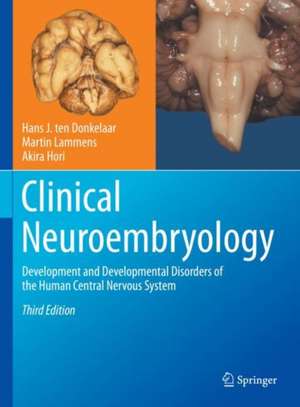
Clinical Neuroembryology
Autor Hans J. Ten Donkelaar, Martin Lammens, Akira Hori Ilustrat de Ad Gruteren Limba Engleză Hardback – 12 sep 2023
In thethird edition, more emphasis has been given to the developmental ontology based on the prosomeric approach, and fetal development. Prenatal diagnosis by ultrasound, MRI and DTI, and classifications of developmental disorders have been updated. A number of new Clinical Cases have been included. Several new co-authors participate in various chapters.
The book is intended for advanced medical students, and all those clinicians working with children and adults with developmental disorders of the CNS. Unique to the book is the integration of data from human embryology, experimental and molecular findings in mice in particular, imaging and developmental neuropathology.
Preț: 1500.70 lei
Preț vechi: 1974.60 lei
-24%
Puncte Express: 2251
Carte tipărită la comandă
Livrare economică 03-09 decembrie
Livrare prin curier în România Termenul estimat este afișat lângă disponibilitate.
Transport gratuit pentru acest produs Plată online sau ramburs, în funcție de opțiunile comenzii.
Retur gratuit în 14 zile Comandă securizată și suport în română.
Specificații
ISBN-13: 9783031260971
ISBN-10: 303126097X
Pagini: 932
Ilustrații: XVI, 916 p. 606 illus., 176 illus. in color.
Dimensiuni: 215 x 285 x 52 mm
Greutate: 2.67 kg
Ediția:Third Edition 2023
Editura: Springer
Locul publicării:Cham, Switzerland
ISBN-10: 303126097X
Pagini: 932
Ilustrații: XVI, 916 p. 606 illus., 176 illus. in color.
Dimensiuni: 215 x 285 x 52 mm
Greutate: 2.67 kg
Ediția:Third Edition 2023
Editura: Springer
Locul publicării:Cham, Switzerland
Cuprins
Overview of the Development of the Human Brain and Spinal Cord.- Mechanisms of Development.- Causes of Congenital Malformations.- Neurulation and Neurulation Defects.- The Neural Crest and Craniofacial Malformations.- Development and Developmental Disorders of the Spinal Cord.- Development and Developmental Disorders of the Brain Stem.- Development and Developmental Disorders of the Human Cerebellum.- Development and Developmental Disorders of the Forebrain.- Development and Developmental Disorders of the Cerebral Cortex.
Notă biografică
Authors: Hans J. ten Donkelaar, M.D., Ph.D., 935 Department of Neurology, Donders Center for Medical Neuroscience, Radboud University Nijmegen Medical Center, has published three major works, not two; you probably forgot 'The Central Nervous System of Vertebrates' (Nieuwenhuys, ten Donkelaar, Nicholson, Springer 1998) Prof. Kachlík is Head of the Department of Anatomy of the Second Faculty of Medicine of Charles University in Prague. He is an expert on anatomical nomenclature. Prof. Tubbs serves as Chief Scientific Officer for the Seattle Foundation. He has published a large number of papers, authored over 20 books, and is editor-in-chief of the journal Clinical Anatomy. Hans J. ten Donkelaar (1946) studied Medicine at the University of Nijmegen (The Netherlands), where he received his M.D. (1974) and Ph.D. (1975). In 1978, he was appointed Associate Professor of Neuroanatomy atthe Department of Anatomy and Embryology of that University. His research interests are developmental and comparative aspects of motor systems, developmental disorders of the CNS and neurodegenerative disease. With Rudolf Nieuwenhuys and Charles Nicholson he published The Central Nervous System of Vertebrates (1998, Springer) and with Anthony Lohman an anatomy and embryology textbook in Dutch, which is now in its fourth edition (ten Donkelaar HJ, Oostra R-J 2014 Klinische Anatomie en Embryologie. Springer Media/Houten/NL). In 1998, he came to the Department of Neurologyof the Radboud University Nijmegen Medical Center to do research on developmental and neurodegenerative diseases. In 2006, he published with Martin Lammens and Akira Hori Clinical Neuroembryology: Development and developmental disorders of the human central nervous system (Springer), which is in its second edition now (2014), and in 2011 Clinical Neuroanatomy: Brain circuitry and its disorders (Springer). Since 2012, he is Co-ordinator of the FIPAT (Federative International Programme for Anatomical Terminology) Working Group Neuroanatomy and responsible for the TNA. David Kachlík (1974) studied Medicine in Prague, where he received his M.D. (1998) and Ph.D. (2006). Since 1998, he worked in the Department of Anatomy of the Third Faculty ofMedicine of the Charles University in Prague. In 2016, he was appointed Professor of Anatomy at its Second Faculty of Medicine. His research concerns vascular and musculoskeletal anatomy, peripheral nerves and morphological terminology and nomenclature. In 2010, he published with Pavel ¿ech, Vladimír Musil and Václav Bá¿a ¿eské T¿lov¿dné Názvosloví (Brno), the Czech translation of the Terminologia Anatomica of 1998. He is a member of FIPAT and published a series of influential papers on anatomical terminology. R. ShaneTubbs (1969) received his MS (1998) and Ph.D (2002) at the University of Alabama, Birmingham, AL, where he started his career as a clinical anatomist and researcher. His research focus has been on the so-called 'reverse translational anatomy research', whereclinical problems are identified and solved with anatomical studies. He has published a large number of papers, authored over 20 books, and is editor-in-chief of the journal Clinical Anatomy. He has recently moved to Seattle, WA, as the Chief Scientific Officer at the Seattle Science Foundation, where he continues his research and teaching to medical professionals. He is an editor of the 41th edition of Gray's Anatomy and recently published with Mohammadali M. Shoja and Marios Loukas Bergman's Comprehensive Encyclopedia of Human Anatomic Variation (Wiley, Blackwell, Hoboken, New Jersey, 2016). He is also a member of FIPAT. Contributors: Robert H. Baud, Ph.D., Service of Medical Informatics, University Hospitals of Geneva, CH-1211 Geneva 14, Switzerland (Informatics and cross-referencing) Axel Brehmer, M.D., Ph.D. Institute of Anatomy. University of Erlangen-Nuremberg, Germany, Krankenhausstraße 9, D-91054 Erlangen, Germany (Enteric nervous system) Jonas Broman, Ph.D., I
Textul de pe ultima copertă
This book provides a comprehensive overview of the development of the human central nervous system (CNS) in the context of its many developmental disorders due to genetic, environmental and hypoxic/ischaemic causes. The book contains three general, introductory chapters in which an overview of the development of the human brain and spinal cord, a summary of mechanisms of development as obtained in experimental studies in various invertebrates and vertebrates, and an overview of the causes of congenital malformations are presented. The developmental disorders of the human brain and spinal cord are presented in a regional, more or less segmental way, starting with neurulation and neural tube defects, and ending with developmental disorders of the cerebral cortex. These chapters are abundantly illustrated in colour with carefully chosen clinical case studies with imaging data, and when available, postmortem verification of the developmental disorders involved.
In the third edition, more emphasis has been given to the developmental ontology based on the prosomeric approach, and fetal development. Prenatal diagnosis by ultrasound, MRI and DTI, and classifications of developmental disorders have been updated. A number of new Clinical Cases have been included. Several new co-authors participate in various chapters.
The book is intended for advanced medical students, and all those clinicians working with children and adults with developmental disorders of the CNS. Unique to the book is the integration of data from human embryology, experimental and molecular findings in mice in particular, imaging and developmental neuropathology.
Caracteristici
Extensively discusses the development of the human CNS and its developmental disorders It integrates data from human embryology, genetic molecular studies in mice, humans Updates include the implementation of developmental ontology based on prenatal diagnosis by US, MRI, DTI