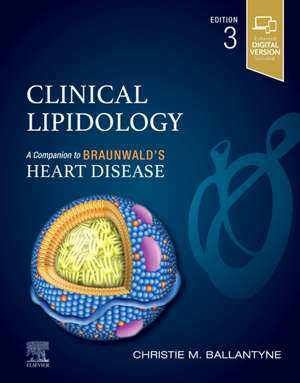
Clinical Lipidology: A Companion to Braunwald's Heart Disease: Companion to Braunwald's Heart Disease
Autor Christie M. Ballantyneen Limba Engleză Hardback – 16 feb 2023
Din seria Companion to Braunwald's Heart Disease
- 28%
 Preț: 931.23 lei
 - 23%
 Preț: 742.02 lei
 - 33%
 Preț: 863.03 lei
 - 25%
 Preț: 749.85 lei
 - 32%
 Preț: 1062.47 lei
 - 29%
 Preț: 792.55 lei
 - 29%
 Preț: 446.18 lei
 - 29%
 Preț: 1009.89 lei
 - 29%
 Preț: 965.43 lei
 - 29%
 Preț: 771.33 lei
 - 28%
 Preț: 525.01 lei
 - 29%
 Preț: 1085.77 lei
 - 30%
 Preț: 1062.57 lei
 - 28%
 Preț: 1120.15 lei
 - 29%
 Preț: 1110.98 lei
 - nou
 Preț: 1302.87 lei
 - nou
 Preț: 957.73 lei
 - 30%
 Preț: 963.90 lei
 - nou
 Preț: 1012.49 lei
Preț: 810.03 lei
Preț vechi: 1139.78 lei
-29%
Puncte Express: 1215
Carte disponibilă
Livrare economică 18 mai-01 iunie
Livrare express 08-14 mai pentru 349.59 lei
Specificații
ISBN-13: 9780323882866
ISBN-10: 0323882862
Pagini: 432
Ilustrații: 200 illustrations (200 in full color)
Dimensiuni: 216 x 276 x 22 mm
Greutate: 1.36 kg
Ediția:3
Editura: Elsevier
Colecția Companion to Braunwald's Heart Disease
Seria Companion to Braunwald's Heart Disease
ISBN-10: 0323882862
Pagini: 432
Ilustrații: 200 illustrations (200 in full color)
Dimensiuni: 216 x 276 x 22 mm
Greutate: 1.36 kg
Ediția:3
Editura: Elsevier
Colecția Companion to Braunwald's Heart Disease
Seria Companion to Braunwald's Heart Disease
V-ar putea interesa
-
 Oxford Handbook of CardiologyPunit Ramrakha-14%Preț: 283.98 lei329.00 leiRecomandat
 -
 Oxford Handbook of Cardiology 3ePunit Ramrakha-5%Preț: 384.08 lei404.30 lei
 -
 HyperlipidaemiaJohn Betteridge-20%Preț: 235.90 lei295.67 lei
 -
 Netter's CardiologyGeorge Stouffer-5%Preț: 544.02 lei572.66 lei
 -
 -10%Preț: 1907.71 lei2119.68 leiRecomandat
 -
 -5%Preț: 2000.68 lei2105.97 lei
 -
 -29%Preț: 446.18 lei626.81 lei
 -
 Hypertension: A Companion to Braunwald's Heart DiseaseGeorge L. Bakris-29%Preț: 771.33 lei1080.86 leiRecomandat
 -
 Goldman-Cecil Medicine, 2-Volume SetLee Goldman-33%Preț: 1017.80 lei1517.76 lei
 -
 Williams Textbook of EndocrinologyShlomo Melmed-31%Preț: 1247.47 lei1810.27 leiRecomandat
 -
 Kumar and Clark's Clinical MedicineDavid Randall-28%Preț: 458.19 lei632.94 leiRecomandat
 -
 -28%Preț: 1608.90 lei2235.23 lei
 -
 Clinical ChemistryWilliam J. Marshall-31%Preț: 339.42 lei490.19 leiRecomandat
 -
 -32%Preț: 1469.24 lei2173.76 lei
 -
 -23%Preț: 742.02 lei966.48 lei
 -
 Atlas of Atherosclerosis and Metabolic SyndromeScott M Grundy-5%Preț: 1568.90 lei1651.47 lei
 -
 -5%Preț: 1145.41 lei1205.69 lei
 -
 Evidence-Based Management of Lipid DisordersMaud N Vissers PhD-16%Preț: 360.84 lei427.37 lei
 -
 Pocket CardiologyMARC SABATINE-30%Preț: 371.46 lei533.71 lei
 -
 -57%Preț: 1697.00 lei3908.44 lei
Cuprins
SECTION I INTRODUCTION/BASIC MECHANISMS
1. Overview of Lipids and Atherosclerosis
SECTION II RISK ASSESSMENT
2. Overview of Risk Assessment
3. Measurement of Low- Density Lipoprotein Cholesterol, Non-High- Density Lipoprotein Cholesterol, Apolipoprotein B, and Low- Density Lipoprotein Particle Concentration
4. Triglycerides, Triglyceride- Rich Lipoproteins, and High- Density Lipoprotein in Coronary Heart Disease Risk Assessment
5. Lipoprotein(a) in Cardiovascular Risk Assessment
6. Clinical Evaluation for Genetic Testing and Secondary Causes of Dyslipidemia
7. Polygenic Risk Scores
8. High- Sensitivity C- Reactive Protein
9. Emerging Assays for Risk Assessment
10. Imaging Atherosclerosis for Risk Stratifi cation: Cardiac Computed Tomography and Carotid Ultrasound
SECTION III THERAPY
11. Overview of General Approach to Management of Dyslipidemias
12. Treatment Guidelines Overview: American Heart Association/American College of Cardiology/Multisociety Guideline and Updates
13. Treatment Guidelines Overview: European Society of Cardiology/European Atherosclerosis Society Guidelines
14. Dietary Patterns for the Prevention and Treatment of Cardiovascular Disease
15. Updated Clinical Guide to Exercise and Lipids
16. Obesity, Lipids, and Cardiovascular Disease
17. Statins
18. Cholesterol Absorption Inhibitors
19. Omega- 3 Fatty Acids
20. Proprotein Convertase Subtilisin/Kexin Type 9 Inhibition
21. Inclisiran
22. Bempedoic Acid
23. Pemafi brate: A New Selective Peroxisome Proliferator-Activated Receptor-_Modulator for Hypertriglyceridemia Management
24. Anti- inflammatory Therapy for Cardiovascular Disease
25. Nutraceuticals and Functional Foods for Cholesterol Reduction
SECTION IV NEW AND EVOLVING THERAPEUTIC TARGETS AND PLATFORMS
26. Evolving Therapeutic Targets: Lipoprotein(a)
27. Inhibition of ANGPTL3 as a Target for Treating Dyslipidemias
28. Evolving Therapeutic Targets: Apolipoprotein C- III
29. Evolving Therapeutic Targets: Cholesteryl Ester Transfer Protein Inhibition
30. Gene Therapy and Therapeutic Genome Editing in Liver for Lipid Disorders
SECTION V SPECIAL PATIENT POPULATIONS
31. Special Patient Populations: Diabetes and Metabolic Syndrome
32. Special Patient Populations: Women and Older Adults
33. Special Patient Populations: Children and Adolescents
34. Special Patient Populations: Familial Hypercholesterolemia and Other Severe Hypercholesterolemias
35. Special Patient Populations: Treatment of Familial Chylomicronemia Syndrome and Sustained Chylomicronemia
36. Special Patient Populations: Acute Coronary Syndromes
37. Special Patient Populations: Transplant Recipients
38. Special Populations: Chronic Kidney Disease
39. Special Patient Populations: Lipid Abnormalities in High- Risk Racial/Ethnic Groups
40. Persons With Human Immunodeficiency Virus
1. Overview of Lipids and Atherosclerosis
SECTION II RISK ASSESSMENT
2. Overview of Risk Assessment
3. Measurement of Low- Density Lipoprotein Cholesterol, Non-High- Density Lipoprotein Cholesterol, Apolipoprotein B, and Low- Density Lipoprotein Particle Concentration
4. Triglycerides, Triglyceride- Rich Lipoproteins, and High- Density Lipoprotein in Coronary Heart Disease Risk Assessment
5. Lipoprotein(a) in Cardiovascular Risk Assessment
6. Clinical Evaluation for Genetic Testing and Secondary Causes of Dyslipidemia
7. Polygenic Risk Scores
8. High- Sensitivity C- Reactive Protein
9. Emerging Assays for Risk Assessment
10. Imaging Atherosclerosis for Risk Stratifi cation: Cardiac Computed Tomography and Carotid Ultrasound
SECTION III THERAPY
11. Overview of General Approach to Management of Dyslipidemias
12. Treatment Guidelines Overview: American Heart Association/American College of Cardiology/Multisociety Guideline and Updates
13. Treatment Guidelines Overview: European Society of Cardiology/European Atherosclerosis Society Guidelines
14. Dietary Patterns for the Prevention and Treatment of Cardiovascular Disease
15. Updated Clinical Guide to Exercise and Lipids
16. Obesity, Lipids, and Cardiovascular Disease
17. Statins
18. Cholesterol Absorption Inhibitors
19. Omega- 3 Fatty Acids
20. Proprotein Convertase Subtilisin/Kexin Type 9 Inhibition
21. Inclisiran
22. Bempedoic Acid
23. Pemafi brate: A New Selective Peroxisome Proliferator-Activated Receptor-_Modulator for Hypertriglyceridemia Management
24. Anti- inflammatory Therapy for Cardiovascular Disease
25. Nutraceuticals and Functional Foods for Cholesterol Reduction
SECTION IV NEW AND EVOLVING THERAPEUTIC TARGETS AND PLATFORMS
26. Evolving Therapeutic Targets: Lipoprotein(a)
27. Inhibition of ANGPTL3 as a Target for Treating Dyslipidemias
28. Evolving Therapeutic Targets: Apolipoprotein C- III
29. Evolving Therapeutic Targets: Cholesteryl Ester Transfer Protein Inhibition
30. Gene Therapy and Therapeutic Genome Editing in Liver for Lipid Disorders
SECTION V SPECIAL PATIENT POPULATIONS
31. Special Patient Populations: Diabetes and Metabolic Syndrome
32. Special Patient Populations: Women and Older Adults
33. Special Patient Populations: Children and Adolescents
34. Special Patient Populations: Familial Hypercholesterolemia and Other Severe Hypercholesterolemias
35. Special Patient Populations: Treatment of Familial Chylomicronemia Syndrome and Sustained Chylomicronemia
36. Special Patient Populations: Acute Coronary Syndromes
37. Special Patient Populations: Transplant Recipients
38. Special Populations: Chronic Kidney Disease
39. Special Patient Populations: Lipid Abnormalities in High- Risk Racial/Ethnic Groups
40. Persons With Human Immunodeficiency Virus