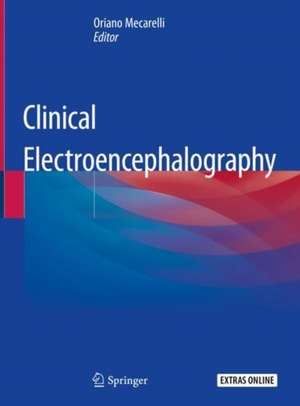
Clinical Electroencephalography
Editat de Oriano Mecarellien Limba Engleză Hardback – 20 iun 2019
Apreciem Clinical Electroencephalography ca fiind o resursă fundamentală care reușește să sintetizeze saltul tehnologic major din ultimii ani în domeniul neurofiziologiei. Pe linia clinică a lucrării Making Sense of the EEG, dar cu un accent pronunțat pe integrarea tehnologiei digitale în practica de zi cu zi, acest volum editat de Oriano Mecarelli oferă o perspectivă riguroasă asupra modului în care digitalizarea a transformat analiza semnalelor cerebrale. Ne-a atras atenția în mod deosebit capacitatea autorilor de a trece dincolo de figurile statice tradiționale, oferind prin materialele electronice suplimentare o experiență de învățare dinamică, esențială pentru interpretarea corectă a traseelor în timp real. În contextul operei editorului, această lucrare consolidează direcția istorică și evolutivă începută în EEG: The First 100 Years, mutând însă focusul de la retrospectivă la aplicabilitatea clinică imediată. Structura cărții reflectă o progresie logică și exhaustivă: prima parte este dedicată fundamentelor tehnice, montajelor și organizării laboratorului, în timp ce a doua parte explorează meticulos patologiile, de la encefalopatiile epileptice neonatale până la epilepsiile genetice generalizate. Putem afirma că rigoarea cu care sunt tratate tehnicile de „back-averaging”, video-EEG și investigațiile invazive plasează acest manual într-o zonă de expertiză similară cu Niedermeyer's Electroencephalography, dar cu un format mai accesibil pentru medicii aflați în diverse stadii de formare. Dincolo de diagnosticarea epilepsiei, volumul subliniază importanța EEG în monitorizarea unităților de terapie intensivă și în evaluarea prognosticului pacienților comatoși. Este o lucrare care nu doar descrie modele, ci explică fiziopatologia din spatele lor, devenind un instrument indispensabil în neurologia clinică modernă.
Preț: 1415.67 lei
Preț vechi: 1490.18 lei
-5%
Carte disponibilă
Livrare economică 17 noiembrie-01 decembrie
Specificații
ISBN-10: 3030045722
Pagini: 844
Ilustrații: XIX, 822 p. 726 illus., 383 illus. in color. With online files/update.
Dimensiuni: 215 x 285 x 48 mm
Greutate: 2.43 kg
Ediția:1st ed. 2019
Editura: Springer
Locul publicării:Cham, Switzerland
V-ar putea interesa
-
 The Physiology and Pathology of the CerebellumRobert S. Dow-28%Preț: 328.84 lei458.10 lei
 -
 Science of VisionK. N. Leibovic-5%Preț: 732.14 lei770.67 lei
 -
 Amaurosis FugaxEugene F. Bernstein-5%Preț: 721.51 lei759.48 lei
 -
 -5%Preț: 700.92 lei737.81 lei
 -
 Infections of the Nervous SystemDavid Schlossberg-5%Preț: 708.31 lei745.59 lei
 -
 Neuromuscular Disorders in Clinical PracticeBashar Katirji-5%Preț: 3160.48 lei3326.83 lei
 -
 Memory LossRonald Devere MD-5%Preț: 107.90 lei113.59 lei
 -
 Transient Global AmnesiaBritt Talley Daniel MD-5%Preț: 392.73 lei413.40 lei
 -
 El Extrano Caso del Dr. ParkinsonDr Rafael Gonzalez Maldonado-5%Preț: 105.05 lei110.58 lei
 -
 El Extrano Caso del Dr. AlzheimerDr Rafael Gonzalez Maldonado-5%Preț: 104.48 lei109.98 lei
 -
 El Estrany Cas del Dr. ParkinsonDr Rafael Gonzalez Maldonado-5%Preț: 103.72 lei109.18 lei
 -
 Behind the Mask of Parkinson's DiseaseLavonne Upton-5%Preț: 96.61 lei101.70 lei
 -
 Parkinson's Disease TrappedMR Christopher C. Evans-5%Preț: 80.46 lei84.70 lei
 -
 Candida and Parkinson's DiseaseLidia M. Epp-5%Preț: 51.84 lei54.57 lei
 -
 Neurobioquimica y Psicofarmacologia de Las Enfermedades PsiquiatricasDr Rafael J. Salin-Pascual-5%Preț: 169.57 lei178.50 lei
 -
 The Mini Neurology Series Volume 2Britt Talley Daniel MD-5%Preț: 170.96 lei179.96 lei
 -
 Mucuna Contra ParkinsonRafael Gonzalez Maldonado-5%Preț: 108.15 lei113.84 lei
 -
 Des Neurones Sur Le DivanDr Vittorio G. Bizzozero-5%Preț: 58.30 lei61.36 lei
 -
 Pour Une Psychanalyse NeuroscientifiqueDr Vittorio G. Bizzozero-5%Preț: 61.48 lei64.72 lei
 -
 Appearance vs. RealitySandra Steranko-5%Preț: 48.51 lei51.06 lei
 -
 Keine Angst VOR Der BlaseCaroline Regnard-Mayer-5%Preț: 59.00 lei62.10 lei
 -
 Ng2-Glia (Polydendrocytes)Arthur M. Butt-5%Preț: 186.07 lei195.86 lei
 -
 The Neurotransmitter Solution for Migraine, Depression, and MoreDr John a. Allocca-5%Preț: 122.82 lei129.28 lei
 -
 -5%Preț: 798.55 lei840.57 lei
 -
 Qualità della vitaMaria Pia Amato-5%Preț: 156.00 lei164.21 lei
 -
 Disturbi psichiatriciV. Zipoli-5%Preț: 219.36 lei230.90 lei
 -
 New Frontiers of MR-based Techniques in Multiple SclerosisMassimo Filippi-5%Preț: 361.04 lei380.04 lei
 -
 Sleepiness and Human Impact AssessmentSergio Garbarino-5%Preț: 751.57 lei791.13 lei
De ce să citești această carte
Recomandăm această carte oricărui neurolog sau tehnolog neurodiagonstician care dorește să stăpânească tranziția către EEG-ul digital. Cititorul câștigă o înțelegere profundă a montajelor moderne și a tehnicilor avansate (precum EEG-fMRI), având totodată la dispoziție un compendiu practic pentru clasificarea sindroamelor epileptice. Este un instrument esențial pentru rafinarea preciziei diagnostice în medii de urgență și în monitorizarea neurodegenerativă.
Despre autor
Oriano Mecarelli este un expert recunoscut în neurofiziologie clinică, activitatea sa fiind marcată de o preocupare constantă pentru evoluția tehnologică a electroencefalografiei. În calitate de editor, el a coordonat echipe internaționale de specialiști pentru a documenta transformările domeniului, de la era analogică la cea digitală. Lucrările sale, precum EEG: The First 100 Years, demonstrează un interes profund pentru istoria și viitorul neuroștiințelor, poziționându-l ca o autoritate în utilizarea EEG-ului ca instrument critic de diagnostic în neurologia modernă și cercetare.
Descriere scurtă
In clinical practice, EEG still represents the most important functional examination in the study CNS development and its anatomical and physiological integrity throughout life. In the pathological context, EEG provides indispensable diagnostic information for classification of epileptic syndromes, and it is also valuable in all the other CNS diseases (infectious, cerebrovascular, neurodegenerative, etc).
Furthermore, monitoring EEG can be widely used in emergency settings, such as emergency departments or intensive care units. In comatose patients, EEG provides information regarding prognosis and evaluation of the sedative effect of anesthetic drugs.
Written by a group of leading national and international experts, it offers a substantial, yet practical, EEG compendium, which serves as a reference resource for physicians and neurodiagnostic technologists as well as physicians-in-training, researchers, practicing electroencephalographers and students.
Cuprins
Notă biografică
Caracteristici
Introduces readers to the technical and methodological aspects of EEG
Defines the physiological patterns of awakeness and sleep
Uses a didactic and systematic method to demonstrate the electrophysiological and clinical patterns of epileptic syndromes
Provides practical examples of the most appropriate EEG methods for different pathologies (video EEG, back averaging, neuromonitoring, etc.)
Supplies indications for immediate and correct interpretation of EEG patterns in emergency situations, during neuromonitoring in Intensive Care Unit and surgery
Defines the EEG peculiarities of the different etiologies of coma
Includes an updated section on EEG in brain tumors
Offers a practical, easy-to-use approach to using and interpreting polysomnography in epileptic and non-epileptic disorders