Cantitate/Preț
Produs

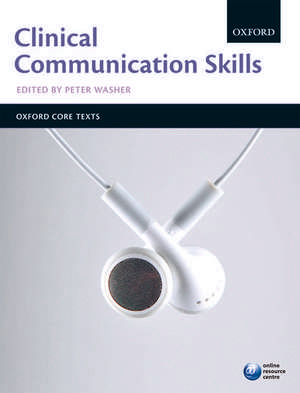
Clinical Communication Skills: Oxford Core Texts

Editat de Peter Washer
en Limba Engleză Paperback – 9 apr 2009

În practica medicală contemporană, simpla posesie a cunoștințelor teoretice nu mai este suficientă; abilitatea de a interacționa eficient cu pacientul a devenit o competență evaluată riguros. În volumul Clinical Communication Skills, editat de Peter Washer, găsim o resursă pragmatică ce răspunde direct nevoii de a traduce abilitățile sociale generale în protocoale clinice stricte. Această ediție se distinge prin ancorarea în experiențe reale, integrând fragmente de interviuri cu pacienți și profesioniști, oferind astfel o perspectivă autentică asupra dinamicii medic-pacient.

Structura cursului este progresivă. Reținem trecerea de la elementele de bază ale anamnezei către scenarii de o complexitate ridicată, precum gestionarea incertitudinii, explicarea riscurilor și comunicarea veștilor proaste. Un element distinctiv al acestei lucrări, față de Communication Skills for Osces de Rachel Wamboldt — care se concentrează predilect pe tehnici de examinare și succesul la examenele practice — este abordarea holistică a comunicării profesionale. Clinical Communication Skills nu se limitează la dialogul în cabinet, ci aprofundează și comunicarea scrisă sau prezentarea formală a pacienților către echipa medicală.

Putem afirma că volumul acoperă un gol esențial prin utilizarea culorilor pentru evidențierea scripturilor conversaționale pozitive, permițând o scanare rapidă a bunelor practici. Acolo unde Clinical Communication Skills for Medicine de Margaret Lloyd pune accent pe evoluția istorică a disciplinei, textul de față rămâne ferm ancorat în utilitatea imediată, fiind un ghid esențial pentru anii de început ai facultății de medicină.
Citește tot Restrânge

Din seria Oxford Core Texts

Preț: 26170 lei

Preț vechi: 32430 lei
-19%

Puncte Express: 393

Carte tipărită la comandă

Livrare economică 11-16 iunie


Specificații

ISBN-13: 9780199550463
ISBN-10: 0199550468
Pagini: 174
Ilustrații: 7 figures
Dimensiuni: 189 x 245 x 10 mm
Greutate: 0.36 kg
Ediția:1
Editura: OUP OXFORD
Colecția OUP Oxford
Seria Oxford Core Texts

Locul publicării:Oxford, United Kingdom

De ce să citești această carte

Această carte este indispensabilă studenților la medicină care doresc să își rafineze interacțiunea clinică dincolo de instinct. Cititorul câștigă acces la metodologii validate internațional și la resurse multimedia care transformă teoria în practică. Este recomandată deoarece tratează comunicarea ca pe o procedură clinică ce poate fi învățată, măsurată și perfecționată, oferind soluții concrete pentru situațiile în care dialogul devine dificil.


Despre autor

Peter Washer este un editor și academician recunoscut pentru contribuțiile sale în domeniul educației medicale și al sociologiei sănătății. Experiența sa în cercetarea comunicării clinice este reflectată în acest volum prin rigoarea bibliografică și prin selecția atentă a materialelor de studiu. Washer a coordonat acest proiect sub egida OUP Oxford, asigurându-se că textul respectă standardele academice internaționale și că oferă resurse digitale moderne, precum podcasturile, pentru a sprijini învățarea activă a viitorilor medici.


Descriere

Clinical communication has been formally taught to medical students in the first few years of their course for several years, but it is only in relatively recent times that clinical communication has become routinely assessed. Increasingly, students recognise the fact that their 'general' communication skills do not automatically translate into effective clinical communication. This textbook reflects the shifts described above and presents the medical student with a compelling resource in a field which has come of age. Clinical Communication Skills is designed to be the first textbook of choice for lecturers and students alike, for early use in the medical degree. The book recognises that this subject is often taught in parallel with Clinical Skills, and makes appropriate links. The book is unapologetically practical in its remit - it aims to equip students to deal with all kinds of clinical encounters, and to optimise the ways in which they communicate with patients and colleagues. Coverage features written communication, and also includes presenting patients to colleagues. Importantly, the book draws on patient and service-user involvement as well as a range of professional views. Readers can listen to these original interviews which are available as podcasts on the book's Online Resource Centre. Extracts from these interviews are woven into the text of the book, and are designed in a second colour for ease of reference. Similarly, sample conversational script is printed in colour so that students can easily scan for examples of positive communication. However, a pragmatic approach is taken; coverage of what to do when things go wrong is also provided. Clinical Communication Skills assumes no prior knowledge, but the communication challenges which the book addresses do advance throughout the chapters. The book starts with the basics of why clinical communication is taught, the process of the medical interview, and taking a medical history. The middle section of the book covers how to talk with other professionals, to a diverse range of patients, to children and young people, and to people with mental health problems. The final section of the book covers information-giving skills which have become more prominent across medicine, including managing uncertainty, explaining risk, patient safety, dealing with complaints and breaking bad news. The material is written to apply to a range of settings, not limiting itself to general practice. The advice provided in the book is informed by, and acknowledges key theories and frameworks. Indeed, the Editor completed a thorough literature review to underpin the writing of the book, and links to much of this research are provided on the book's online resource centre. In terms of comprehensiveness, this text spans the undergraduate clinical communication curriculum and is benchmarked against several international statements on doctor-patient communication, including the UK consensus statement on the content of communication curricula in undergraduate medical communication (von Fragstein et al, 2008). Online Resource Centre: www.oxfordtextbooks.co.uk/orc/washer/ · 11 podcasts of interviews relaying experiences of clinical communication, supported by full transcripts of the interviews. Each podcast is designed to be c. 5 minutes long, for ease of teaching and learning. All interviewees are real people (not simulated patients or actors). Interviewees include a variety of patients, including children, and an experienced General Practitioner. The audio content is reprised in the book, in the form of selected extracts which illustrate points within individual chapters. Full transcripts of each interview are also hosted on line to facilitate closer study of the material.· Podcast introduction to the book from the Editor.

Recenzii

Each chapter is well structured and is presented in an easy-to-read manner with extracts from podcasts used to provide an insight into patients and professional perspectives. This works very well and results in a balanced and credible resource for each chapter... All the chapters in this book use a clinical and functional approach to developing communication skills and this is done well.
This is an excellent book for medical students, providing a simple and basic introduction to the complex area of communication in medicine. It starts by clearly explaining the importance of good communication in medicine, and how this can be achieved. It has a wonderful overview on medical history taking, which I would recommend that all first years read before commencing clinical placements. The book then continues to elaborate on the history taking process in different professions and becomes a very useful tool for those taking speciality placements e.g. paediatrics, psychiatry.Caroline Rance, Medical Student, University of Southampton, School of Medicine
The strenghts of this book are: comprehensive; writing that is informative AND readable (too rare a combination); a layout that is appealing and navigable; very well-targeted at intended audience; and linked podcasts. It fills a gap and deserves to be immediately installed as the standard text for medical students.
The author has produced a scholarly, readable and above-all useful text. It is very well argued, pitched perfectly for the intended audience and beautifully laid out. It is also very useful for more established practitioners.
Skilfully integrates many aspects of communication that are required to become a safe and efficient doctor. This book is an absolute must for medical students to prepare them for the clinical environment and patient interactions.
This invaluable text concisely demonstrates how imperative effective communications skills are and most importantly, manages to expertly outline how clinicians can best improve these skills for the benefit of their everyday practice

Notă biografică

Dr Peter Washer teaches clinical communication at Imperial College London. He has degrees in philosophy, in medical ethics and law and in education. His PhD was awarded by University College London, where he was formerly a member of the Clinical Communication Skills Unit. He has taught medical ethics, education and communication skills in several London universities. He has wide experience of teaching undergraduates, and also delivers advanced courses to postgraduate trainees.