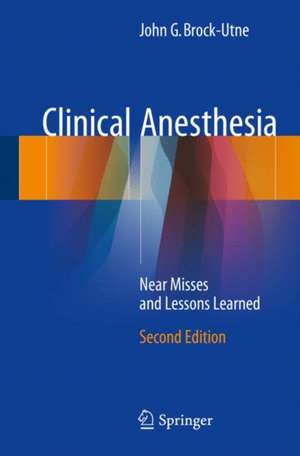
Clinical Anesthesia
Autor John G. Brock-Utneen Limba Engleză Paperback – 13 mar 2018
Cea de-a doua ediție a lucrării Clinical Anesthesia revizuiește și extinde un format educațional esențial în medicina de urgență: studiul incidentelor critice evitate la limită („near misses”). Remarcăm în această nouă versiune o actualizare riguroasă a referințelor bibliografice pentru cele 62 de cazuri originale, la care se adaugă 41 de scenarii clinice inedite, extrase din vasta experiență internațională a autorului John G. Brock-Utne. Găsim în acest volum o structură clinică precisă, unde fiecare incident este prezentat succint pe o pagină, urmat imediat de soluție, discuții asupra rezultatelor alternative și recomandări tehnice pentru prevenție. Abordarea este una pragmatică, axată pe realitățile sălii de operație care nu sunt întotdeauna acoperite de manualele teoretice. De la gestionarea unui sistem de intubație cu fibră optică nefuncțional până la complicațiile neașteptate ale unui banal inel în limbă, textul acoperă o cazuistică vastă. Pe linia clinică a volumului Clinical Cases in Anesthesia de Allan P. Reed, dar cu un accent mult mai pronunțat pe managementul crizelor rare și imprevizibile, lucrarea de față transformă eroarea potențială în material didactic. Această orientare spre succesul profesional și siguranța pacientului este o constantă în opera autorului, făcând tranziția de la ghidurile de carieră precum Life After Residency către rigoarea cercetării aplicate din Clinical Research. Structura logică a cuprinsului, care progresează de la incidente de monitorizare la erori mecanice ale aparatelor de anestezie, oferă rezidenților și specialiștilor un protocol mental de reacție în fața neprevăzutului.
Preț: 784.99 lei
Preț vechi: 826.31 lei
-5%
Carte tipărită la comandă
Livrare economică 04-10 decembrie
Specificații
ISBN-10: 331971466X
Pagini: 360
Ilustrații: XVII, 342 p.
Dimensiuni: 155 x 235 x 19 mm
Greutate: 0.61 kg
Ediția:Second Edition 2017
Editura: Springer
Locul publicării:Cham, Switzerland
V-ar putea interesa
-
 50 Studies Every Anesthesiologist Should KnowAnita Gupta-29%Preț: 506.43 lei713.62 lei
 -
 Anesthesiology Applied Exam Board ReviewRuchir Gupta-25%Preț: 1097.91 lei1462.13 lei
 -
 Preparing to Pass the FRCA: Strategies for Exam SuccessCaroline Whymark-17%Preț: 295.49 lei357.24 lei
 -
 SBAs for the Final FRCACaroline Whymark-17%Preț: 338.76 lei407.17 lei
 -
 -15%Preț: 504.30 lei593.28 lei
 -
 Manual of Anesthesia PracticeManuel Pardo-5%Preț: 640.43 lei674.14 lei
 -
 -5%Preț: 160.17 lei168.60 lei
 -
 Near Misses in Pediatric AnesthesiaJohn G. Brock-Utne-5%Preț: 357.21 lei376.01 lei
 -
 Clinical ResearchJohn G. Brock-Utne-5%Preț: 352.25 lei370.78 lei
 -
 The Final FRCA Structured Oral Examination: A Complete GuideBobby Krishnachetty-5%Preț: 471.26 lei496.06 lei
 -
 Patient Blood Management in Cardiac SurgeryChristian von Heymann-5%Preț: 622.48 lei655.23 lei
 -
 -5%Preț: 507.33 lei534.02 lei
 -
 -5%Preț: 1128.96 lei1188.38 lei
 -
 Comprehensive Healthcare Simulation: ECMO SimulationLindsay C. Johnston-5%Preț: 871.87 lei917.76 lei
 -
 -5%Preț: 1752.11 lei1844.33 lei
 -
 -5%Preț: 1317.86 lei1387.22 lei
 -
 Geriatric AnesthesiologyJ. G. Reves-5%Preț: 1016.36 lei1069.85 lei
 -
 Sterbehilfe in EuropaThela Wernstedt-23%Preț: 450.04 lei584.46 lei
 -
 Common Perioperative Problems and the AnaesthetistG.M. Woerlee-5%Preț: 707.26 lei744.49 lei
 -
 BlockmateArunangshu Chakraborty-5%Preț: 744.55 lei783.74 lei
De ce să citești această carte
Recomandăm această carte oricărui anestezist care dorește să își antreneze reflexele clinice fără a pune în pericol viața pacientului. Este un instrument indispensabil pentru pregătirea examenului oral de specialitate, oferind acces la situații rare pe care un medic le-ar putea întâlni o singură dată în carieră. Cititorul câștigă nu doar soluții tehnice, ci și o metodologie de analiză critică a riscului în sala de operație.
Despre autor
John G. Brock-Utne este profesor de anestezie la Centrul Medical al Universității Stanford din California, SUA. Cu o carieră de peste patru decenii desfășurată pe trei continente, acesta a devenit o autoritate recunoscută în siguranța pacientului și educația medicală. Expertiza sa transnațională îi permite să ofere o perspectivă unică asupra protocoalelor clinice. Dincolo de activitatea de clinician, este un mentor dedicat, publicând lucrări care ghidează tinerii medici prin complexitatea cercetării clinice și a tranziției de la rezidențiat la practica independentă.
Descriere scurtă
In addition, this can be an excellent study aid for the American Board of Anesthesiology oral exam. Since nearmisses are relatively rare, there really is no way to be prepared to successfully manage such crises other than reading about them, so residents, fellows, and practicing, certified registered nurse anesthetists will benefit from the learning of these actual near misses. Additionally, faculty will find the plethora of discussion topics for large or small group settings an ideal way to communicate anesthesia and clinical care problems to the audience.