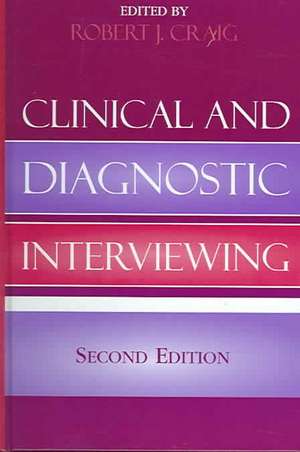
Clinical and Diagnostic Interviewing
Editat de Robert J. Craigen Limba Engleză Hardback – 30 oct 2004
The book stresses the idea that the clinical interview is controlled by the therapist and develops in a phase-sequenced progression along predictable lines. Clinical interviews flow from a theoretical stance on the part of the clinician, are usually semi-structured to the extent that areas are probed consistent with official diagnostic criteria and with know aspects of suspected psychopathologies, including co-morbidities, and include an understanding of the patient's personality and possible personality disorders that may complicate treatment of Axis I disorders or which may be the focus of treatment itself.
This book elucidates this process and may serves as a primary source for practitioners who want to know more about the process of clinical interviewing as well as a useful text for those students who are in the process of learning clinical interviewing.
Preț: 717.83 lei
Preț vechi: 1010.46 lei
-29%
Puncte Express: 1077
Carte tipărită la comandă
Livrare economică 30 noiembrie-14 decembrie
Livrare prin curier în România Termenul estimat este afișat lângă disponibilitate.
Transport gratuit pentru acest produs Plată online sau ramburs, în funcție de opțiunile comenzii.
Retur gratuit în 14 zile Comandă securizată și suport în română.
Specificații
ISBN-13: 9780765700032
ISBN-10: 0765700034
Pagini: 496
Dimensiuni: 157 x 235 x 34 mm
Greutate: 0.76 kg
Ediția:2nd Edition
Editura: JASON ARONSON INC
Locul publicării:New York, United States
ISBN-10: 0765700034
Pagini: 496
Dimensiuni: 157 x 235 x 34 mm
Greutate: 0.76 kg
Ediția:2nd Edition
Editura: JASON ARONSON INC
Locul publicării:New York, United States
V-ar putea interesa
-
 Diagnostic Imaging, Includes Wiley E-TextAndrea G. RockallPreț: 500.37 lei
 -
 Bias in Psychiatric DiagnosisPaula J. Caplan-21%Preț: 365.03 lei463.38 lei
 -
 OverdiagnosedH Gilbert Welch-5%Preț: 104.62 lei110.12 lei
 -
 ColposcopyMahmood Shafi-5%Preț: 505.51 lei532.11 lei
 -
 -5%Preț: 835.94 lei879.94 lei
Cuprins
Chapter 1 Teaching Clinical and Diagnostic Interviewing
Chapter 2 The Clinical Process of Interviewing
Chapter 3 Phenomenological Orientation to the Interview
Chapter 4 Psychoanalytic Interviewing
Chapter 5 The Behavioral Interview
Chapter 6 The Existential/Humanistic Interview
Chapter 7 The Family Therapy Interview
Chapter 8 Anxiety Disorders
Chapter 9 Substance Abuse
Chapter 10 Alcoholism
Chapter 11 Motivational Interviewing
Chapter 12 Anorexia and Bulimia
Chapter 13 Personality Disorders
Chapter 14 Severely Mentally Ill
Chapter 15 Diagnostic Assessment of Children
Chapter 16 Clinical Interviews with Adolescents
Chapter 17 Child and Adolescent Abuse
Chapter 18 The Mental Status Examination
Chapter 19 Suicide Assessment
Chapter 20 Interviewing in Medical Settings
Chapter 21 The Forensic Interview
Chapter 2 The Clinical Process of Interviewing
Chapter 3 Phenomenological Orientation to the Interview
Chapter 4 Psychoanalytic Interviewing
Chapter 5 The Behavioral Interview
Chapter 6 The Existential/Humanistic Interview
Chapter 7 The Family Therapy Interview
Chapter 8 Anxiety Disorders
Chapter 9 Substance Abuse
Chapter 10 Alcoholism
Chapter 11 Motivational Interviewing
Chapter 12 Anorexia and Bulimia
Chapter 13 Personality Disorders
Chapter 14 Severely Mentally Ill
Chapter 15 Diagnostic Assessment of Children
Chapter 16 Clinical Interviews with Adolescents
Chapter 17 Child and Adolescent Abuse
Chapter 18 The Mental Status Examination
Chapter 19 Suicide Assessment
Chapter 20 Interviewing in Medical Settings
Chapter 21 The Forensic Interview
Recenzii
This is definitely a textbook that can be used to advantage by clinical educators in graduate programs in nursing, social work, psychology, and other helping professions....Clinical and Diagnostic Interviewing makes a good addition to the library of anyone who engages in clinical supervision and training in a variety of practive settings.
Psychotherapy is both an art and a science and if, in practice, therapists incline to one or the other, students need to learn both. The second edition of Clinical and Diagnostic Interviewing is an attempt to ensure that they do. Part textbook, andpart reference, it provides both a general introduction to the clinical interview and an account of how different theoretical traditions approach it. Broad in scope and comprehensive in its review of the literature, it accommodates the taxonomy of the Diagnostic and Statistical Manual of Mental Disorders, is inclusive of structured and more phenomenological approaches to the interview and is sensitive to how the interview must be adapted to specific populations, diagnoses, and settings. As such, itbalances the soulful with the practical and serves the reader well. Students will be forced to consider the multiple factors affecting a clinical interview and the complex balance that a therapist must achieve among theory, skill, diagnosis, patient need, and setting. Graduate students should therefore find it a helpful introduction to the process of clinical interviewing and the multiple ways in which it can be undertaken, and in some instances they will benefit from its review of the literature and d
Psychotherapy is both an art and a science and if, in practice, therapists incline to one or the other, students need to learn both. The second edition of Clinical and Diagnostic Interviewing is an attempt to ensure that they do. Part textbook, andpart reference, it provides both a general introduction to the clinical interview and an account of how different theoretical traditions approach it. Broad in scope and comprehensive in its review of the literature, it accommodates the taxonomy of the Diagnostic and Statistical Manual of Mental Disorders, is inclusive of structured and more phenomenological approaches to the interview and is sensitive to how the interview must be adapted to specific populations, diagnoses, and settings. As such, itbalances the soulful with the practical and serves the reader well. Students will be forced to consider the multiple factors affecting a clinical interview and the complex balance that a therapist must achieve among theory, skill, diagnosis, patient need, and setting. Graduate students should therefore find it a helpful introduction to the process of clinical interviewing and the multiple ways in which it can be undertaken, and in some instances they will benefit from its review of the literature and d