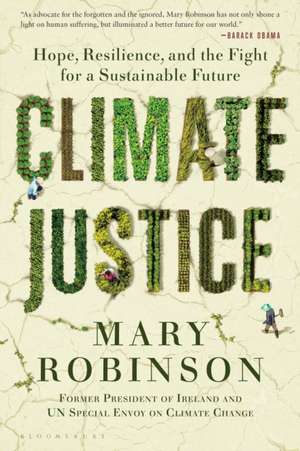
Climate Justice
Autor Mary Robinsonen Limba Engleză Paperback – 10 dec 2019
Descoperim aici resursele practice și studiile de caz esențiale care transformă paralizia în fața schimbărilor climatice într-un plan de acțiune concret. Suntem de părere că forța acestui volum rezidă în capacitatea de a ancora datele științifice în experiențe umane tangibile, oferind cititorului o structură narativă bazată pe mărturii directe din teren. Apreciem modul în care Mary Robinson documentează soluțiile ingenioase apărute la nivel de firul ierbii, de la saloanele de coafură din Mississippi până la fermele din Uganda. Ca și Margaret Alston în Research, Action and Policy: Addressing the Gendered Impacts of Climate Change, autorul distilează experiență reală în principii acționabile, demonstrând că impactul crizei de mediu nu este neutru din punct de vedere al genului. În timp ce alte lucrări se concentrează pe modelări matematice, Climate Justice pune în lumină factorul uman, oferind o perspectivă similară cu cea din Climate Justice and Community Renewal de Brian Tokar, unde rezistența comunităților locale devine motorul schimbării globale. Această lucrare reprezintă o evoluție firească în opera autoarei. Dacă în Everybody Matters Robinson explora fundamentele demnității umane, în Climate Justice ea aplică aceste principii de drept internațional asupra celei mai mari amenințări contemporane. Textul nu se rezumă la teorie, ci este susținut de ilustrații alb-negru care conferă greutate vizuală realităților descrise. Ritmul este alert, specific unui manifest, dar argumentația rămâne lucidă și echilibrată, reflectând rigoarea unui fost diplomat ONU.
Preț: 84.58 lei
Carte indisponibilă temporar
Specificații
ISBN-10: 1635575923
Pagini: 176
Dimensiuni: 141 x 208 x 15 mm
Greutate: 0.19 kg
Editura: Bloomsbury USA
V-ar putea interesa
-
 And Still We MarchMarisa BatePreț: 79.13 lei
 -
 Of Women: In the 21st CenturyShami Chakrabarti-21%Preț: 61.18 lei77.38 lei
 -
 Preț: 93.53 lei
 -
 RoarManjeet MannPreț: 73.00 lei
 -
 -19%Preț: 64.55 lei79.25 lei
 -
 Climate JusticeCass R. SunsteinPreț: 168.04 lei
 -
 A Barrister for the EarthMonica Feria-TintaPreț: 157.10 lei
 -
 It's Not Just YouTori Tsui-18%Preț: 65.25 lei79.65 lei
 -
 Just Earth: How a Fairer World Will Save the PlanetTony Juniper-25%Preț: 92.78 lei123.79 lei
 -
 -26%Preț: 69.94 lei94.06 lei
 -
 You Are a Sacred Place: Visual Poems for Living in Climate CrisisMadeleine Jubilee Saito-17%Preț: 104.43 lei125.25 lei
 -
 A Bigger PictureVanessa Nakate-34%Preț: 47.76 lei71.98 lei
 -
 -19%Preț: 105.59 lei129.56 lei
 -
 Climate InjusticeFriederike OttoPreț: 170.43 lei
 -
 LedgerJane Hirshfield-19%Preț: 74.96 lei92.84 lei
 -
 No Country for Eight-Spot ButterfliesJulian Aguon-20%Preț: 97.42 lei121.07 lei
 -
 The New Breadline: Hunger and Hope in the 21st CenturyJean-Martin Bauer-19%Preț: 68.78 lei85.05 lei
 -
 Half The Sky: How to Change the WorldNicholas D. Kristof-25%Preț: 82.52 lei109.60 lei
 -
 -18%Preț: 41.50 lei50.67 lei
 -
 No Straight Road Takes You ThereRebecca SolnitPreț: 93.02 lei
De ce să citești această carte
Această carte se adresează celor care caută soluții pragmatice la criza climatică, dincolo de retorica politică. Cititorul câștigă o înțelegere profundă a modului în care comunitățile vulnerabile inovează sub presiune. Este o resursă esențială pentru activiști și profesioniști în știința mediului care doresc să integreze drepturile omului în strategiile de sustenabilitate, oferind un motiv concret pentru speranță prin exemple de succes deja implementate.
Despre autor
Mary Robinson este o figură centrală în diplomația globală, fiind prima femeie președinte a Irlandei (1990-1997) și Înalt Comisar al Națiunilor Unite pentru Drepturile Omului. În prezent, conduce fundația care îi poartă numele, dedicată justiției climatice, și este membră a grupului „The Elders”. Experiența sa vastă în drept internațional și advocacy pentru cei marginalizați îi oferă autoritatea necesară pentru a aborda criza ecologică nu doar ca pe o problemă tehnică, ci ca pe una fundamental umanitară. A fost distinsă cu Medalia Prezidențială a Libertății în SUA pentru eforturile sale neobosite în slujba dreptății sociale.
Descriere scurtă
"The antidote for your climate change paralysis." -Sierra
"Insightful and optimistic." -The Guardian
Former President of Ireland Mary Robinson's mission to bring together the fight against climate change and the global struggle for human rights has taken her all over the world. It also brought her to a heartening revelation: that that an irrepressible driving force in the battle for climate justice could be found at the grassroots level, mainly among women, many of them mothers and grandmothers like herself. Robinson met with ordinary people whose resilience and ingenuity had already unlocked extraordinary change: from a Mississippi matriarch whose campaign began in her East Biloxi hair salon and culminated in her speaking at the United Nations, to a farmer who transformed the fortunes of her ailing community in rural Uganda.
In Climate Justice, she shares their stories, and many more. Powerful and deeply humane, this uplifting book is a stirring manifesto on one of the most pressing humanitarian issues of our time, and a lucid, affirmative, and well-argued case for hope.
Descriere
_______________
'As an advocate for the hungry and the hunted, the forgotten and the ignored, Mary Robinson has not only shone a light on human suffering, but illuminated a better future for our world' BARACK OBAMA
SHORTLISTED FOR THE IRISH BOOK AWARDS 2018
Holding her first grandchild in her arms in 2003, Mary Robinson was struck by the uncertainty of the world he had been born into. Before his fiftieth birthday, he would share the planet with more than nine billion people - people battling for food, water, and shelter in an increasingly volatile climate. The faceless, shadowy menace of climate change had become, in an instant, deeply personal.
Mary Robinson's mission would lead her all over the world, from Malawi to Mongolia, and to a heartening revelation: that an irrepressible driving force in the battle for climate justice could be found at the grassroots level, mainly among women, many of them mothers and grandmothers like herself.
From Sharon Hanshaw, the Mississippi matriarch whose campaign began in her East Biloxi hair salon and culminated in her speaking at the United Nations, to Constance Okollet, a small farmer who transformed the fortunes of her ailing community in rural Uganda, Robinson met with ordinary people whose resilience and ingenuity had already unlocked extraordinary change.
Powerful and deeply humane, Climate Justice is a stirring manifesto on one of the most pressing humanitarian issues of our time, and a lucid, affirmative, and well-argued case for hope.
Recenzii
Robinson's humility and compassion resonates through her story-telling . Climate Justice inspires through its portrayals of resilience ... Robinson's stories provide a window into our own future, and her legacy on climate justice is a point of light in Ireland's otherwise dark record on climate change
If there is one thing Mary Robinson's book demonstrates, it is the power of personal experience to change the world . Presenting narratives in this way makes clear the issue at the heart of climate justice: it is consistently the least well-off who bear the brunt of global warming, and are the least well-equipped to deal with its consequences
As an advocate for the hungry and the hunted, the forgotten and the ignored, Mary Robinson has not only shone a light on human suffering, but illuminated a better future for our world
Addressing climate phenomena is the way to ensure justice for humanity. Mary Robinson, as UN Special Envoy on climate change & as UN High Commissioner for Human Rights, has been a global champion to bring justice for all. Her book inspires & guides us on what to do to protect humanity and our only world
The most dramatic symptoms of our changing global climate - rising sea levels, extreme weather events, increasing desertification, and water scarcity - disproportionately affect vulnerable communities that are often far removed from the causes of human greenhouse gas emissions. Mary Robinson has been their champion for many years, and Climate Justice gives them a voice that we all should hear. Robinson makes a powerful and compelling case that the climate crisis is a crisis of humanity, requiring far more than mitigation and adaptation, but a renewed sense of shared destiny. Simply put, climate action must work for the good of all, or it won't work for anyone
This is a book about people: farmers and activists in Africa, Asia, and the Americas, people whose livelihood is ruined by climate change and climate injustice. Yet it is also a celebration of their fight back. I was moved by Mary Robinson's account of amazing women leading the fight for their communities
Sustainable development is at the heart of climate justice - protecting the planet, now and for generations to come. The stories in this book reveal the lived experience of people doing just that, adapting and strengthening their resilience in the face of climate change. They are courageous men and women whose lessons we all should heed
Mary Robinson brings the power of the voice of those heavily affected by climate change - particularly women - to the centre of the consciousness of decision-makers to propel collective action