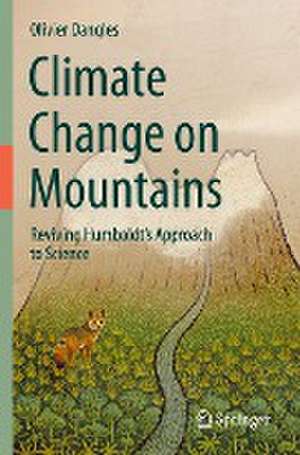
Climate Change on Mountains
en Limba Engleză Paperback – 16 ian 2024
Autorul Olivier Dangles, un cercetător recunoscut pentru studiile sale extinse în regiunile montane înalte, propune în Climate Change on Mountains o schimbare de paradigmă în cercetarea ecologică. Lucrarea nu este doar o prezentare a datelor climatice, ci o fundamentare teoretică ce recuperează moștenirea lui Alexander von Humboldt, adaptând viziunea sa integrativă la provocările secolului XXI. Remarcăm modul în care Dangles își folosește experiența de 15 ani în Anzii tropicali pentru a demonstra că știința modernă poate deveni mai eficientă atunci când reînnoiește tradiția polimaților și adoptă o abordare umanistă. Suntem de părere că structura cărții este neconvențională pentru un text academic, dar extrem de riguroasă. Organizată în șase capitole, de la „Rețelele subterane” la „Istorisirea poveștilor”, lucrarea ghidează cititorul prin concepte complexe precum „capsulele timpului” și „muștele subacvatice”, oferind o progresie logică de la date brute la înțelegerea sistemică. Comparabil cu Alexander von Humboldt de Gregor C. Falk în rigurozitate, volumul de față este actualizat pentru contextul crizei climatice actuale, punând un accent mai mare pe impactul asupra florei și faunei montane. Această primă ediție din 2023 se poziționează ca o continuare firească a operei anterioare a autorului, Ecology of High Altitude Waters. Dacă lucrarea precedentă se concentra pe specificul limnologic al ecosistemelor tropicale, Climate Change on Mountains lărgește cadrul, integrând discipline precum istoria și artele pentru a oferi o imagine cuprinzătoare a terenului. Stilul este precis, dar îmbogățit cu ilustrații care susțin argumentația, făcând din acest volum un „academic cross-over” esențial pentru înțelegerea modului în care se face știința astăzi.
Preț: 267.58 lei
Carte tipărită la comandă
Livrare economică 16-23 noiembrie
Specificații
ISBN-10: 3031395301
Pagini: 284
Ilustrații: XIV, 266 p. 84 illus., 60 illus. in color.
Dimensiuni: 155 x 235 x 15 mm
Greutate: 0.49 kg
Ediția:1st ed. 2023
Editura: Springer
Locul publicării:Cham, Switzerland
V-ar putea interesa
-
 Nature's MemoryJack AshbyPreț: 189.17 lei
 -
 -13%Preț: 131.16 lei151.45 lei
 -
 The Story of Nature: A Human HistoryJeremy MynottPreț: 225.60 lei
 -
 The Immense JourneyLoren EiseleyPreț: 67.70 lei
 -
 Goethe on ScienceJeremy NaydlerPreț: 121.16 lei
 -
 Metamorphosis: A Natural and Human HistoryOren Harman-30%Preț: 133.14 lei191.14 lei
 -
 The Invention of NatureAndrea Wulf-25%Preț: 70.85 lei94.78 lei
 -
 Forms of the VisiblePhilippe DescolaPreț: 290.05 lei
 -
 The Adventures of Alexander von HumboldtAndrea WulfPreț: 205.86 lei
 -
 Wild FictionsAmitav Ghosh-24%Preț: 105.78 lei139.60 lei
 -
 Alexander Von HumboldtOliver LubrichPreț: 374.05 lei
 -
 Alexander Von HumboldtOliver Lubrich-19%Preț: 495.59 lei611.84 lei
 -
 The Mountain: Journeys in High PlacesRobin PattenPreț: 130.04 lei
 -
 Mountains Of The MindRobert MacFarlanePreț: 79.19 lei
 -
 We Are Green and TremblingGabriela Cabezón CámaraPreț: 135.73 lei
 -
 YearDexter HoyosPreț: 116.39 lei
 -
 Chaos in the HeavensJean-Baptiste FressozPreț: 204.98 lei
 -
 Human NatureKate MarvelPreț: 136.91 lei
 -
 Human NatureThomas BellPreț: 142.37 lei
De ce să citești această carte
Recomandăm această carte cercetătorilor și studenților care doresc să depășească barierele disciplinare stricte. Cititorul câștigă o metodologie nouă, „humboldtiană”, care îmbină datele empirice cu o perspectivă istorică și estetică. Este o lectură esențială pentru cei interesați de climatologie și ecologie montană, oferind instrumente concrete pentru a interpreta schimbările accelerate din ecosistemele de mare altitudine dintr-o perspectivă umanistă.
Despre autor
Olivier Dangles este un om de știință specializat în ecologia ecosistemelor de mare altitudine, cu o carieră marcată de cercetări de teren de lungă durată în Anzii tropicali. Expertiza sa acoperă impactul schimbărilor climatice asupra biodiversității și funcționării ecosistemelor, fiind autorul lucrării de referință Ecology of High Altitude Waters. În prezent, activitatea sa se concentrează pe promovarea unei științe transdisciplinare, care să integreze cunoștințele ecologice cu dimensiunile sociale și istorice, modelul său de inspirație fiind Alexander von Humboldt. Prin contribuțiile sale, Dangles a devenit o voce importantă în studiul „montologiei” moderne.
Cuprins
Notă biografică
Textul de pe ultima copertă
There is now a renewed interest, both in academia and beyond, in Humboldt, his writings and his view of nature. But how can we actually make use of his writings? How can we put his philosophy into practice? How can we still learn from past scientific figures and do a better science today?
In this book, the author shows how. He presents how it is possible to succeed in modern science by returning to sources, by renewing the tradition of past polymaths such as Humboldt, and by havinga fully humanistic approach in science. He illustrates his point based on his 15-year experience in the study of the ecological effects of climate change in the tropical Andes, showing how he has incorporated approaches from other disciplines, from different branches of science, from history and the arts to achieve a more comprehensive view of his scientific field. Alongside hard data, discoveries by past naturalists build our understanding of the world but appealing to our emotions makes us want to understand it. In the author’s view this is a productive and enjoyable way of doing science that speaks to our humanity and also increases our knowledge about nature.
The narrative of the book moves in space and time, from the present to the past, from continent to continent, from laboratory to field, from archives to mathematical models, from behind the camera to in an Indigenous community. This makes it an academic cross-over book appealing to a broad audience of students, scientists or, supported by attractive illustrations, to anyone interested in the adventure or making of science, but not necessarily with a scientific background.