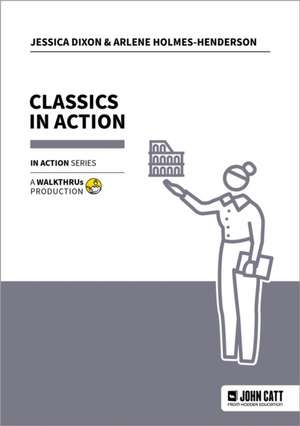
Classics in Action
Autor Jessica Dixon, Dr Arlene Holmes-Hendersonen Limba Engleză Paperback – 29 noi 2024 – vârsta ani
Jessica Dixon and Arlene Holmes-Henderson showcase ideas from their own teaching experience, plus innovative examples from a range of schools, to provide strategies for teaching Latin, Greek, Classical Civilisation and Ancient History that will enrich, enliven and extend your teaching practice.
Inspiring and eye-opening, this will be an enjoyable and useful read for all teachers who are currently teaching, training to teach, or interested in teaching classical subjects and related disciplines, in primary or secondary schools.
Preț: 117.34 lei
Preț vechi: 136.81 lei
-14%
Puncte Express: 176
Carte disponibilă
Livrare economică 02-16 noiembrie
Livrare express 17-23 octombrie pentru 37.18 lei
Livrare prin curier în România Termenul estimat este afișat lângă disponibilitate.
Transport gratuit de la 400.00 lei Plată online sau ramburs, în funcție de opțiunile comenzii.
Retur gratuit în 14 zile Comandă securizată și suport în română.
Specificații
ISBN-13: 9781915261847
ISBN-10: 1915261848
Pagini: 128
Dimensiuni: 146 x 208 x 12 mm
Greutate: 0.18 kg
Editura: Hachette Learning
Colecția John Catt
Locul publicării:London, United Kingdom
ISBN-10: 1915261848
Pagini: 128
Dimensiuni: 146 x 208 x 12 mm
Greutate: 0.18 kg
Editura: Hachette Learning
Colecția John Catt
Locul publicării:London, United Kingdom
Recenzii
A comprehensive and valuable resource for all teachers of the ancient world.
Classics in Action is a truly wonderful book. What I particularly love about it is the way in which it demolishes the myths around Latin and Greek being solely the entitlement of the privately educated or the 'gifted' pupils in maintained schools. It draws together plenty of research to show that the largest gains are made with pupils with the greatest barriers to learning. Having taught Latin at lunchtime, I know this is the case. It is also excellent in showing how classical themes can be incorporated into other subjects. There are terrific case studies, dealing with controversial themes, including classical texts in English at KS3 and clever ways of incorporating the subject at KS3. It is an absolute delight.
Whether you're new to teaching Classics or an established classroom practitioner, this is an indispensable guide to the teaching of classical subjects today. It gives a real sense of the vitality of a discipline that is constantly innovating, combining a rich and insightful picture of the classics teaching landscape with bite-sized pedagogical wisdom drawn from across the subject community. The real beauty of the book and its practical application comes from its respect for the enormously varied range of contexts in which classical subjects are taught and the pressures that teachers are under.
I regularly make reference to the John Catt 'In Action' series as AHT Staff Development at a large north London academy; as an ex head of classics I am delighted at the inclusion of this valuable resource for teachers (from novice to expert) of the subject. Despite the lack of much formal research into the current teaching of classics in the UK highlighted in Chapter 1, over five chapters, Jess and Arlene draw upon an impressive range of diverse and accessible case studies and resources. The 'hinterland of classics teaching' in Chapter 2 includes a particularly welcome reference to trauma-informed teaching of Latin stories while Chapters 3 and 4 deftly summarise key aspects of classroom pedagogy before modelling how each might be delivered in the classics classroom. As expected from this series, the content and layout of each page make it quick and easy to draw upon one or two ideas for your next lesson. However, the book also provides broader frameworks and practical support for developing current schemes of learning or any new ones you might now be inspired to create.
Classics in Action provides a toolkit for Classics teachers to develop their practice. It will be valuable to all teachers of classical subjects, throughout their career, because of its thoughtful and actionable advice.
The authors provide a variety of functional and targeted methods to support PGCE students, ECTs as well as experienced teachers. The book provides an unparalleled insight into classical education in English classrooms.
Classics in Action is a truly wonderful book. What I particularly love about it is the way in which it demolishes the myths around Latin and Greek being solely the entitlement of the privately educated or the 'gifted' pupils in maintained schools. It draws together plenty of research to show that the largest gains are made with pupils with the greatest barriers to learning. Having taught Latin at lunchtime, I know this is the case. It is also excellent in showing how classical themes can be incorporated into other subjects. There are terrific case studies, dealing with controversial themes, including classical texts in English at KS3 and clever ways of incorporating the subject at KS3. It is an absolute delight.
Whether you're new to teaching Classics or an established classroom practitioner, this is an indispensable guide to the teaching of classical subjects today. It gives a real sense of the vitality of a discipline that is constantly innovating, combining a rich and insightful picture of the classics teaching landscape with bite-sized pedagogical wisdom drawn from across the subject community. The real beauty of the book and its practical application comes from its respect for the enormously varied range of contexts in which classical subjects are taught and the pressures that teachers are under.
I regularly make reference to the John Catt 'In Action' series as AHT Staff Development at a large north London academy; as an ex head of classics I am delighted at the inclusion of this valuable resource for teachers (from novice to expert) of the subject. Despite the lack of much formal research into the current teaching of classics in the UK highlighted in Chapter 1, over five chapters, Jess and Arlene draw upon an impressive range of diverse and accessible case studies and resources. The 'hinterland of classics teaching' in Chapter 2 includes a particularly welcome reference to trauma-informed teaching of Latin stories while Chapters 3 and 4 deftly summarise key aspects of classroom pedagogy before modelling how each might be delivered in the classics classroom. As expected from this series, the content and layout of each page make it quick and easy to draw upon one or two ideas for your next lesson. However, the book also provides broader frameworks and practical support for developing current schemes of learning or any new ones you might now be inspired to create.
Classics in Action provides a toolkit for Classics teachers to develop their practice. It will be valuable to all teachers of classical subjects, throughout their career, because of its thoughtful and actionable advice.
The authors provide a variety of functional and targeted methods to support PGCE students, ECTs as well as experienced teachers. The book provides an unparalleled insight into classical education in English classrooms.