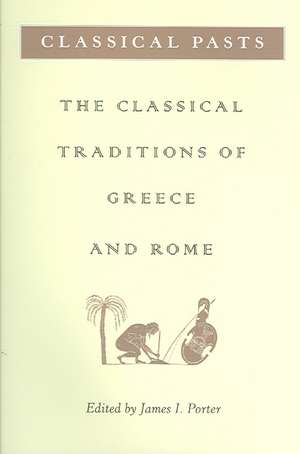
Classical Pasts
Editat de James I. Porteren Limba Engleză Paperback – 11 dec 2005
The book's introduction provides a generous theoretical and historical overview. It is followed by eleven chapters in which the contributors argue for the existence not of a single classical past, but of multiple, competing classical pasts. The essays address a broad range of topics--Homer and early Greek poetry and music, Isocrate, Hellenistic and Roman art, Cicero and Greek philosophy, the history of Latin literature, imperial Greek literature, and more. The most up-to-date and challenging treatment of the topic available, this collection will be of lasting interest to students and scholars of ancient and modern literature, art, and cultural history.
Preț: 447.25 lei
Preț vechi: 552.17 lei
-19%
Puncte Express: 671
Carte tipărită la comandă
Livrare economică 30 noiembrie-14 decembrie
Livrare prin curier în România Termenul estimat este afișat lângă disponibilitate.
Transport gratuit pentru acest produs Plată online sau ramburs, în funcție de opțiunile comenzii.
Retur gratuit în 14 zile Comandă securizată și suport în română.
Specificații
ISBN-13: 9780691089423
ISBN-10: 0691089426
Pagini: 466
Ilustrații: 39 halftones. 2 line illus. 1 table.
Dimensiuni: 156 x 234 x 28 mm
Greutate: 0.79 kg
Editura: Princeton University Press
Locul publicării:Princeton, United States
ISBN-10: 0691089426
Pagini: 466
Ilustrații: 39 halftones. 2 line illus. 1 table.
Dimensiuni: 156 x 234 x 28 mm
Greutate: 0.79 kg
Editura: Princeton University Press
Locul publicării:Princeton, United States
Notă biografică
James I. Porter is Professor of Greek, Latin, and Comparative Literature at the University of Michigan. He is the author of Nietzsche and the Philology of the Future and The Invention of Dionysus: An Essay on the Birth of Tragedy.
Descriere
The term "classical" is used to describe everything from the poems of Homer to entire periods of Greek and Roman antiquity. But just how did the concept evolve? This collection of essays by leading classics scholars from the United States and Europe challenges the limits of the understanding of the term.