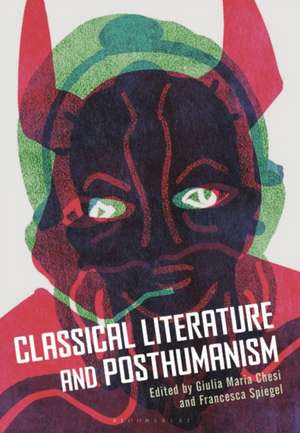
Classical Literature and Posthumanism
Editat de Professor Giulia Maria Chesi, Francesca Spiegelen Limba Engleză Paperback – 18 noi 2021
This volume asks what classical learning can bring to the table of posthuman studies, assembling chapters that explore how exactly the human self of Greek and Latin literature understands its own relation to animals, monsters, objects, cyborgs and robotic devices.
With its widely diverse habitat of heterogeneous bodies, minds, and selves, classical literature again and again blurs the boundaries between the human and the non-human; not to equate and confound the human with its other, but playfully to highlight difference and hybridity, as an invitation to appraise the animal, monstrous or mechanical/machinic parts lodged within humans.
This comprehensive collection unites contributors from across the globe, each delving into a different classical text or narrative and its configuration of human subjectivity-how human selves relate to other entities around them. For students and scholars of classical literature and the posthuman, this book is a first point of reference.
| Toate formatele și edițiile | Preț | Express |
|---|---|---|
| Paperback (1) | 316.98 lei 6-8 săpt. | |
| Bloomsbury Publishing – 18 noi 2021 | 316.98 lei 6-8 săpt. | |
| Hardback (1) | 801.25 lei 6-8 săpt. | |
| Bloomsbury Publishing – 14 noi 2019 | 801.25 lei 6-8 săpt. |
Preț: 316.98 lei
Preț vechi: 400.28 lei
-21%
Puncte Express: 475
Preț estimativ în valută:
56.10€ • 65.56$ • 48.70£
56.10€ • 65.56$ • 48.70£
Carte tipărită la comandă
Livrare economică 19 februarie-05 martie
Preluare comenzi: 021 569.72.76
Specificații
ISBN-13: 9781350231542
ISBN-10: 1350231541
Pagini: 480
Dimensiuni: 166 x 242 x 28 mm
Greutate: 0.82 kg
Editura: Bloomsbury Publishing
Colecția Bloomsbury Academic
Locul publicării:London, United Kingdom
ISBN-10: 1350231541
Pagini: 480
Dimensiuni: 166 x 242 x 28 mm
Greutate: 0.82 kg
Editura: Bloomsbury Publishing
Colecția Bloomsbury Academic
Locul publicării:London, United Kingdom
V-ar putea interesa
-
 Homer and the Poetics of GestureAlex Purves-14%Preț: 537.48 lei624.99 lei
 -
 The Ethics of Revenge and the Meanings of the OdysseyAlexander C. Loney-9%Preț: 556.37 lei608.06 lei
 -
 Medieval English Travel: A Critical AnthologyAnthony Bale-29%Preț: 954.03 lei1347.77 lei
 -
 Campania in the Flavian Poetic ImaginationAntony Augoustakis-27%Preț: 649.33 lei890.33 lei
 -
 Women of Substance in Homeric Epic: Objects, Gender, AgencyLilah Grace Canevaro-23%Preț: 676.60 lei879.83 lei
 -
 -34%Preț: 723.03 lei1090.82 lei
 -
 Cicero, Greek Learning, and the Making of a Roman ClassicCaroline Bishop-19%Preț: 755.04 lei934.43 lei
 -
 -30%Preț: 828.04 lei1174.72 lei
 -
 Boccaccio′s Corpus – Allegory, Ethics, and VernacularityJames C. KrieselPreț: 494.99 lei
 -
 The French Fabliau B.N. MS. 837Raymond Eichmann-18%Preț: 753.37 lei918.75 lei
 -
 Interpreting Classical TextsMalcolm Heath-19%Preț: 167.51 lei205.89 lei
 -
 To Homer Through PopeH.A. Mason-18%Preț: 195.56 lei239.56 lei
 -
 Reading in the Byzantine Empire and BeyondTeresa Shawcross-14%Preț: 1014.72 lei1179.91 lei
 -
 -11%Preț: 667.42 lei749.92 lei
 -
 Terence: AndriaSander M. Goldberg-19%Preț: 155.24 lei191.09 lei
 -
 -34%Preț: 737.05 lei1113.09 lei
 -
 Reflections and New Perspectives on Virgil's GeorgicsDr Nicholas Freer-34%Preț: 677.73 lei1021.84 lei
 -
 The Politics of Youth in Greek Tragedy: Gangs of AthensDr Matthew ShiptonPreț: 229.76 lei
 -
 Homer’s Iliad and the Trojan War: Dialogues on TraditionDr Jan Haywood-26%Preț: 230.69 lei312.20 lei
 -
 Pliny the Younger: A Life in Roman LettersRex Winsbury-16%Preț: 273.75 lei324.36 lei
 -
 -17%Preț: 180.56 lei218.55 lei
 -
 -34%Preț: 1000.37 lei1505.06 lei
 -
 -26%Preț: 237.18 lei321.22 lei
 -
 Advanced Level Latin Prose CompositionA.H. Nash-Williams-23%Preț: 149.11 lei193.36 lei
 -
 The Design of Virgil's BucolicsJohn Van Sickle-17%Preț: 244.24 lei294.87 lei
 -
 -23%Preț: 635.42 lei825.22 lei
Cuprins
Theoretical Introduction
Giulia Maria Chesi and Francesca Spiegel: The Subject of the Human
Introductions to Post/human theories
1. Oxana Timofeeva: The question of the animal and the Aristotelian human horse
2. Luciano Nuzzo: Foucault, the monstrous and monstrosity
3. Kirstin Mertlitsch: How to become a cyborg
4. Yuk Hui: Anders, Simondon and the becoming of the Posthuman
Part I De/humanization and animals
1. Marianne Hopman: Odysseus, the boar and the anthropogenic machine
2. Tua Korhonen: What is it like to be a donkey (with a human mind)? Pseudo-Lucian's Onos
3. Anne Tuttle Mackay: Quam soli vidistis equi: focalization and animal subjectivity in Valerius Flaccus
4. Chiara Thumiger: Animality, illness and dehumanisation: the phenomenology of illness in Sophocles' Philoctetes
5. Tom Geue: The imperial animal: Virgil's Georgics and the anthropo-/theriomorphic enterprise
6. Manuela Giordano: Animals, governance and warfare in the Iliad and Aeschylus' Persians
7. Roland Baumgarten: The Sovereign and the beast: images of ancient tyranny
Part II The monstrous
8. Jenny Strauss Clay: Typhoeus or cosmic regression (Theogony 821-880)
9. Giovanni Ceschi: Demonic disease in tragedy: illness, animality, and dehumanisation
10. Kathrine Fleming: The Sphinx and another thinking of life
11. Aaron Kachuck: When Rome's elephants weep. Humane monsters from Pompey's theater to Virgil's Trojan Horse
12. James McNamara: The monstrosity of Cato in Lucan's Civil war
13. Maria Gerolemou: Why can't I have wings? Aristophanes' Birds
Part III Bodies and entanglements
14. Martin Devecka: The Seer's two bodies: some early Greek histories of technology
15. Johan Tralau: Fluid cypress and hybrid bodies as a cognitively disturbing metaphor in Euripides' Cretans
16. Yuddi Gershon: Body politics in the Antiquitates Romanae of Dionysius of Halicarnassus
17. Antonietta Provenza: The myth of Io, and female cyborgic identity
18. Laura Rosella Schluderer: Cosmic, animal and human becomings: a case study in ancient philosophy
19. Alex Dressler: Post-humanism in Seneca's Happy Life: "animalism", personification, and private property in Roman Stoicism (Epistulae morales 113 and De vita beata 5-8)
20. Virginia Burrus: Hagiography without humans: Simeon the Stylite
Part IV Objects, machines and robotic devices
21. Nancy Worman: Assemblages and objects in Greek tragedy
22. Anne-Sophie Noel: Hybris and hybridity in Aeschylus' Persians: a post-humanist perspective on Xerxes' expedition
23. Francesca Spiegel: Malfunctions of embodiment: Man/weapon agency and the Greek ideology of masculinity
24. Elena Giusti: Aeneid 12: a cyborg border war
25. Katherine Wasdin: The presence of presents: Speaking objects in Martial's Xenia and Apophoreta
26. Mireille Courrent: Automatopoetae machinae: laws of nature and human invention (Vitruvius IX. 8.4-7)
27. Giulia Maria Chesi & Giacomo Sclavi: Pandora and robotic technology today
28. Agis Marinis: Art, life and the creation of automata. On Pindar, Olympian 7.50-53
29. Alexander Kirichenko: Staying alive: Plato, Horace and the written text
30. Genevieve Liveley: Beyond the beautiful evil? The ancient/future history of sex robots
Conclusions
Simon Goldhill
Bibliography
Index
Giulia Maria Chesi and Francesca Spiegel: The Subject of the Human
Introductions to Post/human theories
1. Oxana Timofeeva: The question of the animal and the Aristotelian human horse
2. Luciano Nuzzo: Foucault, the monstrous and monstrosity
3. Kirstin Mertlitsch: How to become a cyborg
4. Yuk Hui: Anders, Simondon and the becoming of the Posthuman
Part I De/humanization and animals
1. Marianne Hopman: Odysseus, the boar and the anthropogenic machine
2. Tua Korhonen: What is it like to be a donkey (with a human mind)? Pseudo-Lucian's Onos
3. Anne Tuttle Mackay: Quam soli vidistis equi: focalization and animal subjectivity in Valerius Flaccus
4. Chiara Thumiger: Animality, illness and dehumanisation: the phenomenology of illness in Sophocles' Philoctetes
5. Tom Geue: The imperial animal: Virgil's Georgics and the anthropo-/theriomorphic enterprise
6. Manuela Giordano: Animals, governance and warfare in the Iliad and Aeschylus' Persians
7. Roland Baumgarten: The Sovereign and the beast: images of ancient tyranny
Part II The monstrous
8. Jenny Strauss Clay: Typhoeus or cosmic regression (Theogony 821-880)
9. Giovanni Ceschi: Demonic disease in tragedy: illness, animality, and dehumanisation
10. Kathrine Fleming: The Sphinx and another thinking of life
11. Aaron Kachuck: When Rome's elephants weep. Humane monsters from Pompey's theater to Virgil's Trojan Horse
12. James McNamara: The monstrosity of Cato in Lucan's Civil war
13. Maria Gerolemou: Why can't I have wings? Aristophanes' Birds
Part III Bodies and entanglements
14. Martin Devecka: The Seer's two bodies: some early Greek histories of technology
15. Johan Tralau: Fluid cypress and hybrid bodies as a cognitively disturbing metaphor in Euripides' Cretans
16. Yuddi Gershon: Body politics in the Antiquitates Romanae of Dionysius of Halicarnassus
17. Antonietta Provenza: The myth of Io, and female cyborgic identity
18. Laura Rosella Schluderer: Cosmic, animal and human becomings: a case study in ancient philosophy
19. Alex Dressler: Post-humanism in Seneca's Happy Life: "animalism", personification, and private property in Roman Stoicism (Epistulae morales 113 and De vita beata 5-8)
20. Virginia Burrus: Hagiography without humans: Simeon the Stylite
Part IV Objects, machines and robotic devices
21. Nancy Worman: Assemblages and objects in Greek tragedy
22. Anne-Sophie Noel: Hybris and hybridity in Aeschylus' Persians: a post-humanist perspective on Xerxes' expedition
23. Francesca Spiegel: Malfunctions of embodiment: Man/weapon agency and the Greek ideology of masculinity
24. Elena Giusti: Aeneid 12: a cyborg border war
25. Katherine Wasdin: The presence of presents: Speaking objects in Martial's Xenia and Apophoreta
26. Mireille Courrent: Automatopoetae machinae: laws of nature and human invention (Vitruvius IX. 8.4-7)
27. Giulia Maria Chesi & Giacomo Sclavi: Pandora and robotic technology today
28. Agis Marinis: Art, life and the creation of automata. On Pindar, Olympian 7.50-53
29. Alexander Kirichenko: Staying alive: Plato, Horace and the written text
30. Genevieve Liveley: Beyond the beautiful evil? The ancient/future history of sex robots
Conclusions
Simon Goldhill
Bibliography
Index
Recenzii
Classical Literature and Posthumanism . constitutes both a treasury of provocations and ultimately something more than the sum of its parts.
The volume takes an important step in initiating and furthering discussions between the field of Classics and the theories of critical posthumanism.
The volume takes an important step in initiating and furthering discussions between the field of Classics and the theories of critical posthumanism.