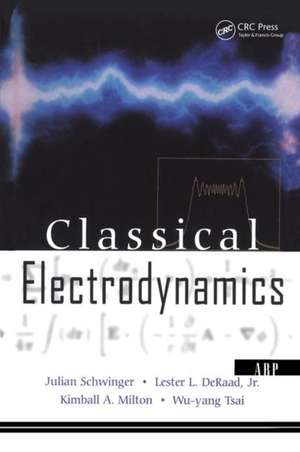
Classical Electrodynamics
Autor Julian Schwinger, Lester L Deraad, Kimball Miltonen Limba Engleză Hardback – 11 sep 1998
Aplicabilitatea practică a acestui tratat rezidă în modul în care transformă teoria câmpurilor clasice într-un instrument predictiv indispensabil pentru fizica modernă, fiind o etapă pregătitoare obligatorie pentru studiul electrodinamicii cuantice. În Classical Electrodynamics, descoperim stilul inconfundabil al lui Julian Schwinger, unde conceptele curg organic, evitând segmentarea artificială dintre fizică și aparatul matematic. Putem afirma că originalitatea lucrării constă în abordarea deductivă: spre deosebire de manualele care prezintă ecuațiile lui Maxwell ca postulate, aici ele sunt derivate din legea lui Coulomb și relativitate. Structura celor 33 de capitole reflectă o progresie riguroasă, de la legile de conservare și electrodinamica macroscopică, până la tratamente detaliate ale radiației de sincrotron și difracției. Un element distinctiv este utilizarea funcțiilor Green ca numitor comun pentru problemele de statică și dinamică, oferind o coerență metodologică rar întâlnită. Această abordare completează perspectiva oferită de Classical Electrodynamics, International Adaptation de John David Jackson, care rămâne standardul pentru aplicații inginerești și probleme de calcul, adăugând o rigoare teoretică bazată pe principiul acțiunii staționare care lipsește în prezentările tradiționale. De asemenea, spre deosebire de Electromagnetic Radiation de Richard Freeman, care se concentrează rapid pe fenomenologia luminii, lucrarea de față insistă pe fundamentarea matematică a funcțiilor speciale direct prin probleme fizice. Ediția beneficiază de un „Ghid al cititorului” care permite instructorilor să adapteze materialul dens (aproape 600 de pagini) în funcție de nivelul cursului, selectând temele prioritare. Classical Electrodynamics nu este doar un manual de studiu, ci o piesă centrală în opera lui Julian Schwinger, făcând puntea necesară între mecanica clasică și lucrările sale fundamentale despre teoria cuantică a câmpurilor.
Preț: 416.43 lei
Preț vechi: 943.72 lei
-56%
Carte indisponibilă temporar
Specificații
ISBN-10: 0738200565
Pagini: 596
Dimensiuni: 152 x 229 x 37 mm
Greutate: 1.04 kg
Ediția:1
Editura: Taylor & Francis
V-ar putea interesa
-
 Hidden FiguresMargot Lee ShetterlyPreț: 79.55 lei
 -
 Thinking, Fast and SlowDaniel Kahneman-27%Preț: 90.79 lei123.57 leiRecomandat
 -
 -32%Preț: 691.72 lei1014.43 lei
 -
 Galileo's Finger: The Ten Great Ideas of SciencePeter Atkins-18%Preț: 76.49 lei93.76 lei
 -
 Superintelligence: Paths, Dangers, StrategiesNick Bostrom-16%Preț: 80.63 lei95.74 lei
 -
 -19%Preț: 329.10 lei405.26 lei
 -
 Combustion TheoryForman A. Williams-18%Preț: 713.80 lei870.48 lei
 -
 -15%Preț: 553.88 lei651.63 lei
 -
 The Early UniverseEdward Kolb-15%Preț: 614.56 lei723.01 lei
 -
 Our Mathematical UniverseMax Tegmark-29%Preț: 66.91 lei94.27 lei
 -
 Selected Papers on Quantum ElectrodynamicsJulian SchwingerPreț: 149.05 lei
 -
 The Great Questions of TomorrowDavid RothkopfPreț: 82.62 lei
 -
 Dog, Inc.: The Uncanny Inside Story of Cloning Man's Best FriendJohn WoestendiekPreț: 121.11 lei
 -
 AstronomyDinah L MochéPreț: 178.77 lei
 -
 The Rise of the RobotsMartin FordPreț: 81.03 lei
 -
 Preț: 476.65 lei
 -
 Quantum MechanicsJulian Schwinger-15%Preț: 524.67 lei617.26 lei
 -
 Peak: Secretele performanței de top și noua știință a expertizeiAnders EricssonPreț: 65.00 lei
Public țintă
Postgraduate and UndergraduateDe ce să citești această carte
Recomandăm această lucrare studenților la masterat și cercetătorilor care doresc să înțeleagă electrodinamica nu ca pe o colecție de formule, ci ca pe o teorie unitară a câmpurilor. Cititorul câștigă o stăpânire profundă a funcțiilor Green și a principiilor de acțiune, instrumente esențiale pentru tranziția către fizica teoretică avansată. Este o oportunitate rară de a parcurge cursul unuia dintre cei mai mari fizicieni ai secolului XX.
Despre autor
Julian Schwinger (1918–1994) a fost un fizician teoretician american de geniu, laureat al Premiului Nobel pentru fizică în 1965 pentru contribuțiile sale fundamentale la electrodinamica cuantică. Autor prolific, opera sa include lucrări de referință precum Selected Papers on Quantum Electrodynamics și Particles, Sources, And Fields, Volume 2. Cunoscut pentru stilul său matematic elegant și abordarea bazată pe surse și câmpuri, Schwinger a format generații de fizicieni la Harvard. Classical Electrodynamics reprezintă moștenirea sa pedagogică finală, fiind finalizată postum de colaboratorii săi apropiați pentru a păstra rigoarea și claritatea viziunii sale asupra fizicii clasice.