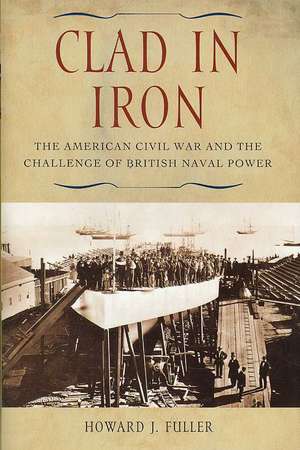
Clad in Iron
Autor Howard Fulleren Limba Engleză Hardback – 30 dec 2007
The relatively unknown 'Cold War' of the American Civil War was a nevertheless crucial aspect of the survival, or not, of the United States in the mid 19th-century. Foreign intervention-explicitly in the form of British naval power-represented a far more serious threat to the success of the Union blockade, the safety of Yankee merchant shipping worldwide, and Union combined operations against the South than the Confederate States Navy. Whether or not the North or South would be 'clad in iron' thus depended on the ability of superior Union ironclads to deter the majority of mid-Victorian British leaders, otherwise tempted by their desire to see the American 'experiment' in democratic class-structures and popular government finally fail. Discussions of open European involvement in the Civil War were pointless as long as the coastline of the United States was virtually impregnable. Combining extensive archival research on both sides of the Atlantic, this work offers an in-depth look at how the Union Navy achieved its greatest grand-strategic victory in the American Civil War. Through a combination of high-tech 'machines' armed with 'monster' guns, intensive coastal fortifications and a new fleet of high-speed Union commerce raiders, the North was able to turn the humiliation of the Trent Affair of late 1861 into a sobering challenge to British naval power and imperial defense worldwide.
Preț: 399.88 lei
Preț vechi: 475.28 lei
-16%
Puncte Express: 600
Carte tipărită la comandă
Livrare economică 07-21 decembrie
Livrare prin curier în România Termenul estimat este afișat lângă disponibilitate.
Transport gratuit de la 400.00 lei Plată online sau ramburs, în funcție de opțiunile comenzii.
Retur gratuit în 14 zile Comandă securizată și suport în română.
Specificații
ISBN-13: 9780313345906
ISBN-10: 0313345902
Pagini: 448
Dimensiuni: 161 x 240 x 29 mm
Greutate: 0.78 kg
Editura: Praeger
Locul publicării:New York, United States
ISBN-10: 0313345902
Pagini: 448
Dimensiuni: 161 x 240 x 29 mm
Greutate: 0.78 kg
Editura: Praeger
Locul publicării:New York, United States
Recenzii
The US Civil War witnessed new engines of war, some of the most powerful of which were naval guns mounted on shallow draft, armor-protected warships. Most prominent were the monitors. Deployment of these vessels in inshore waters changed naval warfare and gave the Federal Navy advantage over the Confederacy. The naval construction program of the Federal Navy had marked influence in Great Britain, where naval architects and gunnery experts pondered the influence such new mechanisms would have in their own narrow seas. France took a similar interest, causing Britain anguish. But the British Admiralty realized that the Royal Navy could not blockade US ports if war broke out with the US: ironclads in brown water could ruin British naval supremacy. Based on various documentary troves in the US and Britain, this work seeks to compare and contrast the influence that new technological innovation had on the emerging US power at sea and the reactions of the British government, Parliament, and Admiralty.
Between 1860 and 1863, British and American navies faced a technological revolution in ship construction admist a cold war with the Trent crisis, British aid to the South, and fears of a blockade felt by Northern cities. Dr. Fuller provides a detailed description of the players--private engineers, admiralty, contractors, Department of the Navy, departments and officers, diplomats, and politicians--on both sides of the Atlantic..[T]he book should be of interest to anyone concerned with handling technological change, contracting, deterrance, the effect of political oversight, publicity, and the maneuvering of statesman during a time of crisis.
By placing the early ironclad fleets of Britain and America in their diplomatic context, Fuller provides an altogether more persuasive explanation of naval technology and the war of words between Admirals, engineers and politicians that swept both countries. A work of the first importance.
This is a detailed, well-referenced, fascinating account of the development before and during the American Civil War of two new forms of warship and a complex naval arms race involvnig three powers.
Howard J. Fuller's book expands our view of the American Civil War at sea by examining the interplay between the ironclad programs and diplomatic relations of the US and Great Britain. [.] Fuller's integration of the competing ironclad programs into the international scene is well-done and thought-provoking. For the Union, it broadens the debate about the monitor program by expanding the criteria for 'success' from operations to strategy. Through his highly detailed research, Fuller clearly shows the monitors' effect in neutralizing the 'blunt instrument of 'Palmerstonian Diplomacy'' [xxvi] Serious scholars need this book; the insights it contains will repay the effort in reading it.
Howard Fuller's Clad in Iron is a particularly welcome and interesting example because he integrates two stories which have usually been told not only in isolation, but as it were facing in opposite directions: the Franco-British story of how the
Europeans invented the ironclad, and the Union-Confederate story of how the Americans invented the ironclad.[.] The focus is close and the level of detail is likely to overwhelm the casual reader, but this is an important book and in many ways a model of how this sort of history ought to be written.
Between 1860 and 1863, British and American navies faced a technological revolution in ship construction admist a cold war with the Trent crisis, British aid to the South, and fears of a blockade felt by Northern cities. Dr. Fuller provides a detailed description of the players--private engineers, admiralty, contractors, Department of the Navy, departments and officers, diplomats, and politicians--on both sides of the Atlantic..[T]he book should be of interest to anyone concerned with handling technological change, contracting, deterrance, the effect of political oversight, publicity, and the maneuvering of statesman during a time of crisis.
By placing the early ironclad fleets of Britain and America in their diplomatic context, Fuller provides an altogether more persuasive explanation of naval technology and the war of words between Admirals, engineers and politicians that swept both countries. A work of the first importance.
This is a detailed, well-referenced, fascinating account of the development before and during the American Civil War of two new forms of warship and a complex naval arms race involvnig three powers.
Howard J. Fuller's book expands our view of the American Civil War at sea by examining the interplay between the ironclad programs and diplomatic relations of the US and Great Britain. [.] Fuller's integration of the competing ironclad programs into the international scene is well-done and thought-provoking. For the Union, it broadens the debate about the monitor program by expanding the criteria for 'success' from operations to strategy. Through his highly detailed research, Fuller clearly shows the monitors' effect in neutralizing the 'blunt instrument of 'Palmerstonian Diplomacy'' [xxvi] Serious scholars need this book; the insights it contains will repay the effort in reading it.
Howard Fuller's Clad in Iron is a particularly welcome and interesting example because he integrates two stories which have usually been told not only in isolation, but as it were facing in opposite directions: the Franco-British story of how the
Europeans invented the ironclad, and the Union-Confederate story of how the Americans invented the ironclad.[.] The focus is close and the level of detail is likely to overwhelm the casual reader, but this is an important book and in many ways a model of how this sort of history ought to be written.