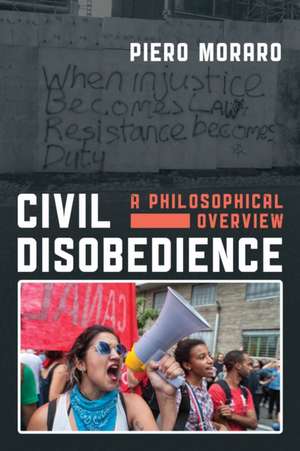
Civil Disobedience: A Philosophical Overview
Autor Piero Moraroen Limba Engleză Paperback – 15 iul 2019
| Toate formatele și edițiile | Preț | Express |
|---|---|---|
| Paperback (1) | 270.10 lei 6-8 săpt. | |
| Bloomsbury Publishing – 15 iul 2019 | 270.10 lei 6-8 săpt. | |
| Hardback (1) | 692.63 lei 6-8 săpt. | |
| Bloomsbury Publishing – 16 iul 2019 | 692.63 lei 6-8 săpt. |
Preț: 270.10 lei
Preț vechi: 358.73 lei
-25%
Puncte Express: 405
Preț estimativ în valută:
47.77€ • 56.64$ • 41.59£
47.77€ • 56.64$ • 41.59£
Carte tipărită la comandă
Livrare economică 30 martie-13 aprilie
Specificații
ISBN-13: 9781786607188
ISBN-10: 1786607182
Pagini: 160
Dimensiuni: 148 x 226 x 12 mm
Greutate: 0.28 kg
Editura: Bloomsbury Publishing
Colecția Rowman & Littlefield
Locul publicării:New York, United States
ISBN-10: 1786607182
Pagini: 160
Dimensiuni: 148 x 226 x 12 mm
Greutate: 0.28 kg
Editura: Bloomsbury Publishing
Colecția Rowman & Littlefield
Locul publicării:New York, United States
Cuprins
Introduction
Chapter 1. What's Wrong with Disobedience?
Chapter 2. The Concept of Civility
Chapter 3. Disagreement and Civility
Chapter 4. Nonviolence and Civility
Chapter 5. The Moral Right to Civil Disobedience
Chapter 6. Political Obligation: 'Inside-Out' Vs. 'Outside-In'
Chapter 1. What's Wrong with Disobedience?
Chapter 2. The Concept of Civility
Chapter 3. Disagreement and Civility
Chapter 4. Nonviolence and Civility
Chapter 5. The Moral Right to Civil Disobedience
Chapter 6. Political Obligation: 'Inside-Out' Vs. 'Outside-In'
Recenzii
Moraro does an outstanding job of charting the emerging philosophical terrain, while insisting that the virtues of citizenship-rather than the duty to obey-should be the primary point of reference in considering civil disobedience.
This book focuses on the discussion of civil disobedience among philosophy professors over the past 20 or so years. . . Moraro believes his own contribution is to emphasize the display of civility by the disobedient actor: the heart of his discussion is to connect justifiable civil disobedience to respect for others' autonomy, "a respect due to their status . as self-legislators," who have the "capacity" to choose their "own ends in life" with a right that these choices be respected. . . this is a thoughtful and competent book.
Summing Up: Recommended. Upper-division undergraduates through faculty.
There has been a quiet renaissance in the philosophy of civil disobedience. Moraro offers a masterful survey of the emerging debates, showing how a new generation of political theorists is grappling with challenges posed by a new generation of political protesters. This is a superb primer for anyone wishing to understand civil disobedience in the twenty-first century.
There is much to admire in this book. In addition to providing a much needed introduction to the most recent philosophical discussion of civil disobedience, Moraro outlines an original account that grounds the value of this practice in certain aspects of virtue ethics. Moraro succeeds in appealing both to students and more experienced readers by discussing complex problems while writing in an accessible and engaging style. Highly recommended.
Piero Moraro's book provides a useful and analytically clear introduction to the philosophical literature on political obligation and civil disobedience. By emphasizing agents' moral dispositions rather than their acts, Moraro defends a nuanced virtue-ethical account of the duty to respect the law, which citizens may sometimes satisfy by engaging in civil disobedience.
An impressive achievement: at once an expert and concise overview of decades of philosophical discussion about the nature of both political obligation and civil disobedience, as well as a development of Moraro's own distinctive views. Essential reading, as both an accessible introduction and substantial and original contribution to the debate.
In this thoughtful and engaging investigation of the philosophy on civil disobedience, Piero Moraro weaves together recent advancements in the literature, canonical treatments, and his own illuminating take on civil disobedience as a matter of virtue and not just rights and duties. The work not only provides an excellent overview and analysis, but shows clearly why civil disobedience has re-emerged as an important topic for debate.
This book focuses on the discussion of civil disobedience among philosophy professors over the past 20 or so years. . . Moraro believes his own contribution is to emphasize the display of civility by the disobedient actor: the heart of his discussion is to connect justifiable civil disobedience to respect for others' autonomy, "a respect due to their status . as self-legislators," who have the "capacity" to choose their "own ends in life" with a right that these choices be respected. . . this is a thoughtful and competent book.
Summing Up: Recommended. Upper-division undergraduates through faculty.
There has been a quiet renaissance in the philosophy of civil disobedience. Moraro offers a masterful survey of the emerging debates, showing how a new generation of political theorists is grappling with challenges posed by a new generation of political protesters. This is a superb primer for anyone wishing to understand civil disobedience in the twenty-first century.
There is much to admire in this book. In addition to providing a much needed introduction to the most recent philosophical discussion of civil disobedience, Moraro outlines an original account that grounds the value of this practice in certain aspects of virtue ethics. Moraro succeeds in appealing both to students and more experienced readers by discussing complex problems while writing in an accessible and engaging style. Highly recommended.
Piero Moraro's book provides a useful and analytically clear introduction to the philosophical literature on political obligation and civil disobedience. By emphasizing agents' moral dispositions rather than their acts, Moraro defends a nuanced virtue-ethical account of the duty to respect the law, which citizens may sometimes satisfy by engaging in civil disobedience.
An impressive achievement: at once an expert and concise overview of decades of philosophical discussion about the nature of both political obligation and civil disobedience, as well as a development of Moraro's own distinctive views. Essential reading, as both an accessible introduction and substantial and original contribution to the debate.
In this thoughtful and engaging investigation of the philosophy on civil disobedience, Piero Moraro weaves together recent advancements in the literature, canonical treatments, and his own illuminating take on civil disobedience as a matter of virtue and not just rights and duties. The work not only provides an excellent overview and analysis, but shows clearly why civil disobedience has re-emerged as an important topic for debate.