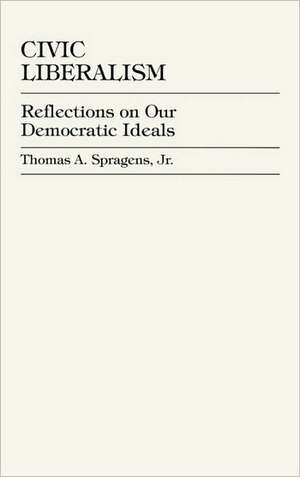
Civic Liberalism: Reflections on Our Democratic Ideals
Autor Thomas A. Spragens Jr.en Limba Engleză Hardback – 30 sep 1999
Civic liberalism, Spragens contends, endorses both liberty and equality although neither can properly be understood as a maximizing principle. Instead, liberty should be seen as the constitutive threshold good of autonomy; and equality should be seen as a moral postulate and instrumental good. Moreover, civic liberalism explicitly embraces forms of 'fraternity,' civic friendship, and civic virtue consistent with respect for social pluralism.
Therefore, a better understanding of our democratic ideals will free us from the constrictive orthodoxies of the left and right, lead us toward better public policy, and help us become a well ordered society of flourishing, self-governing civic equals.
Preț: 696.90 lei
Preț vechi: 1004.69 lei
-31%
Puncte Express: 1045
Carte tipărită la comandă
Livrare economică 08-22 decembrie
Livrare prin curier în România Termenul estimat este afișat lângă disponibilitate.
Transport gratuit pentru acest produs Plată online sau ramburs, în funcție de opțiunile comenzii.
Retur gratuit în 14 zile Comandă securizată și suport în română.
Specificații
ISBN-13: 9780847696109
ISBN-10: 0847696103
Pagini: 271
Dimensiuni: 158 x 226 x 26 mm
Greutate: 0.52 kg
Editura: Bloomsbury Publishing
Colecția Rowman & Littlefield
Locul publicării:New York, United States
ISBN-10: 0847696103
Pagini: 271
Dimensiuni: 158 x 226 x 26 mm
Greutate: 0.52 kg
Editura: Bloomsbury Publishing
Colecția Rowman & Littlefield
Locul publicării:New York, United States
V-ar putea interesa
-
 On Liberty and the Subjection of WomenJohn Stuart Mill-26%Preț: 53.22 lei71.69 lei
 -
 Liberalism, Community and CultureWill Kymlicka-28%Preț: 546.32 lei754.44 lei
 -
 -31%Preț: 752.06 lei1097.55 lei
 -
 The Problems of Communitarian Politics: Unity and ConflictElizabeth Frazer-27%Preț: 405.83 lei557.33 lei
 -
 Social Democracy in Neoliberal Times: The Left and Economic Policy since 1980The Late Andrew Glyn-31%Preț: 668.86 lei976.08 lei
 -
 LibertyIsaiah BerlinPreț: 297.88 lei
 -
 Liberalism, Constitutionalism, and DemocracyRussell Hardin-27%Preț: 343.88 lei468.45 lei
 -
 Democratic Procedures and Liberal ConsensusGeorge Klosko-27%Preț: 405.99 lei557.44 lei
 -
 A Brief History of NeoliberalismDavid Harvey-16%Preț: 139.14 lei165.16 lei
 -
 Liberalization Challenges in HungaryU. KorkutPreț: 403.27 lei
 -
 Preț: 376.92 lei
 -
 Reclaiming LibertyM. BentwichPreț: 399.29 lei
 -
 Political LiberalismJohn RawlsPreț: 212.84 lei
 -
 Rawls′s Political LiberalismThom BrooksPreț: 225.56 lei
 -
 The Law of Peoples - With "The Idea of Public Reason Revisited"John Bordley RawlsPreț: 238.56 lei
 -
 Liberty before LiberalismQuentin SkinnerPreț: 114.02 lei
 -
 The New Way of the WorldPierre DardotPreț: 118.57 lei
 -
 Profits Over People: Neoliberalism and the New OrderNoam Chomsky-19%Preț: 91.32 lei113.19 lei
Cuprins
Chapter 1 Democratic Realism
Chapter 2 The Appeal and Limits of Liberalism
Chapter 3 The Weakness and Dangers of Liberal Egalitarianism
Chapter 4 Identity Politics and the Liberal Difference
Chapter 5 Political Liberty and the Good of Autonomy
Chapter 6 The Moral Imperative and Political Value of Equality
Chapter 7 Civic Friendship in Liberal Society
Chapter 8 Civic Virtues in Liberal Regimes
Chapter 2 The Appeal and Limits of Liberalism
Chapter 3 The Weakness and Dangers of Liberal Egalitarianism
Chapter 4 Identity Politics and the Liberal Difference
Chapter 5 Political Liberty and the Good of Autonomy
Chapter 6 The Moral Imperative and Political Value of Equality
Chapter 7 Civic Friendship in Liberal Society
Chapter 8 Civic Virtues in Liberal Regimes
Recenzii
Civic Liberalism defines a new liberalism suitable for contemporary life. Approaching his task through a nuanced reading of several contending perspectives, Spragens articulates a vision that will convince many and challenge the rest of us to refine our thinking further. This book is a model of critical engagement and reflective construction.
Spragens' Civic Liberalism offers an appreciative and thoughtful critique of both libertarianism and of liberal egalitarianism as a prelude to constructing his own 'civic liberal' alternative. Part theoretical treatise, part guide for the perplexed democratic citizen, Civic Liberalism offers a new vision of political possibilities.
Thomas Spragen's Civic Liberalism is a fine critique of contemporary public theorizing about democracy and a creative and daring effort to point a new direction based on what is best and most enduring in our traditions. Spragens' is a grand voice, learned, accessible, and challenging and Civic Liberalism makes an invaluable contribution to public debate.
"Spragens' vision of civic liberalism is marked by the same qualities which characterize his defense of it in this wise and important book: reflective awareness, critical intelligence, and a spirit of generosity toward those with whom he disagrees that is truly liberal.
Civic Liberalism: Reflections on Our Democratic Ideals is a stimulating work, breaking new ground in drawing together both liberal and democratic thought and ideals. Spragens does this in working with very familiar materials from both the cannon as well as contemporary political theory, reading them in a fresh thought-provoking way. . . . Furthermore, Spragens introduces exciting concepts to liberal democratic theory that have received little or no attention in the current debates. . . . This is a welcome addition to the literature on liberal democratic theory.
A very important book. Thorough. Carefully argued and laid out. The very best of its kind. For everyone interested in the foundations of contemporary thought.
Thomas Spragens is committed to an idea of political theory as dialectic in an ancient and illustrious sense of that term, namely refining his own understanding of political ideals through reasoned conversation with leading alternatives that currently contend with each other. Recently, some of the most thoughtful liberal thinkers have tried to address the civic dimension of liberalism, and to articulate theoretically what conditions must be met in order for liberal society to provide a richer sense of common citizenship. Spragens, with his calm reflectiveness and accessible prose, makes an important contribution to these efforts."
The vexing problem is that liberal political theory does not yield an image of humanity that has real moral meaning. Herein, Thomas Spragens, with his usual good sense and fine scholarship, shows how a subtle reweaving of liberal democratic political theory can provide us with a moral message we might actually want to encourage one another to live by. His book is literate and thoughtful, the product of a lifetime of reflection on these problems. His critique of the dominant liberal democratic theorists and theories is fresh, wise, and often surprising.
It is obvious from this thoughtful and well-written work that Spragens has thought and read extensively about contemporary liberalism . . . Civic Liberalism provides an excellent secondary source for students of 20th-century liberalism.
A thoughtful, engagingly committed book.
Of the many endeavors in the last three decades to restate the central aspiratons of liberalism, this important work is one of the most balanced, nuanced, and cogent. ...There is much to admire in this work: its criticisms are incisive, but balanced; its restatement of liberal ideals is nuanced, mindful of the trade-offs among political goods, persuasive, and well moored in the moral intuitions underlying liberal pracice; its spirit is genearous, though tough-minded; its style is clear, lively, and friendly. Indeed the work exemplifies many of the ideals that civic liberalism extols.
Spragens' Civic Liberalism offers an appreciative and thoughtful critique of both libertarianism and of liberal egalitarianism as a prelude to constructing his own 'civic liberal' alternative. Part theoretical treatise, part guide for the perplexed democratic citizen, Civic Liberalism offers a new vision of political possibilities.
Thomas Spragen's Civic Liberalism is a fine critique of contemporary public theorizing about democracy and a creative and daring effort to point a new direction based on what is best and most enduring in our traditions. Spragens' is a grand voice, learned, accessible, and challenging and Civic Liberalism makes an invaluable contribution to public debate.
"Spragens' vision of civic liberalism is marked by the same qualities which characterize his defense of it in this wise and important book: reflective awareness, critical intelligence, and a spirit of generosity toward those with whom he disagrees that is truly liberal.
Civic Liberalism: Reflections on Our Democratic Ideals is a stimulating work, breaking new ground in drawing together both liberal and democratic thought and ideals. Spragens does this in working with very familiar materials from both the cannon as well as contemporary political theory, reading them in a fresh thought-provoking way. . . . Furthermore, Spragens introduces exciting concepts to liberal democratic theory that have received little or no attention in the current debates. . . . This is a welcome addition to the literature on liberal democratic theory.
A very important book. Thorough. Carefully argued and laid out. The very best of its kind. For everyone interested in the foundations of contemporary thought.
Thomas Spragens is committed to an idea of political theory as dialectic in an ancient and illustrious sense of that term, namely refining his own understanding of political ideals through reasoned conversation with leading alternatives that currently contend with each other. Recently, some of the most thoughtful liberal thinkers have tried to address the civic dimension of liberalism, and to articulate theoretically what conditions must be met in order for liberal society to provide a richer sense of common citizenship. Spragens, with his calm reflectiveness and accessible prose, makes an important contribution to these efforts."
The vexing problem is that liberal political theory does not yield an image of humanity that has real moral meaning. Herein, Thomas Spragens, with his usual good sense and fine scholarship, shows how a subtle reweaving of liberal democratic political theory can provide us with a moral message we might actually want to encourage one another to live by. His book is literate and thoughtful, the product of a lifetime of reflection on these problems. His critique of the dominant liberal democratic theorists and theories is fresh, wise, and often surprising.
It is obvious from this thoughtful and well-written work that Spragens has thought and read extensively about contemporary liberalism . . . Civic Liberalism provides an excellent secondary source for students of 20th-century liberalism.
A thoughtful, engagingly committed book.
Of the many endeavors in the last three decades to restate the central aspiratons of liberalism, this important work is one of the most balanced, nuanced, and cogent. ...There is much to admire in this work: its criticisms are incisive, but balanced; its restatement of liberal ideals is nuanced, mindful of the trade-offs among political goods, persuasive, and well moored in the moral intuitions underlying liberal pracice; its spirit is genearous, though tough-minded; its style is clear, lively, and friendly. Indeed the work exemplifies many of the ideals that civic liberalism extols.