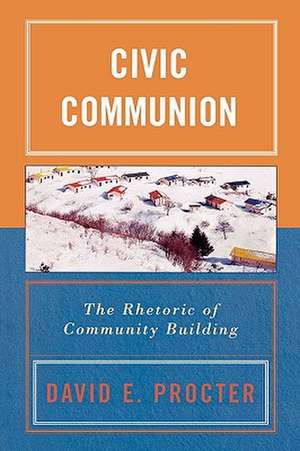
Civic Communion: The Rhetoric of Community Building
Autor David E. Procteren Limba Engleză Paperback – 12 mai 2006
Preț: 276.27 lei
Preț vechi: 360.88 lei
-23%
Puncte Express: 414
Carte tipărită la comandă
Livrare economică 04-18 decembrie
Livrare prin curier în România Termenul estimat este afișat lângă disponibilitate.
Transport gratuit de la 400.00 lei Plată online sau ramburs, în funcție de opțiunile comenzii.
Retur gratuit în 14 zile Comandă securizată și suport în română.
Specificații
ISBN-13: 9780742537033
ISBN-10: 074253703X
Pagini: 180
Dimensiuni: 163 x 228 x 14 mm
Greutate: 0.27 kg
Editura: Bloomsbury Publishing
Colecția Rowman & Littlefield
Locul publicării:New York, United States
ISBN-10: 074253703X
Pagini: 180
Dimensiuni: 163 x 228 x 14 mm
Greutate: 0.27 kg
Editura: Bloomsbury Publishing
Colecția Rowman & Littlefield
Locul publicării:New York, United States
V-ar putea interesa
-
 -25%Preț: 568.18 lei761.42 lei
 -
 Constructing China's CapitalismD. BuckPreț: 404.31 lei
 -
 Preț: 479.88 lei
 -
 Preț: 501.19 lei
 -
 Another CountryScott HerringPreț: 269.77 lei
 -
 News from SomewhereRoger Scruton-45%Preț: 72.45 lei130.70 lei
 -
 -5%Preț: 751.03 lei790.55 lei
 -
 Rural America: Aspects, Outlooks & Development -- Volume 1Clyford L Lewis-27%Preț: 1000.98 lei1363.38 lei
 -
 Rural America: Aspects, Outlooks & Development -- Volume 6Clyford L Lewis-27%Preț: 1382.48 lei1886.64 lei
 -
 The Country and the CityRaymond Williams-17%Preț: 78.38 lei94.91 lei
 -
 -15%Preț: 521.93 lei614.04 lei
Cuprins
Chapter 1 Preface
Chapter 2 Acknowledgments
Part 3 Part I: Orientations and Beginnings
Chapter 4 1. The Connection of Communication and Community
Chapter 5 2. In Search of Rural Community
Part 6 Part II: Civic Communion Case Studies
Chapter 7 3. Performing Gender through Local Festival
Chapter 8 4. Building Community through Strategic Planning
Chapter 9 5. Constructing Community from Conflict
Chapter 10 6. Exhibiting Collective Memory
Chapter 11 7. Infusing "Spirit" into Community Building
Part 12 Part III: Community-Building Lessons
Chapter 13 8. Lessons Learned
Chapter 14 Works Cited
Chapter 15 Index
Chapter 16 About the Author
Chapter 2 Acknowledgments
Part 3 Part I: Orientations and Beginnings
Chapter 4 1. The Connection of Communication and Community
Chapter 5 2. In Search of Rural Community
Part 6 Part II: Civic Communion Case Studies
Chapter 7 3. Performing Gender through Local Festival
Chapter 8 4. Building Community through Strategic Planning
Chapter 9 5. Constructing Community from Conflict
Chapter 10 6. Exhibiting Collective Memory
Chapter 11 7. Infusing "Spirit" into Community Building
Part 12 Part III: Community-Building Lessons
Chapter 13 8. Lessons Learned
Chapter 14 Works Cited
Chapter 15 Index
Chapter 16 About the Author
Recenzii
Civic Communication is a pleasure to read. It represents a wealth of scholarship, but it is David Procter's unmistakable voice that brings to life the people and their performances as they enact the bonds and practices of civic communion. I find it inspirational and a call to the discipline to pursue this most fruitful line of contribution. Graduate students will benefit from the careful research, undergraduates from its life-expanding vision, and both from the deep sense of civic responsibility that it imparts.
Procter's book is a perceptive contemporary account of rural community and rural community development processes in the Great Plains, with applicability beyond this region. Moreover, he has added a valuable tool to our kit of heuristic devices for facilitating community development processes.
Procter is a gifted ethnographer and rhetorician who makes highly productive use of those gifts to make sense of, and to story, the relational, symbolic, and communal aspects of building a shared sense of time, place, and meanings among rural people in the heartland. I highly recommend this book to anyone interested in the study of real people using everyday communication to create meaning in communities.
Procter's book is a perceptive contemporary account of rural community and rural community development processes in the Great Plains, with applicability beyond this region. Moreover, he has added a valuable tool to our kit of heuristic devices for facilitating community development processes.
Procter is a gifted ethnographer and rhetorician who makes highly productive use of those gifts to make sense of, and to story, the relational, symbolic, and communal aspects of building a shared sense of time, place, and meanings among rural people in the heartland. I highly recommend this book to anyone interested in the study of real people using everyday communication to create meaning in communities.